The house sold several months later.
Grandma chose the realtor herself.
She interviewed three.
She rejected the first because he kept speaking to me instead of her.
She rejected the second because he told her the property would be “perfect for an easy retirement transition.”
The third simply asked what she wanted.
Grandma hired her.
At the closing, I sat beside her while she reviewed every page.
The attorney explained each section.
Grandma asked questions.
She read the answers.
Then she signed.
Nobody rushed her.
Nobody told her what she remembered.
Nobody suggested that she was too old to understand.
When she placed the final document on the table, she looked at me.
“That felt different.”
“How?”
“I chose it.”
The buyer wanted the house for his family.
He didn't know what had happened there.
He didn't know about the recordings or the forged deed.
He didn't need to.
The house belonged to him now.
Grandma kept some furniture.
She gave away other pieces.
She refused to part with the enormous dining table Grandpa had bought when my father was still a teenager.
“It takes up half the room,” I told her.
“It has survived worse than furniture movers.”
So it came with her.
Her new house was fifteen minutes from mine.
One story.
A small garden.
Two bedrooms.
A bright sunroom.
No long staircase.
No enormous driveway.
No hidden corners where boxes could disappear.
The first morning after she moved in, sunlight fell across the kitchen floor.
Grandma stood in the doorway holding a mug.
“I like it.”
“You've been here twelve hours.”
“That's enough.”
I laughed.
She smiled.
But the past didn't disappear simply because the address changed.
Dad and Mom were still dealing with the consequences.
The investigation continued.
Some of Grandma's money was recovered.
Some wasn't.
Grandpa's tools were eventually found in a storage unit rented by Dad.
His watch was missing.
Months later, I found out it had been sold.
I tracked it down.
The seller had no idea where it came from.
I bought it.
I didn't tell Grandma.
Not yet.
I wanted to give it to her when she least expected it.
Christmas came.
Grandma hosted dinner in the new house.
The dining room was crowded.
Neighbors came.
A few old friends came.
Brenda from Oak Creek came too.
Grandma had invited her personally.
There was no empty seat at the table for my parents.
Nobody mentioned it.
We didn't need to.
After dinner, Grandma poured coffee.
Brenda told a story about one of the residents at Oak Creek hiding cookies in a flowerpot.
Grandma laughed so hard she had to put her cup down.
For the first time in months, the room felt ordinary.
That mattered.
Ordinary had become precious.
Later, I brought Grandma the small box.
“What is this?”
“Open it.”
She lifted the lid.
Her hand stopped.
Inside was Grandpa's watch.
The scratched silver band caught the light.
She didn't speak.
She touched it with one finger.
“Where?”
“I found it.”
She looked at me.
“You found Arthur's watch?”
“I tracked it down.”
Her eyes filled.
She closed the box.
Then opened it again, as though she needed to make certain it was still there.
“I thought that was gone.”
“I know.”
She pressed the watch against her palm.
Then she hugged me.
It wasn't a dramatic embrace.
It was quiet.
The kind where neither person needs to say what the other already understands.
After she pulled away, she looked at the watch again.
“He wore this every day.”
“I remember.”
“No,” she said softly.
“You remember him wearing it.”
She smiled through tears.
“I remember him complaining about being late while standing in the kitchen looking for the watch that was already on his wrist.”
I laughed.
“That sounds like Grandpa.”
She put the watch back into the box.
“Thank you.”
That night, after everyone left, I stayed behind to help clean.
Grandma stood at the sink.
“You know what I keep thinking about?”
“What?”
“That day at Oak Creek.”
I dried a plate.
“What about it?”
“I was terrified.”
I looked at her.
“You didn't seem terrified.”
“I was.”
She placed a plate into the cabinet.
“Being afraid doesn't mean you have to surrender.”
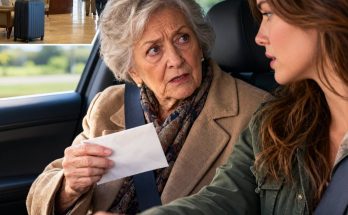
I remembered her first words in the car.
Don't call them.
Then the envelope.
Drive to the courthouse.
At the time, I had thought she was simply refusing to panic.
Now I understood.
She had spent those three hours thinking.
She had noticed what was missing.
She had connected things.
She had decided what she needed to know before she allowed anyone else to tell her what was happening.
A few weeks after Christmas, Grandma asked me to drive her somewhere.
“Where?”
“Oak Creek.”
I glanced at her.
“Why?”
“I want to see Brenda.”
We drove there on a cold afternoon.
Oak Creek looked exactly as it had the day she was abandoned there.
Same entrance.
Same glass doors.
Same reception desk.
Grandma paused outside.
“You sure?”
“Yes.”
Inside, Brenda was working.
When she saw Grandma, her face lit up.
“Oh my goodness.”
They hugged.
Grandma handed her flowers.
“I wanted to thank you.”
Brenda shook her head.
“You don't have to.”
“I do.”
Brenda smiled.
“I only called Marcus because you asked me to.”
“You did more than that.”
Brenda looked embarrassed.
“I just thought someone should know you were still sitting there.”
Grandma squeezed her hand.
“That mattered.”
They talked for a while.
Then we walked back outside.
The winter air smelled clean.
Grandma lowered herself into the passenger seat.
She pulled the seatbelt across her chest.
Click.
I looked at her.
“Do you remember?”
She smiled.
“Of course.”
“That was where you stopped me from calling Dad.”
“Yes.”
“And you told me to drive to the courthouse.”
“I remember.”
I started the engine.
After a moment, I asked, “How did you know?”
“Know what?”
“That they had done something with the house.”
She looked out the window.
“I didn't know.”
I waited.
“I suspected.”
“Because of what?”
She thought about it.
“Your father had been asking strange questions.”
“About the house?”
“About documents.”
She looked down at her hands.
“He asked where your grandfather kept certain papers. He asked whether the house had a mortgage. He asked whether I still had the original deed.”
“And you didn't tell me.”
“I didn't want to accuse him without proof.”
She turned toward me.
“Then he started telling everyone I was forgetting things.”
I remembered every conversation.
Every subtle suggestion.
Every time Dad had said, “Mom's getting mixed up.”
Every time I had believed him.
“I feel terrible.”
Grandma shook her head.
“Don't.”
“I should have noticed.”
“They wanted you to believe them.”
“But I did.”
“So did other people.”
She reached over and touched my hand.
“That's why it worked.”
We drove past the courthouse.
Neither of us spoke.
Then I asked the question that had stayed with me since the beginning.
“Were you scared when they left you at Oak Creek?”
She looked through the windshield.
For several seconds, she said nothing.
Then:
“Terrified.”
I nodded.
“I never would have guessed.”
“That's because fear isn't the same as helplessness.”
I thought about that for a long time.
When we reached her house, she got out slowly.
I carried the groceries inside.
She went to the kitchen.
The dining table filled the room exactly as it had in the old house.
Grandpa's watch sat on her wrist now.
She checked it.
Then looked at me.
“You're staying for dinner.”
“That wasn't a question.”
“No.”
I smiled.
“No, it wasn't.”
That evening, she made soup.
We ate at the enormous table.
Nothing about the meal was remarkable.
There was no courtroom victory.
No dramatic confrontation.
No sudden apology from my parents.
There was simply soup, warm bread, and my grandmother sitting beneath the kitchen light with her grandfather's watch on her wrist.
And somehow that ordinary scene meant more than the legal victory ever could.
Because the thing my parents had nearly taken wasn't simply a house.
It wasn't even the fifty-five thousand dollars.
Those things had numbers.
They could be documented.
Tracked.
Recovered.
Argued over.
What they had tried to take was harder to measure.
They had tried to take Grandma's credibility.
Her independence.
Her right to make decisions.
They had built a version of her for everyone else to believe.
An old woman who was confused.
An old woman who forgot.
An old woman who couldn't be trusted.
An old woman who needed her children to decide where she should live.
They repeated that story until it became familiar.
And because it became familiar, people accepted it.
Including me.
That was the part I would regret longest.
Not because I had failed to rescue her.
I had eventually come.
But because I had almost allowed their version of her to replace the woman I had known my entire life.
Grandma never asked me to apologize for that.
She never held it over me.
Instead, she did something much harder.
She trusted me again without pretending nothing had happened.
My parents never returned to her life in the way they once had.
There were legal consequences.
Financial consequences.
Family consequences.
But Grandma didn't build her new life around punishing them.
She built it around choosing for herself.
She chose her house.
Her finances.
Her routines.
Her friends.
Her boundaries.
She even chose who would handle her affairs.
And it wasn't me.
At first, I had wondered why.
Later, I understood.
She didn't need another family member holding the keys to her life.
She needed independence protected by structure.
That was her decision.
And nobody argued with it.
One spring afternoon, I visited her and found her in the garden.
She was planting tomatoes.
“You're doing that wrong,” I said.
She looked up.
“You're welcome to leave.”
I laughed.
She handed me another seedling.
“Put that one there.”
I knelt beside her.
For a while, we worked without speaking.
Then she said, “Marcus?”
“Yeah?”
“If they hadn't done all of this, I might never have moved.”
I looked at her.
“You're saying something good came from it?”
“No.”
She pressed soil around the plant.
“I'm saying I can choose what happens next.”
I understood.
She wasn't grateful for what had been done to her.
She simply refused to let it determine the rest of her life.
That distinction stayed with me.
Months later, we passed Oak Creek again.
Grandma looked toward the entrance.
Then she looked away.
She didn't need to go inside.
She didn't need to prove anything.
She was already home.
And I finally understood what she had meant on that first drive.
She had been afraid.
She had been abandoned.
She had been lied about.
She had been treated as though her own decisions no longer mattered.
But she had never forgotten who she was.
My parents thought leaving her at Oak Creek would make the rest easy.
They thought the suitcase in the lobby meant the difficult part was over.
They thought the house could be sold before anyone questioned the deed.
They thought a story repeated often enough would become the truth.
They were wrong.
The phone call that afternoon had changed everything.
A suitcase had been left beside a reception desk.
A woman had made one phone call.
A grandson had driven 190 miles.
And before that day was over, Grandma had already made the most important decision of all.
She would not let anyone else decide what happened to her next.
Click here to continue reading: PART 5: The First Quiet Months Were Harder Than the Courtroom, Because Grandma Had to Learn Which Ordinary Choices Were Still Hers
The Phone Call That Turned a Harmless Family Lunch Into a 190-Mile Drive I Could Not Afford to Delay
Part 4 of 12