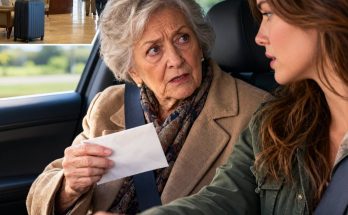
Years passed after Grandma died.
I kept the navy suitcase.
The handle remained crooked.
The old tape finally fell away.
I never replaced it.
I kept the suitcase exactly as it had been.
Inside were her letters.
The note from Oak Creek.
The courthouse receipt.
Grandpa's photograph.
The postcards from her train trips.
The copy of the final estate plan.
The letter she had written before she died.
I added things occasionally.
A photograph from the garden.
A newspaper clipping about Brenda's wedding.
A recipe card Grandma had written in the margin of an old cookbook.
A photograph of Dad holding Grandpa's tools.
A photograph of the small house Grandma had chosen.
Each item belonged to the same story.
Not the story of the day my parents abandoned her.
The story of everything that came after.
Dad changed too.
He never became the man he had been before the fraud.
I don't think anyone could.
He rebuilt his life slowly.
He worked for another company.
He paid what he owed.
He remained in contact with me.
Our relationship never returned to childhood simplicity.
There were things I could never unknow.
But there was also something new.
Honesty.
He stopped pretending.
One evening, years after Grandma died, he came to my house.
He noticed the navy suitcase near the closet.
“You kept that.”
“Yes.”
He touched the handle.
“I remember that day.”
“So do I.”
He stood there quietly.
Then he said, “I don't think I ever told you the truth about the first time I saw that suitcase.”
“What do you mean?”
“At Mom's house.”
I waited.
“I packed it.”
I already knew that.
But hearing him say it still hurt.
“I chose the clothes.”
He stared at the floor.
“I thought I was making it easier.”
“For whom?”
He shook his head.
“I don't know.”
I didn't answer.
He continued.
“I told myself she needed help.”
“You knew she didn't.”
“Yes.”
“Why?”
He rubbed his face.
“Because if I admitted she was capable of saying no, then I had to admit she could say no to me.”
That was the most honest thing he had ever said about it.
I nodded.
“That was the problem.”
“Yes.”
He looked at the suitcase.
“I thought if I controlled the circumstances, I could control the outcome.”
“And?”
“I lost everything that mattered.”
I didn't tell him he was wrong.
I didn't tell him he deserved it.
I simply listened.
That was what Grandma had asked me to do.
Dad left an hour later.
I watched him walk down the driveway.
He looked old.
Not defeated.
Just older.
I wondered whether Grandma would have felt sorry for him.
Probably.
But she would not have rescued him from consequences.
She would have said, “Those are yours.”
I smiled at the thought.
The next morning, I opened the suitcase.
The contents smelled faintly of old paper.
I found Grandma's letter.
I read it again.
Then I found the note from Oak Creek.
Patient repeatedly stated that she had not agreed to permanent placement. Patient appeared oriented and consistent in her account.
That sentence had become more important to me over the years.
Not because it proved the legal case.
That had already been proven.
It mattered because it preserved her voice at a moment when other people were trying to replace it.
Someone had written down what she said.
Someone had listened.
That was enough.
I kept the note.
I kept the courthouse receipt.
I kept the photograph.
I kept everything.
Not because I was afraid to let go.
Because some things deserve to be remembered accurately.
People often say time heals.
I don't think that's exactly right.
Time changes the shape of things.
The wound becomes a scar.
The memory becomes less sharp.
The anger becomes quieter.
But healing, if it happens, comes from what you do with the years.
Grandma used hers to build something new.
She didn't get the old house back.
She didn't recover every dollar.
She didn't restore the relationship with my parents to what it had once been.
She didn't pretend.
Instead, she built a smaller life that belonged completely to her.
She planted tomatoes.
She wore a red raincoat.
She took trains.
She learned to make ravioli.
She complained about a yellow umbrella.
She gave Brenda a garden bench.
She watched Dad learn to live with consequences.
She forgave him when she was ready.
She refused to forgive when she wasn't.
She chose.
That was the part I remembered most.
Choice.
The word became a kind of inheritance.
Not the house.
Not the money.
Not Grandpa's tools.
Choice.
She left that to me.
Years after her death, I visited the neighborhood where her old house had stood.
The house had changed.
The new owners had painted it pale blue.
The garden was different.
The windows had new curtains.
A child's bicycle leaned against the porch.
I sat in my car for a few minutes.
I didn't feel angry.
I didn't feel sad in the way I expected.
I felt grateful.
That surprised me.
I had thought the house was where everything had gone wrong.
Now I understood that it was simply where one chapter had ended.
Grandma had been right.
The house wasn't her life.
It had been part of it.
That was all.
I drove away.
On the way home, I stopped at a diner.
I ordered chicken soup.
It wasn't as good as Grandma's.
I laughed to myself.
The waitress looked at me.
“What?”
“Nothing.”
I ate the soup anyway.
It needed salt.
Grandma would have said so.
That night, I opened the suitcase again.
I added the diner receipt.
It seemed silly.
But Grandma had always kept ordinary things.
Tickets.
Postcards.
Notes.
Small evidence that a day had happened.
So I added mine.
Then I closed the suitcase.
My children were older by then.
One of them came into the room.
“What is that?”
“My grandmother's.”
“What happened to her?”
I thought about the question.
I could have told the whole story.
The forged deed.
The bank transfers.
The assisted-living facility.
The courthouse.
The recordings.
The legal case.
The forgiveness.
But I didn't begin there.
I said, “She was a woman who taught me that getting older doesn't mean giving up your choices.”
My child looked at the suitcase.
“Was she nice?”
I smiled.
“She was stubborn.”
“That's not what I asked.”
“She was very nice.”
I opened the suitcase.
I showed the photograph.
“This is her.”
The photograph showed Grandma in her garden.
White hair.
Red coat.
Grandpa's watch.
Tomato plants behind her.
She was smiling.
“That's her?”
“Yes.”
“She looks happy.”
“She was.”
I closed the suitcase.
“Mostly.”
That was the truth.
Nobody is happy all the time.
Grandma wasn't.
She had been hurt.
She had been betrayed.
She had been frightened.
She had been angry.
She had cried.
But none of those things became the final sentence.
That mattered.
I think about that whenever life becomes complicated.
Whenever someone tells me what another person supposedly wants.
Whenever someone says, “They don't understand.”
Whenever someone suggests that a decision would be easier if made for someone else.
I remember Grandma.
I remember the lobby.
I remember the navy suitcase.
I remember driving 190 miles through the rain.
I remember the courthouse.
I remember the deed.
I remember the recordings.
But most of all, I remember the question she taught me to ask.
What do you want?
It sounds simple.
Sometimes it is the most important question you can ask.
What do you want?
Not what is easiest.
Not what is safest according to someone else.
Not what would make the family more comfortable.
Not what would save money.
Not what would avoid embarrassment.
What do you want?
Grandma had been denied that question.
Then she took it back.
She used it to choose a new house.
A new routine.
New friendships.
New boundaries.
Forgiveness.
And eventually, the way she wanted her story to be remembered.
Not as the woman who was abandoned.
Not as the woman whose son tried to steal her house.
Not as the old woman whose family decided she could no longer make decisions.
As Eleanor.
Grandpa's wife.
My grandmother.
The woman with the red coat.
The woman who made terrible ravioli and defended it anyway.
The woman who planted tomatoes in raised beds and then replaced them with planters.
The woman who took a train alone.
The woman who kept a crooked suitcase.
The woman who said no when everyone else expected yes.
The woman who forgave without surrendering her boundaries.
The woman who understood that love and control were not the same thing.
That is the story I carry now.
And whenever I open the navy suitcase, I don't see the lobby anymore.
I see the train station.
I see the garden.
I see Grandpa's watch.
I see a small kitchen filled with the smell of soup.
I see Grandma sitting at her table, making choices.
Her choices.
Not mine.
Not Dad's.
Not Mom's.
Hers.
The final document in the suitcase is the note from Oak Creek.
I keep it because it captures the moment before the rest of her life changed.
Patient repeatedly stated that she had not agreed to permanent placement.
I think about that sentence often.
She told them the truth.
They wrote it down.
Then I came.
And together, everyone who listened helped give her the chance to live according to that truth.
That was all rescue ever needed to be.
Not taking over.
Not deciding for her.
Not becoming another person holding the keys.
Just showing up.
Listening.
Helping when asked.
Then stepping back.
Grandma taught me that distinction better than any book could have.
My parents had tried to take her future because they believed they knew what was best.
They were wrong.
Not because they were evil.
Because nobody owns another person's future.
Not a parent.
Not a child.
Not a spouse.
Not a family.
Nobody.
The house was never the real prize.
The money wasn't either.
The real thing they tried to take was the right to decide what happened next.
And that was the one thing Grandma refused to surrender.
She kept it.
She carried it through the courthouse.
She carried it into her new house.
She carried it into old age.
And, eventually, she handed the lesson to me.
The navy suitcase sits in my closet now.
The handle is still crooked.
The tape is gone.
The fabric is faded.
But it remains strong.
Every few years, I open it.
I read her letter.
I look at the photograph.
I touch Grandpa's old watch.
Then I close it again.
Not because I am afraid of forgetting.
Because I know exactly what I want to remember.
A woman was left in a lobby with a suitcase.
Her family thought that was the end of her choices.
They were wrong.
She chose to make the phone call.
She chose to ask for help.
She chose to fight for her home.
She chose to leave it.
She chose another one.
She chose to forgive.
She chose her boundaries.
She chose her friends.
She chose her garden.
She chose her final years.
And when the time came, she chose what story would remain behind.
Not a story about what was taken from her.
A story about what she chose to keep.
Her voice.
Her dignity.
Her memories.
Her love.
Her freedom.
Her life.
And that was enough.
The End
Read more original stories on Feel Every Story.
The Phone Call That Turned a Harmless Family Lunch Into a 190-Mile Drive I Could Not Afford to Delay
Part 12 of 12