Dad told me later that he knew something was wrong before Gerald finished speaking.
It wasn't anything dramatic.
Gerald didn't shout or make a scene.
He simply stood near the garage with his hands positioned comfortably at his sides, as though the conversation were a minor interruption to his day.
Dad opened his folder.
The invoice was there, along with the records of the work and the agreed changes.
Gerald glanced at the house.
Then he looked at the paper.
"We need to discuss the balance," he said.
Dad waited.
He had expected to discuss the balance.
That was why he had brought the invoice.
The amount still owed was $4,800.
Dad had calculated it carefully.
The agreed price was recorded.
The payments already made were accounted for.
The changes had been documented, including the replacement paint Mrs. Prescott had requested after the first purchase.
There was nothing mysterious about the number.
Dad showed Gerald the invoice.
Gerald barely gave it a proper look.
"We've gone over budget," he said.
Dad thought he meant the renovation as a whole.
He started to explain that the additional work and paint changes had been handled according to their agreement.
Gerald stopped him.
"We aren't paying the rest."
For a moment, Dad didn't answer.
He looked down at the invoice.
Then he looked at Gerald again.
He told me later that he genuinely thought he had misunderstood.
Perhaps Gerald was saying the payment would be delayed.
Perhaps there was some issue with the sale.
Perhaps he had a question about a charge that could be settled by checking the signed paperwork.
Dad was accustomed to working through disagreements.
He wasn't accustomed to a customer simply announcing that an agreed payment would not be made.
"What do you mean?" he asked.
Gerald's expression remained unchanged.
"The project cost us more than we planned."
Dad held the invoice between them.
He explained that the contract covered the payment.
He reminded Gerald that both of them had signed it.
The changes were written down, too.
There were no surprises in the final amount.
Gerald looked at him.
Then he laughed.
Dad described that laugh to me later, and I understood why it had stayed with him.
It wasn't nervous.
It wasn't the sound of someone who had made a mistake and was trying to cover it.
Gerald seemed genuinely entertained by the idea that my father expected him to honor his agreement.
Dad had spent nine weeks working on that house.
He had climbed ladders in the summer heat.
He had purchased supplies, followed instructions, and corrected every detail he thought needed attention.
He was seventy-two years old, and he had come to collect money he had earned.
Gerald treated the entire thing like a joke.
"Take us to court if you think that will help," he said. "You might not live long enough to see a judge."
Dad didn't answer immediately.
He looked at Gerald for a moment.
He told me afterward that the words themselves weren't what shocked him most.
It was how casually Gerald said them.
There was no anger behind the remark.
No embarrassment.
Gerald had simply decided that my father's age made him an easy person to dismiss.
The unpaid amount was almost five thousand dollars.
Gerald knew that.
He knew the work had been completed.
He knew Dad was standing there with a contract and an invoice.
And he appeared to believe none of it mattered.
Mrs. Prescott was still on the porch.
She had been taking photographs of the house, but she was close enough to hear the conversation.
Dad glanced in her direction.
He thought she might tell her husband to stop.
He thought she might at least acknowledge that the agreement existed.
Instead, she joined him.
She looked toward the newly painted exterior.
Then she looked back at Dad.
"What are you going to do about it?" she asked.
Her tone was almost casual.
"The paint is already there. It's not as if you can remove it."
I remember gripping the edge of the table when Dad told me that part.
I wasn't there when it happened.
I heard it afterward, in his quiet voice, while he sat in his truck and explained what the Prescotts had done.
But even then, I could picture the scene.
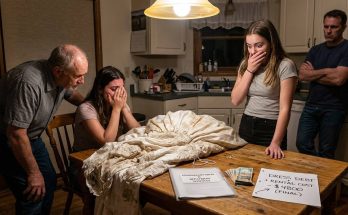
My father holding a sheet of paper.
Gerald standing in front of him.
Mrs. Prescott watching from the porch.
The house looking exactly as they had wanted it to look.
The job completed.
The money withheld.
And two people who seemed convinced that the work itself had left Dad with no leverage.
They were right about one thing.
He couldn't take the paint back.
He couldn't scrape it off the walls, undo nine weeks of labor, or somehow restore the property to the condition it had been in before they hired him.
But they had mistaken that fact for helplessness.
Dad didn't shout.
He didn't tell Gerald what he thought of him.
He didn't plead with Mrs. Prescott to remember how many hours he had worked.
He stood quietly with the invoice in his hand.
Then he nodded.
"All right."
Gerald appeared pleased.
Dad's calm response seemed to reassure him that the argument was over.
He had refused to pay, and the old painter wasn't going to fight him.
That was probably how Gerald understood the moment.
He didn't know my father the way I did.
Dad had never enjoyed arguing.
But he also had never been careless about the things that mattered.
He placed the invoice back inside his folder.
Then he reached for another sheet.
It was a single page.
He told the Prescotts that he needed both of them to sign it for his records.
Gerald looked at the paper.
Dad didn't describe it as a legal document or threaten to use it against them.
He simply presented it as something that needed their signatures.
Gerald appeared amused.
Perhaps he thought my father was trying to preserve the appearance of professionalism after being cheated.
Perhaps he believed the paperwork was an empty gesture.
Whatever he thought, he didn't seem worried.
"Fine," he said. "Let's get this over with."
Mrs. Prescott came down from the porch.
She signed the page, too.
Neither of them took much time to examine what they were signing.
Dad watched them complete the task.
He didn't interrupt.
He didn't explain himself.
When they finished, he thanked them.
Then he put the paper safely into his folder.
That was all.
The Prescotts had just refused to pay him $4,800.
They had laughed at his age and suggested that he would never live long enough to challenge them.
Then they had signed the page he placed in front of them.
Dad didn't tell me what was written on it.
Not that day.
He simply gathered his things and left.
I wish I could say I would have handled the situation as calmly as he did.
I wouldn't have.
I would have demanded an explanation.
I would have told Gerald that the contract was a contract, regardless of whether he had overspent on his renovation.
I would have reminded Mrs. Prescott that a finished house didn't make the labor free.
And when Gerald made that remark about Dad dying before the case reached court, I probably would have said something I regretted.
My father didn't do any of those things.
He walked to his truck.
He put his folder inside.
He checked that the coffee can was where he had left it.
Then he drove away.
The road from the lake house was familiar.
He had traveled it for nine weeks.
He knew the turns, the stretches where the road narrowed, and the places where branches leaned over the pavement.
On other days, he had driven home thinking about the next job.
That afternoon, he had something else to think about.
He had been cheated by people who knew exactly what they owed him.
He had been mocked for being old.
And he had left their property carrying a document they had signed without giving it much attention.
I didn't know any of that until he called me later.
When my phone rang, I was in the middle of an ordinary evening.
I answered without thinking anything was wrong.
Dad's voice sounded tired.
He told me he was sitting in his truck.
I asked whether he had finished at the lake house.
He said he had.
Then he explained what had happened.
At first, I thought there must be some missing detail.
I asked him whether Gerald had questioned the amount.
Dad said no.
I asked whether Mrs. Prescott had found something wrong with the work.
He said she had praised it.
I asked whether they had asked for another change.
He said they hadn't.
The job was finished.
They had simply decided not to pay the final balance.
I stood up so quickly that the chair scraped across the floor.
"They can't do that."
Dad didn't respond.
"They signed a contract, Dad."
"I know."
"You did everything they asked."
"I know that, too."
His voice was steady.
Mine wasn't.
I began thinking of all the things I could do.
I could help him find a lawyer.
I could contact people who knew the Prescotts.
I could tell anyone who might be considering hiring them what they had done.
The longer I thought about it, the angrier I became.
My father had spent more than half a century earning his reputation.
He had done nothing wrong.
Now a wealthy couple had decided they could take advantage of him because they believed he wouldn't have the strength or the time to fight.
I wanted them to understand how wrong they were.
I wanted them to regret laughing at him.
But Dad was quiet while I talked.
That silence made me angrier.
Finally, I stopped long enough to ask him what he intended to do.
He took a breath.
Then he said he was going home.
I stared at the phone.
That wasn't an answer.
Not the answer I wanted, anyway.
"You're just going to leave it like this?"
He didn't say yes.
He didn't say no.
He told me not to worry.
I knew my father well enough to recognize when he had decided not to discuss something.
It was the same expression he wore when I was younger and tried to persuade him to change a decision he had already made.
I pushed anyway.
"There's got to be something we can do."
He was silent for a moment.
Then he asked me to let him handle it.
I didn't understand how he could be so calm.
Not yet.
All I knew was that the Prescotts had taken money he had earned, and he wasn't behaving like a man who had been defeated.
He was behaving like someone who had reached a decision.
And I couldn't tell what that decision was.
Click here to continue reading: PART 3: I Wanted to Call a Lawyer That Night, but Dad Wouldn’t Explain Why He Had Asked the Prescotts to Sign One Last Page
I Thought Fifty-One Years of Honest Work Would Protect My Father, Until Two People Decided His Age Made Him Easy to Cheat
Part 2 of 12