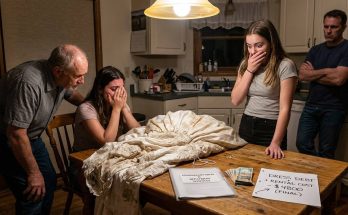
Mrs. Prescott came back toward the driveway after greeting the first visitors.
She had put her phone away.
Her smile was gone.
Gerald stood with his hands on his hips, staring at the ground as though the answer might be written there.
Dad remained near the edge of the driveway.
He wasn't blocking the entrance.
He wasn't trying to stop the open house.
He was waiting for the Prescotts to take responsibility for their decision.
Mrs. Prescott looked at him.
"We need to understand what you think that paper means."
Dad answered without hesitation.
"You signed it after you refused to pay the final balance."
"We know when we signed it."
"Then you know why I'm here."
She looked at Gerald.
He rubbed his forehead.
For two weeks, they had apparently treated the matter as settled.
Now the signed page had returned to their attention, and neither of them seemed comfortable discussing it.
Mrs. Prescott asked whether Dad had brought a lawyer.
He told her he had come by himself.
She appeared surprised.
Perhaps she had expected him to arrive with someone who could make the dispute seem more serious.
Dad didn't need an audience.
He had the document.
He had the contract.
He had the records of the work.
The evidence of the agreement wasn't something he had to reconstruct from memory.
He had kept it all.
Gerald looked toward the house.
A visitor had stepped onto the porch and was examining the exterior.
Another person stood near the mailbox, looking toward the entrance.
The Prescotts had wanted people to notice the renovation.
They had succeeded.
But now they were distracted by the person who had helped make it possible.
Gerald lowered his voice again.
"We're not discussing this in front of everyone."
Dad nodded.
"That's fine."
For a moment, Gerald seemed relieved.
Then Dad continued.
"But we're still discussing it."
The relief disappeared.
Mrs. Prescott folded her arms.
"You can't expect us to stop everything because you've decided to return."
Dad glanced at the house.
"I didn't ask you to stop the open house."
"Then what do you want?"
"I've told you."
She looked frustrated.
Dad wasn't changing his answer.
He wasn't offering a new argument.
He wasn't demanding that they publicly apologize.
He was asking them to deal with the signed document and the unpaid amount.
Gerald stepped closer to his wife.
They spoke quietly to each other.
Dad couldn't hear every word.
He didn't try to.
He waited until they turned back toward him.
Gerald had lost some of his earlier confidence.
He no longer laughed when Dad mentioned the contract.
He no longer made remarks about my father's age.
Instead, he asked whether Dad had kept copies of everything.
Dad said he had.
Gerald asked about the original agreement.
Dad told him it was in his folder.
Mrs. Prescott looked at the folder with a different expression now.
The old object had been easy to dismiss when Dad first arrived at the garage.
It had seemed like a place to store invoices and scraps of paper.
But those papers documented the entire job.
The agreed price.
The changes.
The supplies.
The final balance.
And the page they had signed when they thought the conversation was over.
Gerald asked to see the document again.
Dad took it out.
This time, Gerald examined it more carefully.
He read the page from top to bottom.
Then he read it again.
His face became still.
Mrs. Prescott leaned toward him.
"What does it say?"
He didn't answer immediately.
She reached for the paper.
Gerald held it a moment longer, then gave it to her.
She read it in silence.
Dad watched them without interrupting.
I imagine that was the first time the Prescotts truly paid attention to the document.
They had signed it because they thought it was insignificant.
Now they were examining every line.
Mrs. Prescott looked up.
"Why didn't you explain this to us?"
Dad's expression barely changed.
"You asked me to leave."
She opened her mouth, then closed it.
That was the truth.
They had been so certain that he had no way to challenge them that they hadn't taken the time to ask what they were signing.
Now they wanted to know why he had allowed them to make that mistake.
Dad didn't accuse them of being foolish.
He didn't need to.
Gerald looked back at the page.
He seemed to be calculating what the document might mean for them.
The open house continued behind him.
A guest asked Mrs. Prescott a question from the porch.
She turned and answered automatically, but her attention remained on the paper.
Her voice sounded strained.
She wanted the event to continue as planned.
She also wanted to understand what she and her husband had signed.
Those two desires were no longer easy to reconcile.
Gerald handed the document back.
"You're making this more complicated than it needs to be."
Dad slipped it into the folder.
"It was simple before you refused to pay."
Gerald's eyes narrowed.
"We told you we were over budget."
"And I told you what the contract said."
"That's not the point."
Dad waited.
Gerald didn't seem able to explain what the point was without returning to the same excuse.
The renovation had cost more than expected.
That was a problem the Prescotts had created for themselves.
It did not erase the agreement they had made with my father.
Mrs. Prescott stepped closer.
"If we had known you were going to use that paper this way, we would have taken more time with it."
Dad looked at her.
"I gave you time to read it."
She looked away.
I thought about that sentence afterward.
Dad hadn't hidden the page.
He hadn't snatched it away before they could examine it.
He had presented it to them and asked for their signatures.
They had been free to read it.
They had chosen not to.
That choice had seemed harmless when they believed they were dealing with a man who would never challenge them.
Now it mattered.
Gerald glanced toward the porch again.
More guests were arriving.
He looked as if he wanted the conversation to end before anyone asked why the painter was standing near the driveway with a folder.
Dad didn't move.
He wasn't going to let the presence of visitors decide whether the matter deserved attention.
Mrs. Prescott asked what would happen next.
Dad told her he wanted the signed agreement honored.
She looked at Gerald.
Gerald looked back at the house.
Neither of them spoke for several seconds.
Then Gerald asked whether Dad would leave if they agreed to discuss the matter privately.
Dad considered the question.
"I'll leave when we have a clear understanding."
Gerald seemed irritated by the answer.
He had expected a simple promise.
Instead, Dad had asked for something more definite.
That was what the Prescotts had failed to understand about him.
He didn't need to shout to be firm.
He didn't need to threaten people to insist on an agreement.
He had spent fifty-one years learning that calm words were often enough, provided he was prepared to stand by them.
Mrs. Prescott looked down at the document one more time.
Then she handed it back to Dad.
"We need some time."
Dad nodded.
He didn't argue about the delay.
But he didn't pretend the dispute had been settled, either.
He returned the paper to the folder and closed it.
The Prescotts turned toward the house.
Their guests were waiting.
The flowers were arranged.
The porch was ready.
The freshly painted exterior looked exactly as it had before Dad arrived.
Yet the mood around the entrance had changed.
Gerald no longer seemed like a man who had saved $4,800 by refusing to pay a contractor.
He looked like a man who had discovered that the contractor had kept careful records of every decision.
And Mrs. Prescott, who had once dismissed the work by pointing out that the paint could not be taken back, had begun to understand that the finished house wasn't the only thing that remained from the job.
The paperwork remained, too.
Click here to continue reading: PART 7: My Father Had Kept Every Change in That Old Coffee Can, but the Prescotts Were Finally Looking at the One Page They Had Ignored
I Thought Fifty-One Years of Honest Work Would Protect My Father, Until Two People Decided His Age Made Him Easy to Cheat
Part 6 of 12