By the third day, I was tired of waiting.
I had no new information, but I had developed a dozen possible conversations in my head.
In one, Gerald called Dad and apologized.
In another, he insisted that the final amount was unfair.
In a third, he claimed the signed page meant something different from what Dad believed.
I knew I was imagining these things.
Still, each possibility made me angrier.
Dad didn't seem interested in guessing.
When I called him, he was sorting through a box of old receipts in his workshop.
I could hear paper moving in the background.
“Are you still working on the Prescotts' paperwork?” I asked.
“Just checking the dates.”
“Why?”
“Because if I have to explain the order of things, I want to be certain.”
I sat down.
“Have they contacted you?”
“No.”
“Then why keep preparing?”
“Because I already have the papers. I may as well keep them straight.”
I imagined him at the workbench, his reading glasses low on his nose, the receipts spread in front of him.
He had never been careless about the small details of a job.
He wrote down the date when he began.
He noted what the customer wanted changed.
He kept track of materials.
He made sure the final invoice matched the work he had completed.
The Prescotts might have viewed those habits as unnecessary.
To Dad, they were part of doing the job properly.
“What if they never call?” I asked.
“Then I'll have to decide what comes next.”
He didn't sound defeated.
He sounded practical.
I was the one who wanted to rush toward a conclusion.
I wanted to know how the story ended before the people involved had decided what they were going to do.
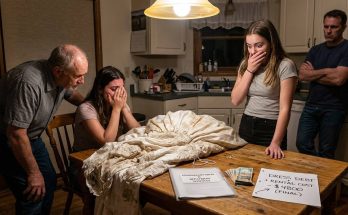
That evening, Dad came by with the invoice.
He placed it on my table.
The paper had a crease near one corner.
I ran my finger over the printed amount.
$4,800.
It was a simple number.
It didn't show the nine weeks of work behind it.
It didn't show the hours Dad had spent preparing surfaces or the time he had lost waiting for a room to be cleared.
It didn't show the extra care he had taken when Mrs. Prescott asked him to change a color or adjust a detail.
The invoice was only the final amount.
Everything else was in the work itself and in the records he had kept.
“I keep thinking about what Gerald said,” I told him.
Dad looked up.
“Which part?”
“That you'd be dead before you could do anything about it.”
He was quiet for a moment.
“I remember.”
“How can you sit there and be so calm?”
He folded the invoice along its existing crease.
“Because getting angry won't make the paperwork clearer.”
“It might make you feel better.”
“Maybe for five minutes.”
I looked away.
He wasn't telling me that anger was wrong.
He was telling me it couldn't do the work for him.
“I don't want them to think they can treat you like this,” I said.
“Neither do I.”
“Then why does it feel as if you're letting them get away with it?”
Dad rested both hands on the table.
“Because we don't know what they're going to do yet.”
I didn't have a reply.
He was right.
The fact that he hadn't received a response didn't mean he had lost.
It also didn't mean he would win.
We were still waiting.
Dad gathered the invoice and placed it back in his folder.
“I'm not going to tell you that this is easy,” he said. “It isn't.”
He looked toward the kitchen doorway.
“But I don't want to make promises about something that hasn't happened.”
I nodded.
He stood, thanked me for the coffee, and carried his folder to the door.
Before leaving, he turned back.
“Don't let this take over your whole week.”
I almost laughed.
It had already taken over far too much of my week.
But I understood what he meant.
He didn't want the Prescotts' behavior to become the center of every conversation we had.
He didn't want me to spend my evenings inventing arguments for him to make.
He wanted me to live my life while he handled his own business.
The next morning, I went to work.
I answered emails.
I attended a meeting.
I ate lunch with a colleague and listened to her talk about a problem with her car.
For a few hours, I managed not to think about the lake house.
Then my phone rang.
It was Dad.
“Have you heard from them?” I asked immediately.
“No.”
I felt my shoulders sink.
He heard the change in my voice.
“I wanted to tell you I'm going to keep the folder ready.”
“Of course.”
“I've put the original agreement, the change slips, and the invoice together. The signed page is separate.”
“Why separate?”
“Because I don't want to bend it or misplace it among the others.”
I could picture the care with which he handled every sheet.
“What will you do if they ask to see everything?”
“Show them what they ask to see.”
“And if they don't?”
“Then I'll know they haven't asked.”
He didn't offer a grand lesson.
He didn't tell me that patience always worked or that people eventually did the right thing.
He simply described what he intended to do.
That was more reassuring than a promise he couldn't guarantee.
Later that afternoon, I stopped by his house.
The folder sat on the table beside his reading glasses.
The coffee can was on a shelf in the workshop.
It looked almost comically ordinary.
I lifted the lid.
Inside were small scraps of paper, folded slips, and a few old notes from other jobs.
The Prescotts' records were no longer all mixed together, but Dad had kept the can anyway.
“You could throw this away now,” I said.
He glanced over from the table.
“Why would I?”
“Because you have the folder.”
“The can still holds things.”
I put the lid back.
There was something familiar about the answer.
Dad never discarded something useful simply because he had found a newer way to organize it.
He kept the old can because it still served a purpose.
He kept the folder because it made the current job easier to follow.
He kept the receipts because he might need to refer to them.
And he kept his word because he believed it mattered.
I sat beside him.
“Do you regret going back to the house?”
“No.”
“Even with all the uncertainty?”
“Yes.”
He closed the folder.
“I did the work. I asked to be paid. I gave them the chance to address the matter.”
He looked at me.
“I don't think I should regret that.”
I couldn't argue with him.
I had spent days wishing he would force the situation to end.
He had spent those same days making sure he was ready to deal with whatever came next.
The difference between us was not that he cared less.
It was that he knew caring about something didn't give him control over the outcome.
I stayed for dinner.
We talked about other things.
The conversation wandered to a neighbor's new fence and a television program neither of us had finished watching.
For an hour, the lake house was just another job Dad had completed.
Then I saw the folder beside his chair.
The invoice was still inside.
The signed page was still there.
The matter remained unsettled.
Dad didn't pretend otherwise.
He also didn't let it erase the rest of his life.
Click here to continue reading: PART 12: My Father Had Done His Work and Kept His Records, but the Last Page Could Not Tell Us What the Prescotts Would Choose to Do
I Thought Fifty-One Years of Honest Work Would Protect My Father, Until Two People Decided His Age Made Him Easy to Cheat
Part 11 of 12