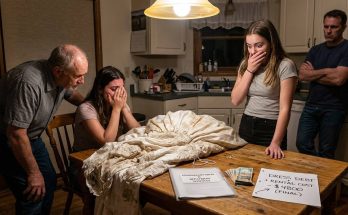
The days that followed were ordinary in every way except for the unanswered question between Dad and the Prescotts.
Dad continued with his routines.
He checked his tools.
He answered calls from people who needed small repairs or wanted an estimate for a painting job.
He made his own breakfast and kept the kitchen clean.
The folder remained in a safe place.
When I visited, I sometimes saw it on the table.
I never saw him staring at it for hours or carrying it around as if it were the only thing he owned.
He had organized the papers.
He knew where each one belonged.
There was nothing more he could do to make the records clearer.
I began to understand that this was his way of refusing to let the situation consume him.
He had not forgotten the $4,800.
He had not decided the Prescotts were right.
He had simply done what he could do that day.
One afternoon, I asked whether he had considered calling them again.
“I have considered it,” he said.
“And?”
“I haven't decided.”
“Would it hurt to call?”
“Maybe not.”
He set his mug on the table.
“But I don't want to call just because I'm impatient.”
I smiled a little.
“You think I'm impatient.”
“I know you are.”
He said it without criticism.
I had been impatient all my life.
When I was a child, I wanted to know what was inside a wrapped birthday present before anyone was ready to give it to me.
When I started a project, I wanted to see the finished result immediately.
Now I wanted a clean answer to a problem that depended on other people's choices.
Dad knew that about me.
He also knew there was no point in pretending the answer was already available.
“What do you think they'll do?” I asked.
He shook his head.
“I don't know them well enough to say.”
“You worked for them for nine weeks.”
“I worked on their house.”
He paused.
“That's not the same as knowing what they'll decide when they're unhappy.”
I thought about that for a long time.
We often assume that because we have seen someone in one situation, we understand how they will behave in another.
Dad had seen the Prescotts choose colors, inspect walls, and request changes.
He had seen them praise the finished work.
He had also seen them refuse the final payment.
But he could not know what they would do next.
Neither could I.
A few days later, I visited Dad's workshop.
The coffee can sat on its shelf.
The folder was in the drawer below the workbench.
He was cleaning a brush that had been used for a small job that morning.
The water ran into the sink while he worked the bristles gently between his fingers.
I watched him for a moment.
“You still enjoy painting?” I asked.
He looked over.
“Most days.”
“Even after what happened?”
He turned the brush beneath the water.
“One bad customer doesn't change every other job I've done.”
I leaned against the workbench.
“Doesn't it make you more cautious?”
“Perhaps.”
He shut off the tap and shook the water from the brush.
“But being careful is different from expecting everyone to behave badly.”
He hung the brush to dry.
I knew he was right, though I wasn't sure I could have followed his example so easily.
The Prescotts' behavior had left me angry not only because they owed him money, but because they had acted as though his age made him powerless.
Gerald had laughed at a seventy-two-year-old man who had done exactly what he had been hired to do.
He had treated the possibility of delay as if it made the obligation disappear.
Dad had not answered that insult with another insult.
He had returned with his records.
He had asked the Prescotts to address the page they had signed.
And when Gerald requested time, Dad had allowed him that time.
I didn't know whether that approach would lead to payment.
I only knew it was consistent with the man my father had been for as long as I could remember.
He believed people should be given a fair chance to do the right thing.
He also believed that fairness did not require him to pretend nothing had happened.
Before I left, I asked if I could see the signed page again.
Dad opened the drawer and took out the folder.
He removed the document and placed it on the workbench.
The signatures were there.
The paper had a slight crease from being handled.
I studied it without touching it.
The page itself couldn't tell me what the Prescotts would choose.
It couldn't tell me whether they would call Dad, whether they would pay the final balance, or whether the disagreement would continue.
It could only show that they had signed.
I looked at Dad.
“Do you wish you had made them read it first?”
He considered the question.
“I wish people would read anything before they sign it.”
That answer was so simple that I almost laughed.
Then he added, “But I can't make them read.”
He slid the paper back into the folder.
“I can only keep a copy and remember what happened.”
I nodded.
The folder closed with a soft sound.
There was no dramatic moment.
No phone rang.
No one appeared at the workshop door with an envelope or an apology.
The question remained where it had been.
I had wanted the story to end with something I could point to.
A payment.
A clear decision.
A final conversation in which everyone admitted what they had done.
Life rarely arranges itself that neatly.
Sometimes a person does everything carefully and still has to wait for someone else to decide how to respond.
That doesn't make the careful work meaningless.
It doesn't turn an unpaid invoice into a paid one.
It simply means the outcome is not always available when we want it.
Dad returned the folder to the drawer.
Then he went back to cleaning his tools.
I stood beside the workbench, looking at the old coffee can on the shelf.
It was dented.
Its lid still didn't fit quite right.
Inside it were the small records of work that had already been done and paid for, along with the remnants of jobs that no longer needed attention.
The can had never been special.
The paper slips inside it had never looked important.
But Dad had kept them because he believed details mattered.
The original agreement mattered.
The changes mattered.
The final invoice mattered.
And the signed page mattered because it belonged to the same chain of events.
I couldn't tell him that everything would turn out well.
He hadn't asked me to.
Instead, I told him I was proud of how he had handled the situation.
He looked down at the brush in his hand.
“I just want to be paid for my work,” he said.
“I know.”
He gave me a small nod.
That was enough for him.
When I left, the folder was still in the drawer, and the coffee can was still on its shelf.
The Prescotts' house stood by the lake, freshly painted and ready for people to walk through.
Dad had done what he was hired to do.
He had recorded the changes, finished the work, presented the bill, and kept the paperwork.
He had returned when the final payment was refused.
He had not forgotten the laughter or the insult.
But he had also not allowed either one to change the facts of the job.
The remaining question belonged to the Prescotts.
They had signed the page.
They had asked for time.
What they would do with that time was not something Dad could decide for them.
I used to think a story like this needed a final moment when every loose end was tied up.
Now I understand that an honest account sometimes has to stop where the evidence stops.
The final amount on Dad's invoice was still $4,800.
The document remained in his folder.
And the work he had done was still the work he had done, whether or not the people who owned the house chose to acknowledge what they owed him.
The End
Read more original stories on Feel Every Story.
I Thought Fifty-One Years of Honest Work Would Protect My Father, Until Two People Decided His Age Made Him Easy to Cheat
Part 12 of 12