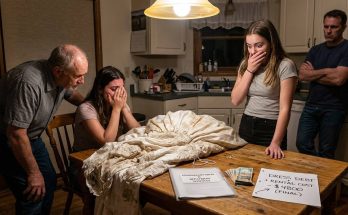
I learned more about what happened at the open house when Dad and I spoke later.
He still didn't tell me every detail.
He never enjoyed repeating an argument, especially one that involved people who had treated him badly.
But he explained enough for me to understand how the situation had changed.
The Prescotts had spent two weeks believing the dispute was over.
They had the finished house.
They had the benefit of Dad's work.
They had not paid the final $4,800.
And they assumed he would do nothing about it.
Then he returned with the page they had signed.
That was when they began asking questions.
Dad told me that Gerald wanted to know why he hadn't explained the document more thoroughly.
I asked Dad what he had said.
He reminded me that the Prescotts had been the ones in a hurry.
They had refused the payment.
They had mocked him.
They had asked him to sign off on the conversation by leaving.
When he presented the page, neither of them had shown much interest in reading it.
They had signed because they believed it couldn't matter.
Dad wasn't responsible for that assumption.
I thought about the coffee can again.
For years, I had treated it as a harmless quirk.
Now I understood that it represented something more important.
My father had learned to protect himself without changing who he was.
He didn't become rude because customers could be difficult.
He didn't assume everyone was dishonest.
He simply kept records.
Every time a customer requested a change, he wrote it down.
Every time the agreement shifted, he made sure the change was acknowledged.
He knew that people could remember a conversation one way when the job began and another way when the invoice arrived.
The Prescotts had given him plenty of opportunities to use that habit.
Mrs. Prescott had changed her mind about the paint color.
She had approved the replacement.
She had requested other alterations.
Dad had documented each one.
The signed slips were still in the coffee can.
The contract was still in the folder.
And the invoice still showed the amount they owed.
I asked whether Gerald had finally admitted the debt.
Dad said the man had not apologized.
That didn't surprise me.
People who were comfortable humiliating someone rarely became generous with apologies once they realized they had gone too far.
Gerald had asked questions.
He had looked at the document.
He had tried to move the conversation away from the guests.
But he hadn't offered a sincere acknowledgment of what he had done.
Mrs. Prescott hadn't either.
They were concerned about the consequences.
That was different from being sorry.
I told Dad I wished I could have seen their faces when they realized he hadn't simply accepted the loss.
He chuckled softly.
"You shouldn't enjoy other people's trouble too much."
I reminded him that they had laughed at him first.
He didn't disagree.
He only said he wanted the matter settled.
That was always his priority.
Not revenge.
Not humiliation.
Payment for the work he had done.
I found that difficult to accept at first.
After the way Gerald had treated him, I wanted more than a payment.
I wanted the man to understand how cruel his remark had been.
I wanted Mrs. Prescott to remember the sight of Dad standing beside the garage with an invoice in his hand.
I wanted them to feel ashamed.
But Dad had never measured success that way.
He had done a job.
He expected to be paid.
The contract had been signed.
That was the foundation of the dispute.
Everything else was a distraction.
He told me that after the initial conversation at the open house, the Prescotts became more careful about what they said.
They stopped treating the signed page as a joke.
They no longer insisted that the matter could be dismissed simply because they had overspent.
Instead, they wanted to understand what they had agreed to.
Dad let them examine the document.
He answered questions when they were relevant.
He didn't invent new demands.
He didn't change his story.
The same facts remained true.
They had hired him.
He had completed the work.
They owed him $4,800.
They had refused to pay.
And they had signed the additional page after that refusal.
The more they examined the situation, the harder it became for them to pretend they had misunderstood the original agreement.
I asked Dad whether he thought they had read the page at all when they signed it.
He shook his head.
"They wanted me gone."
That was the simplest explanation.
They had been pleased with themselves.
Gerald had made his cruel remark.
Mrs. Prescott had laughed along.
Then Dad had offered the page, and they had signed it because they thought doing so would end the conversation.
They hadn't considered the possibility that the paper might become important later.
I wondered what they thought when Dad drove away that first afternoon.
Perhaps they believed he would complain to a few people and then forget the matter.
Perhaps they imagined that he would decide the amount wasn't worth the effort.
Perhaps they had convinced themselves that an older man who worked alone would never challenge a wealthy couple.
I didn't know.
But I knew they had underestimated him.
That evening, I asked Dad if he had kept a copy of the page.
He said he had.
I asked whether the signed original was in the folder.
He said it was.
I asked about the contract and the records of the paint changes.
He told me everything was where it belonged.
I felt some of the tension leave my shoulders.
At least the evidence hadn't been lost.
At least Dad wasn't trying to reconstruct the job from memory.
He had kept the records from the beginning.
That was what he had always done.
I apologized for pushing him to act before he was ready.
He told me I didn't need to apologize.
I said I had assumed he was going to let the Prescotts get away with it.
He was quiet for a moment.
Then he told me that being quiet didn't mean he had given up.
I remembered those words.
They were simple, but they changed the way I understood my father.
I had mistaken his refusal to argue for weakness.
I had mistaken his patience for acceptance.
And I had assumed that because he didn't want to discuss his plans, he must not have had any.
The truth was that he had been thinking carefully about what to do.
He had not forgotten the money.
He had not forgotten the contract.
He had not forgotten the way Gerald laughed.
But he wasn't going to let anger make his decisions for him.
I asked whether the Prescotts had agreed to settle the balance.
Dad said they were still dealing with the matter.
I wanted a clearer answer.
He didn't give me one.
That was frustrating, but I had begun to understand that he would tell me when there was something definite to say.
Until then, he intended to keep the dispute between himself and the people who had hired him.
I tried not to interfere.
The next time we spoke, we talked about his work.
He had another job to prepare for.
He needed to check the supplies he already had before buying anything new.
He mentioned a brush that had begun to wear down at the edge.
It was an ordinary conversation.
The sort we had always had.
But now I noticed the way he handled his paperwork.
He placed the receipts in order.
He checked the notes.
He made sure the folder was closed before putting it away.
He had done all of that long before the Prescotts came along.
I simply hadn't understood why it mattered so much.
The lake house had taught me something I should have learned years earlier.
A person could be kind without being careless.
A person could remain calm without surrendering.
And a person could refuse to shout while still refusing to be cheated.
My father hadn't changed.
He was still the same man who filled tiny nail holes because he couldn't bear to leave a job unfinished.
He was still the man who believed promises ought to mean something.
He was still the man who carried an old coffee can full of signed slips in his truck.
The difference was that the Prescotts had finally discovered what those habits meant.
They had assumed the paper was unimportant.
They had assumed the old painter was finished with them.
Now they knew he wasn't going to disappear just because they wanted him to.
Click here to continue reading: PART 8: The House Was Ready for Buyers, but the Couple Who Wanted Every Detail Perfect Had Left One Important Thing Unsettled
I Thought Fifty-One Years of Honest Work Would Protect My Father, Until Two People Decided His Age Made Him Easy to Cheat
Part 7 of 12