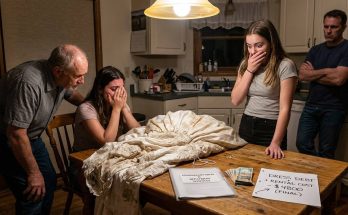
Dad came to my house that afternoon.
He arrived carrying the folder and a small stack of papers held together with a rubber band.
I had made coffee before he knocked.
He sat at the kitchen table while I placed a mug in front of him.
For a while, neither of us mentioned the Prescotts.
He asked how my week had been.
I told him about work, the errands I hadn't finished, and the leaking tap I still needed to fix.
He listened carefully.
Then he removed the rubber band from the papers.
“I want to make sure everything is together,” he said.
I sat opposite him.
“Didn't you already do that?”
“Most of it.”
He arranged the papers into neat piles.
The original agreement went on one side.
The change slips went beside it.
The invoice sat at the top of another pile.
The signed page remained inside the folder.
He handled each piece slowly, as if he were checking tools before leaving for a job.
I had seen him do the same thing when I was younger.
Before starting work, he checked his brushes, rollers, ladders, and paint trays.
He didn't assume that because he had used them yesterday, they would be ready today.
He checked.
Then he checked again.
“You've got everything?” I asked.
“As much as I kept.”
He lifted the invoice and looked at it.
The final balance was $4,800.
That number had become hard for me to look at.
It wasn't only the amount itself.
It was the fact that someone could accept nine weeks of another person's work and then act as if the payment were optional.
Dad set the invoice down.
“I should have known they'd try something,” he said.
I looked up.
“Why would you say that?”
“They were particular from the start.”
“Being particular doesn't mean they were going to refuse to pay you.”
“No,” he said. “It doesn't.”
He didn't blame himself loudly.
That made the words worse.
I could tell he was replaying the inspection, wondering whether he had missed some warning or trusted someone he shouldn't have trusted.
“You did the work they asked for,” I said.
“I did.”
“You recorded every change.”
“Yes.”
“They signed the slips.”
“They did.”
“Then you didn't do anything wrong.”
He rubbed a hand over his cheek.
“I don't like having to argue about money I've already earned.”
“I know.”
“I've spent fifty-one years trying not to leave people with a reason to complain about my work.”
He looked toward the window.
“Sometimes I stayed late to fix something that wasn't even my fault. Sometimes I bought another tin of paint because I thought a room could be better.”
I remembered the smell of paint on his work shirts.
Even after washing, it seemed to remain in the seams.
He had spent much of his adult life working in other people's homes, making their rooms look better than they had before.
He had never talked about it as if he were doing them a favor.
He considered it a job.
A job had a price.
A job had a beginning and an end.
And if someone agreed to pay for it, the payment was part of the agreement.
I picked up one of the change slips.
The writing was Dad's, small and tidy.
It described a change Mrs. Prescott had requested.
Her initials were at the bottom.
There were several more like it.
Each one recorded a decision made during the project.
“You kept these in the coffee can?” I asked.
“Until I put the folder together.”
“Why a coffee can?”
He smiled faintly.
“Because I had one.”
“That can't be the whole reason.”
“It was a good can.”
I laughed despite myself.
He looked pleased that he had managed it.
The old coffee can had lived in his truck for years.
It had held screws once, then nails, then paper slips from jobs where customers changed their minds halfway through.
He never threw those records away until he was certain they were no longer needed.
“Did you show Gerald all of these?” I asked.
“I told him I had them.”
“Why not take them inside?”
“He didn't ask to see them.”
I thought about that.
Gerald had wanted time to review the matter.
Dad had offered the records.
It was up to Gerald to decide whether he intended to look at them.
“Do you think he'll pay you tomorrow?” I asked.
Dad wrapped the rubber band around the stack again.
“I don't know.”
“You sound as if you're expecting trouble.”
“I'm expecting him to decide what he wants to do.”
That was not the answer I wanted.
I wanted certainty.
Dad had never given me certainty when he didn't have it.
He had taught me that pretending to know something didn't make it true.
I leaned back in my chair.
“What does that signed page mean to you?”
He looked at the folder.
“It means they signed it.”
“But what does it say?”
He paused.
I waited.
“I don't want to turn this into a conversation about what I think it might mean,” he said. “The paper is there. They can read it.”
I could have pressed him.
I could have demanded that he explain every word.
But I understood something about him by then.
He wasn't trying to make the situation mysterious.
He simply didn't want to replace the document with his own interpretation of it.
The Prescotts had signed the page.
They needed to read it and decide what they would do.
The next morning, Dad called me before I left for work.
“They haven't called,” he said.
I stood beside my kitchen counter with my keys in my hand.
“Did you expect them to?”
“I thought they might.”
“Are you going over there?”
“Not yet.”
I glanced at the clock.
I was already running late.
“Dad, you shouldn't have to chase people for money they've promised you.”
“No,” he said. “I shouldn't.”
There was no anger in his voice.
Only a quiet agreement.
I left for work, but the conversation stayed with me all day.
At lunch, I checked my phone.
There was no message from him.
In the afternoon, I checked again.
Still nothing.
When I got home, I found a message saying he had put the papers back in order and was waiting to see whether the Prescotts would respond.
I called him.
“Any news?”
“Nothing yet.”
“What are you going to do?”
“Give them the time they asked for.”
I closed my eyes.
“You're more patient than I am.”
“That's probably true.”
He said it so plainly that I laughed.
Then he asked whether I had eaten.
That was Dad.
Even when something weighed on him, he remembered to ask about the ordinary parts of my life.
I told him I was making dinner.
He told me not to burn it.
I promised I wouldn't.
We ended the call.
The following day passed without a word from the Prescotts.
I didn't know what they were discussing in their house.
I didn't know whether they had laid the document beside the invoice or left it in a drawer.
I didn't know whether they had examined the change slips or remembered the inspection.
All I knew was that Dad had done the work, kept the records, and given them the time they requested.
He was not trying to win an argument by being louder than they were.
He was waiting for them to address the matter.
And for the first time, I realized how much of his life had been spent doing exactly what he said he would do, even when other people made it difficult.
Click here to continue reading: PART 11: The Final Bill Still Said $4,800, and My Father Was Determined Not to Let an Awkward Silence Replace an Honest Answer
I Thought Fifty-One Years of Honest Work Would Protect My Father, Until Two People Decided His Age Made Him Easy to Cheat
Part 10 of 12