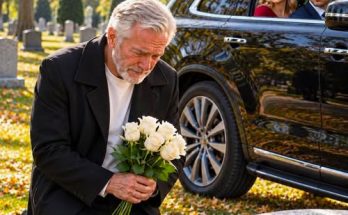
I used to believe that no matter how badly life treated me, my daughter would never leave me stranded.
I was seventy-one when I learned how wrong a father could be about his own child.
The first message came while I was standing beside my wife's grave, holding a bunch of white roses in one hand and my phone in the other.
You're on your own. Find your way back.
That was the meaning of Derek's message, though his actual words were even colder.
I stared at the screen, waiting for something else to appear.
An explanation, perhaps.
A joke that had gone too far.
Anything that might make me believe my son-in-law hadn't just abandoned me in a cemetery nearly 190 miles from home.
Then another message arrived.
It was from Vanessa.
My only daughter.
She told me not to expect them to come back.
I read it twice.
The second time hurt more than the first.
Their black SUV had already disappeared beyond the cemetery gates. I could still hear the fading sound of its engine, mixed with the dry rustle of leaves scraping across the pavement.
November had settled in early that year.
The wind worked its way through my coat, and my fingers were beginning to stiffen around the roses.
I could have shouted after them.
I could have called Vanessa and demanded to know what kind of person did this to her father.
Instead, I lowered my phone.
I looked at Eleanor's headstone.
My wife had been dead for exactly two years.
And somehow, standing there alone, I felt as if I had lost her all over again.
My name is Harold Bennett.
For most of my adult life, I had been a businessman, a husband, and a father who believed that providing for his family was the same thing as keeping it safe.
I had built Bennett Freight Holdings from two borrowed trucks and a rented patch of industrial land.
Thirty-eight years later, the company operated on a scale I could barely have imagined when Eleanor and I first started it.
We had made mistakes along the way.
We had lost contracts, worked through recessions, and spent nights worrying about payroll.
But we had never forgotten who had helped us get there.
Eleanor was the person who reminded me of that.
She could look at a stack of figures and spot a problem before I had finished explaining it. She could also tell when I was pretending to be fine.
That second skill had always been more troublesome.
Even near the end of her life, when the illness had taken most of her strength, she worried more about me than herself.
She knew how much I depended on her.
She also knew how much I depended on Vanessa.
Or thought I did.
The morning I visited Eleanor's grave, my own car was sitting in a repair shop.
The mechanic had called the previous afternoon to say a replacement part had been delayed. I could have hired a car, but I had already arranged the visit with Vanessa and Derek.
They lived close enough that the trip was manageable for them.
I didn't want to make a fuss.
When I asked Vanessa whether they could drive me to the cemetery, she paused long enough for me to notice.
"That far?"
"It's the anniversary, sweetheart."
"I know what day it is, Dad."
Her voice wasn't angry.
Not exactly.
It had the tired edge of someone who believed I was asking for more than I should.
Then Derek appeared in the background and asked where she was going.
She told him.
I heard him sigh.
A moment later, Vanessa returned to the phone.
"Fine. We'll take you. But we can't spend all day there."
"Of course not."
"We have things to do."
"I understand."
I meant it.
That was one of my problems. I had spent so many years making life easier for my family that I had become uncomfortable whenever they had to inconvenience themselves for me.
Vanessa said they would arrive before noon.
I thanked her.
I even apologized for asking.
Looking back, that last part makes me ashamed.
A father should be able to ask his daughter for a ride to his wife's grave without feeling as if he has committed some offense.
But by then, our relationship had changed in ways I had been trying not to see.
For months, Vanessa had been less patient with me.
Phone calls became shorter.
Visits were postponed.
When I spoke about Eleanor, she sometimes looked toward Derek as though waiting for him to tell her how long she had to listen.
I blamed grief.
Mine, mostly.
Eleanor's absence had changed the shape of every room in my house. I still caught myself turning toward her when something happened that I wanted to share.
Then I remembered.
The silence that followed was always worse than the memory.
Vanessa had been close to her mother once.
I thought she might be struggling too.
So I made excuses for her.
I made excuses for Derek as well, though he had never been someone I particularly liked.
He was polished, ambitious, and very good at making ordinary requests sound like opportunities.
When he joined Bennett Freight Holdings as operations director, I had wanted to give him a fair chance.
He was married to my daughter.
I told myself that was reason enough to help him succeed.
His salary was generous, and the position gave him access to parts of the business he had never managed before.
I expected him to work hard.
I did not expect gratitude.
I did expect honesty.
That distinction would eventually cost him everything he had been planning.
But on the morning of the cemetery visit, I still thought of Derek as an irritating son-in-law rather than a man capable of deliberate betrayal.
They arrived a little after eleven.
Vanessa stayed in the passenger seat while Derek unlocked the doors.
I climbed into the back, carrying the white roses Eleanor had always liked.
They were wrapped in plain paper, tied with a narrow ribbon from the florist.
Vanessa glanced at them when I settled into my seat.
"Those are nice."
"Your mother loved white roses."
"I remember."
Then she turned toward the window.
Derek asked how long the visit would take.
"I'd like a little time with her."
"How much time?"
"I don't know. Perhaps half an hour."
He looked at me in the rearview mirror.
"We need to be back for dinner."
"I won't keep you."
He nodded as if the matter had been settled.
The drive took several hours.
There were stretches when no one spoke.
I watched the roadside trees pass and thought about the last time Eleanor had made the trip with me.
She had been alive then, though already tired enough to lean her head against the window.
She had complained about the heater in the car.
I had told her I would have it fixed.
She had smiled and said I always promised to fix things.
I remembered that smile so clearly that, for a moment, I forgot she was gone.
Then Derek braked hard at an intersection, and the moment passed.
Vanessa spent most of the journey looking at her phone.
Once, she laughed at something on the screen and showed Derek.
He smiled.
I sat behind them, listening to their conversation, waiting for a chance to join in.
It never came.
I could have asked about their week.
I could have asked how work was going.
Instead, I looked out at the passing fields and told myself that young people had their own lives.
That was true.
It was also a convenient way to avoid admitting that I felt unwanted.
When we finally reached the cemetery, the sky was low and gray.
The parking area was nearly empty.
Derek stopped near the entrance and left the engine running.
"How long?"
I unfastened my seat belt.
"Twenty minutes, perhaps."
"You said half an hour."
"I know. I'll try to be quick."
Vanessa let out a breath.
"Dad, please don't make this difficult."
I looked at her.
"I wasn't trying to."
She said nothing.
I stepped out of the car and closed the door carefully.
The white roses were cool against my palm.
I watched them drive toward the exit lane before I turned toward the graves.
For a few minutes, the familiar path helped me forget everything else.
I knew the turns.
I knew the low stone wall near the older section and the bare branches hanging over the narrow walkway.
I knew where Eleanor rested.
I had been there often enough to recognize the small patch of ground beside her headstone where the grass never seemed to grow properly.
I knelt.
My knees complained, and I had to steady myself with one hand against the stone.
"Hello, sweetheart."
The words came out quietly.
I placed the roses at the base of the headstone and adjusted the paper so it wouldn't blow away.
Then I sat on the nearby bench.
I told Eleanor about the house.
About the garden she had loved, which I had been trying to maintain without much success.
About the kitchen clock that had stopped twice because I kept forgetting to replace its batteries.
I told her I missed her.
That was the part I couldn't make sound ordinary.
I missed her when I woke up.
I missed her when I ate.
I missed her when I found something funny and had nobody to share it with.
Most of all, I missed having someone who could tell me the truth without making me feel foolish for needing to hear it.
The wind moved through the trees.
I lowered my head.
I didn't know how long I sat there.
Twenty minutes, perhaps.
Maybe a little longer.
I was not watching the time.
I was speaking to my wife.
And when I finally stood up, I discovered that the people who had brought me there were gone.
Click here to continue reading: PART 2: The Argument They Called an Inconvenience Had Begun Months Earlier, With a House Deed and a Smile I No Longer Trusted
I Thought Visiting My Wife’s Grave Would Be the Hardest Thing I Faced That Day, Until I Read Two Messages
Part 1 of 16