Vanessa called again the following Thursday.
I was outside clearing leaves from the front steps when I heard the phone vibrating in my coat pocket.
I brushed my hands together before answering.
"Hi, Dad."
"Hello."
"I wanted to ask about Sunday."
I knew what she meant.
"The cemetery?"
"Yes."
I set the rake against the wall.
"Why now?"
There was a pause.
"Because I've been thinking about Mom. And because I know you go every week."
"Those are two different reasons."
"I suppose they are."
I waited for her to continue.
"I miss her," she said.
"So do I."
"I keep thinking she would be disappointed in me."
I looked toward the lake.
The water had turned dark beneath the afternoon clouds.
"Your mother loved you," I said. "That doesn't mean she would have approved of everything you've done."
"I know."
"Do you?"
"Yes, Dad."
Her voice was steady, but I could hear the strain in it.
"I don't want to go there just so you'll forgive me," she said. "I want to go because I should have been going."
I considered that.
It was not a grand confession.
It did not resolve anything.
But she had made a distinction I had wanted her to make.
"All right," I said. "You can come with me this Sunday."
"Thank you."
"We'll meet at the entrance. I'll drive from there."
She hesitated.
"Could I ride with you?"
I glanced at my car through the window.
The request carried more meaning than she probably intended.
For months, the thought of giving Vanessa a ride had brought back the day she had left me behind.
I could have refused simply to avoid the feeling.
Instead, I asked myself what I actually wanted.
I wanted to visit Eleanor's grave without turning the trip into a test.
I wanted Vanessa to understand that being allowed into my life again was not the same as having every old privilege restored.
"Yes," I said. "You can ride with me."
She exhaled.
"Okay."
We agreed that I would pick her up Sunday morning.
When the call ended, I stood outside for another minute.
Then I finished clearing the steps.
I didn't spend the weekend rehearsing what I would say to Vanessa.
I wasn't going to give her a speech.
If she wanted to talk, I would listen.
If she wanted to apologize, I would hear her.
But I would not pretend that the cemetery visit itself meant everything was forgiven.
Sunday arrived cold and bright.
I picked up the white roses from the florist near the main road, then drove to Vanessa's apartment.
She was waiting outside with a small bunch of flowers of her own.
They were white too.
She opened the passenger door and held the flowers carefully on her lap.
"Thank you for coming to get me," she said.
"You're welcome."
We drove in silence for several minutes.
The road passed familiar shops and then narrowed as we left the busier streets behind.
Vanessa watched the fields through the window.
"I haven't been here since the day we left you," she said.
I kept my eyes on the road.
"I know."
"I should have come back."
"Yes."
She swallowed.
"I kept telling myself you would manage."
"I did manage."
"I know that now."
I turned onto the road leading toward the cemetery.
"What do you mean?"
"I mean I used the fact that you were capable as an excuse not to think about what I was doing to you."
I didn't answer immediately.
The words were closer to the truth than anything she had said before.
She looked down at the flowers.
"I knew you would find a way home," she continued. "I didn't think about how frightening it might be to be left there. I didn't think about what it would feel like to read those messages."
"Why did you send yours?"
She closed her eyes briefly.
"Because I wanted to hurt you."
The admission landed heavily between us.
I tightened my hands on the steering wheel.
"Why?"
"I was angry that you wouldn't agree with us about everything. I was angry that you were asking questions about the company. I thought you were making our lives difficult."
"You thought I was making your lives difficult by asking where the money was going?"
"I didn't understand the whole situation then."
"That doesn't answer why you wanted to hurt me."
"No," she said. "It doesn't."
We reached the cemetery entrance.
I parked in the same general area where I had left the car that first day.
For a moment, neither of us moved.
Then Vanessa opened her door.
We walked along the gravel path side by side.
The trees were nearly bare.
A few leaves moved across the ground in the wind.
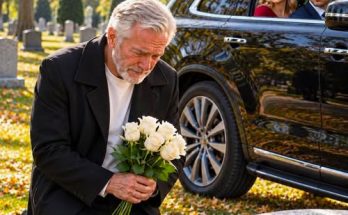
When we reached Eleanor's grave, I set my roses down.
Vanessa knelt and placed hers beside them.
She brushed a small twig away from the stone.
"Hi, Mom," she whispered.
I turned slightly, giving her privacy without leaving.
She stayed there for a while.
When she stood, her eyes were wet.
"I don't know what she would say to me," she told me.
"Neither do I."
"I wish I could ask her."
"So do I."
We stood together without speaking.
The silence did not feel comfortable, but it didn't feel false either.
After a while, Vanessa looked at me.
"I am sorry, Dad."
"I believe that you're sorry."
She waited.
"But being sorry is the beginning," I continued. "It doesn't repair trust by itself."
"I understand."
"I need you to understand that I won't go back to paying for everything or making every decision for you."
"I don't expect you to."
"And I won't interfere with the company's investigation to protect you or Derek."
She nodded slowly.
"I know."
"If you were involved in something, the truth needs to be established. If you weren't, the evidence should show that too."
"I agree."
I studied her face.
I couldn't know whether she fully understood the consequences of what she was saying.
But I could hear that she was no longer asking me to declare everything settled.
That was enough for the moment.
We walked back to the car.
On the way, Vanessa asked about the lake house.
I told her about the small study and the kitchen window.
I told her how the mornings had become my favorite part of the day.
She listened.
When we reached the car, she paused beside the passenger door.
"I remember when Mom used to sit in the passenger seat and tell you to slow down."
"She told me that every time I drove."
"She said you drove as if the road owed you something."
I laughed before I could stop myself.
"That sounds like her."
Vanessa smiled.
For a few seconds, I could almost see the three of us in the old car, before illness and grief and money had changed the shape of our family.
Then the moment passed.
I opened the driver's door.
Vanessa got into the passenger seat.
We drove her back to the apartment, and when I stopped outside, she thanked me again.
"Call me next week," I said. "If you'd like to talk."
"I will."
She closed the door gently.
I watched her walk inside, then drove away.
The visit had not erased the cemetery messages.
It had not answered every question about the money.
But it had allowed us to stand in the same place and tell the truth about what happened there.
For now, that was more than we had managed before.
Click here to continue reading: PART 15: I Could No Longer Measure My Future by What My Daughter Might Need, So I Began Building Something That Would Outlast My Anger
I Thought Visiting My Wife’s Grave Would Be the Hardest Thing I Faced That Day, Until I Read Two Messages
Part 14 of 16