By the time the weather began to soften, I had made a decision about the house.
I would not sell it because Vanessa and Derek thought I should.
I would not keep it simply because I was afraid of letting go of Eleanor.
I would decide what I wanted my life to look like.
That distinction mattered.
For months, I had treated the house as if changing anything about it meant betraying my wife.
The truth was that Eleanor had never asked me to live in a museum.
She had wanted me to keep living.
She had wanted me to make choices that belonged to me.
I began looking at smaller properties.
Not because I had become incapable of managing my home, but because I no longer needed so much space.
The garden required more work than I could comfortably do alone.
The spare bedrooms stood empty.
The kitchen still felt too large for one person.
I wanted somewhere quiet, with enough room for my books and a place to sit outside.
I found a modest house near the lake Eleanor had always loved.
The property was simple.
The rooms were bright, and the garden was small enough to manage without hiring help every week.
From the back windows, I could see the water through a line of trees.
I visited twice before making an offer.
On the second visit, I stood by the fence and watched the wind move across the lake.
I could almost hear Eleanor commenting on the garden.
She would have told me where to plant roses.
She would have complained that the kitchen needed better shelves.
Then she would have smiled and said the place had potential.
I decided to buy it.
The move took several weeks.
I sorted through drawers, old photographs, and boxes we had carried from one house to another for decades.
Some things were easy to give away.
Others took longer.
I kept Eleanor's letters.
I kept the photographs of Vanessa as a child.
I kept the small blue mug with the crack near its handle.
I also kept the white-rose ribbon from the cemetery visit.
I found it in the pocket of the coat I had worn that day.
For a long time, I held it between my fingers.
It was only a narrow strip of ribbon.
But it brought back the cold, the empty parking area, and the messages on my phone.
I considered throwing it away.
Instead, I placed it in a small box with Eleanor's letter.
I did not want to forget what had happened.
I also did not want to spend the rest of my life letting that afternoon define me.
The company continued its work.
The recovery process brought back much of the money through insurance and settlement proceeds.
The remaining issues were handled by the attorneys and the appropriate investigators.
Derek faced an ongoing fraud investigation.
I did not interfere with it.
I did not ask anyone to punish him beyond what the evidence and law warranted.
He had made his choices.
The consequences belonged to him.
Vanessa rented a smaller apartment.
She told me about it during one of our calls.
The place was not as spacious as their previous home, but it was affordable.
She sounded embarrassed.
I told her that there was nothing shameful about living within her means.
She asked whether I could help her buy new furniture.
I said I would consider a specific request, but I would not return to paying for whatever she wanted simply because she asked.
She was quiet for a moment.
Then she said she understood.
I did not know whether she truly did.
But I was learning not to demand immediate proof of change.
I could watch what happened over time.
Our conversations became less frequent but more honest.
Sometimes she called to ask about the business.
Sometimes she asked how I was settling into the new house.
Once, she called to tell me she had found an old photograph of Eleanor in a drawer.
She sent me a copy.
My wife was standing in the garden, holding a pair of pruning shears and laughing at something outside the frame.
I printed the photograph and placed it on a shelf near the window.
For several days, I found myself looking at it whenever I passed.
Vanessa apologized again, this time without asking for anything afterward.
She said she understood why I had stopped offering money whenever we disagreed.
I thanked her for saying so.
I did not tell her that everything was fixed.
It wasn't.
There were still moments when I remembered the cemetery and felt the old hurt rise unexpectedly.
Sometimes it happened while I was driving.
Sometimes it happened when my phone rang and I saw her name.
I had to accept that forgiveness did not erase memory.
It changed what I chose to do with it.
I could listen to my daughter without agreeing to every demand.
I could care about her without funding her lifestyle.
I could hope that she became more honest without pretending that she had already changed.
That was enough for the time being.
The new house gradually began to feel like mine.
I unpacked the books first.
Then the kitchen things.
The blue mug went on the shelf beside the coffee maker.
I replaced the batteries in the kitchen clock and hung it above the stove.
I bought a small table for the garden and placed two chairs around it.
At first, I found myself looking at the empty chair opposite mine.
I would think about Eleanor and the conversations we might have had.
Then I would make coffee, sit down, and let the memory remain without trying to escape it.
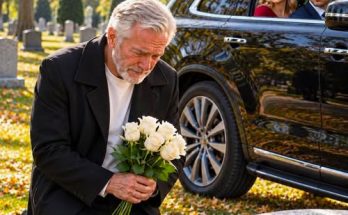
I also began visiting her grave every Sunday.
The drive was manageable.
I could leave when I wanted and return when I was ready.
I no longer needed to ask anyone to take me.
The first Sunday after the move, I bought white roses from a florist near the lake.
I carried them to the cemetery and placed them carefully beside her headstone.
The paper rustled in the wind.
I knelt long enough to straighten the stems.
Then I sat on the bench and told Eleanor about the new house.
I told her about the lake.
I told her that the garden was small and that I had already managed to kill one of the plants.
I could almost hear her laughing.
For the first time in months, I felt something close to peace.
Not happiness without sadness.
Something quieter.
The knowledge that I could miss my wife and still build a life after her.
I stayed for half an hour.
When I stood, my knees complained as usual.
I brushed the dirt from my trousers and looked at the roses.
Then I walked toward the parking area.
My own vehicle was waiting where I had left it.
No one was checking their watch.
No one was sighing because I needed more time.
No one was deciding when I had to leave.
I unlocked the door and sat behind the wheel.
Before starting the engine, I looked once more toward the path leading back to Eleanor's grave.
I thought about the man who had stood there months earlier, holding his phone and trying to understand how his daughter could abandon him.
I wished I could tell him that the pain would not disappear quickly.
I wished I could tell him that he would still miss her, still want her approval, and still wonder whether he had done something wrong.
But I would also tell him something else.
He did not have to earn the right to be treated decently.
He did not have to sign away his home to prove that he trusted his family.
And he did not have to buy love with money.
I started the engine.
The road home was clear.
At the lake house, I made coffee and sat by the window.
The water was gray beneath the afternoon sky.
My phone lay on the table beside Eleanor's letter.
For once, I did not feel compelled to check whether Vanessa had called.
If she wanted to speak, I would listen.
If she needed help, I would consider what I could reasonably offer.
But my life would no longer be organized around preventing her from becoming upset with me.
I had spent years building a company.
I had spent decades loving my wife.
I had raised a daughter whom I still loved, despite what had happened between us.
Those things mattered.
So did my dignity.
I lifted the blue mug and took a sip of coffee.
It was a little too strong.
Eleanor would have told me so.
I smiled at the thought, then set the mug down.
Outside, the wind moved gently through the trees.
I was alone.
But I was no longer waiting for someone else to decide whether I deserved to go home.
Click here to continue reading: PART 9: The First Quiet Sunday at the Lake House Forced Me to Face What I Had Been Avoiding Since Eleanor Died
I Thought Visiting My Wife’s Grave Would Be the Hardest Thing I Faced That Day, Until I Read Two Messages
Part 8 of 16