The final figures took longer to settle than I had hoped.
There were records to reconcile, insurance details to confirm, and settlement terms that had to be documented properly.
I stopped expecting the process to end with one phone call.
When Richard finally told me that the recovery efforts had accounted for much of the money, I was sitting at the kitchen table with a cup of coffee and a stack of scholarship papers.
"Much of it?" I asked.
"Yes. The insurance and settlement proceeds have recovered a substantial portion of the loss."
"And the rest?"
"The company has pursued what it can establish through the available records. Some matters remain unresolved."
I let that sit for a moment.
"Then we keep the records."
"Exactly."
"And the investigation?"
"Derek continues to face an ongoing fraud investigation. The evidence has been provided to the appropriate authorities. Decisions about any charges are theirs to make."
I looked out the window.
The lake was bright that morning, with sunlight breaking across the surface.
"I don't want to interfere with that process."
"You haven't."
"I don't want anyone saying I used my position to decide the outcome."
"Then continue doing what you've been doing. Let the evidence speak for itself."
I thanked him.
After the call, I put the scholarship papers into their folder and returned them to the study.
The company had suffered a serious breach of trust.
But it had continued operating.
The board had strengthened the controls.
The financial records were being handled through the proper channels.
The people who depended on the business had been able to keep doing their jobs.
I could not ask for a perfect ending.
I could ask for a responsible one.
Derek's employment had ended through the formal process.
His access to company systems had been removed.
The company had followed the terms governing the apartment provided as an employment benefit, rather than allowing the arrangement to continue as if nothing had happened.
I did not celebrate any of it.
I had never wanted my daughter's husband to become the subject of a fraud investigation.
I had wanted him to be honest.
That was a smaller wish than it should have been, and a more important one than I had understood.
Vanessa continued living in her modest apartment.
We spoke regularly, though not every conversation was easy.
Sometimes she called to talk about ordinary things.
Sometimes she apologized again for leaving me at the cemetery.
I told her I had heard her apology.
I also told her that trust was rebuilt through what people did after they apologized.
She had begun taking responsibility for her own expenses.
She no longer assumed I would cover every difficulty.
There were still moments when she slipped into old habits.
Once, she began describing a bill she hadn't expected and stopped halfway through.
"I'm not asking you to pay it," she said.
"I didn't think you were."
"I was about to."
"What are you going to do?"
She sighed.
"Adjust my budget. I can manage it."
"Then do that."
"I will."
We finished the conversation without an argument.
It wasn't dramatic.
It was simply a different way of speaking.
I had learned not to turn every small improvement into a promise about the future.
Vanessa was learning that love did not mean unlimited financial support.
I was learning that a boundary did not have to be delivered as a punishment.
We were both late to the lesson.
We were still learning it.
One afternoon, Vanessa came to the lake house for coffee.
She stood on the deck for a while, looking across the water.
"It's peaceful here," she said.
"It is."
"Do you miss the old house?"
"Sometimes."
"Do you regret moving?"
I thought about the rooms Eleanor and I had shared for so many years.
I missed the familiar marks on the doorframe, the kitchen where she had kept her notebooks, and the corner of the living room where she used to sit with a blanket over her knees.
But I did not miss living in a house that had become a museum of the life I had lost.
"I miss parts of it," I said. "I don't regret coming here."
She nodded.
"I'm glad you found somewhere you like."
We drank coffee at the small kitchen table.
Eleanor's blue mug sat beside my hand.
Vanessa noticed it.
"Mom loved that mug."
"She did."
"I remember her getting annoyed when you used it for tea."
"She said it changed the taste."
"She said you changed the taste."
We both laughed.
For a moment, the laughter came easily.
Then Vanessa looked down at her cup.
"I wish I had treated you better."
"I wish you had too."
She nodded.
I didn't rush to tell her that everything was all right.
Everything was not all right.
But we could sit at the same table and speak honestly.
That mattered.
Before she left, she asked whether she could visit again.
"Of course," I said. "Call first."
"I will."
She hugged me at the door.
It was a longer hug than the one we'd exchanged at the café months earlier.
I returned it, then watched her walk to her car.
When she drove away, I didn't feel responsible for what she would do next.
I hoped she would keep building a life she could manage.
I hoped she would continue examining her choices.
I hoped that one day, she would understand that the most loving thing I could do for her was not to remove every consequence from her path.
But those hopes belonged to her future.
I had my own life to tend.
The scholarship in Eleanor's name moved forward.
The administrative arrangements were finalized, and the purpose remained what I had intended from the beginning: helping students who had lost a parent continue their education.
When I read the final description, I thought about Eleanor's words on grief.
You still have to get up, go to class, pay attention, and answer questions.
I imagined a student sitting at a desk, trying to concentrate after a funeral.
I imagined the bills that might arrive while that student was still trying to understand the loss.
A scholarship could not replace a parent.
It could make one part of the road less difficult.
That was enough.
I did not put my name on it.
I wanted Eleanor's name to stand on its own.
She had done enough work in her life without needing me to explain her worth to anyone.
As the weeks passed, Sunday mornings became familiar again.
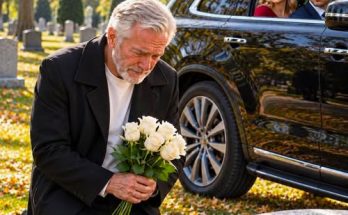
I bought white roses from the same florist.
I drove to the cemetery by myself.
I carried the flowers along the gravel path and placed them beside Eleanor's headstone.
Sometimes I told her about the company.
Sometimes I talked about the scholarship.
Sometimes I said almost nothing.
I had stopped expecting every visit to bring an answer.
The grave was a place to remember her, not a place where I had to prove I had made the right decisions.
One cold Sunday, I arrived before the groundskeeper had finished his rounds.
The sky was pale, and the grass was wet beneath my shoes.
I placed the roses in their holder and brushed a small leaf from the stone.
"Good morning, Eleanor," I said.
The words came easily now.
I told her that the company was still working through the consequences of what had happened.
I told her that much of the money had been recovered through insurance and settlement, while the investigation continued.
I told her Vanessa was living in her own apartment and learning to manage her life.
I told her that our daughter had apologized, and that I had listened.
I didn't tell Eleanor that I had forgiven Vanessa completely.
I wasn't sure that forgiveness could be measured in a single sentence.
I knew only that I no longer wanted to carry anger into every morning.
I could remember what happened without letting it decide everything that came afterward.
I could love my daughter without handing her control of my life.
I could protect the company without seeking revenge.
I could remember my wife without treating grief as a reason to stop living.
The wind moved through the bare branches overhead.
I adjusted one of the rose stems so it would stand upright.
Then I stepped back.
"I miss you," I said.
It was the truest thing I could tell her.
I stayed a little longer before returning to the car.
The path was familiar beneath my feet.
At the parking area, I unlocked my own vehicle and opened the driver's door.
The passenger seat was empty.
The white ribbon from the roses lay in the cup holder, where I had placed it after the flowers were arranged.
I picked it up, folded it neatly, and put it in the console.
Then I sat down and started the engine.
I didn't need to call anyone for a ride.
I didn't need to ask whether I was allowed to leave.
I knew the way home.
As I pulled out of the cemetery, I thought about the man I had been on the day Derek drove away.
He had been hurt, frightened, and angry.
He had also been a man who had spent so long making himself useful that he had forgotten his worth did not depend on what he could give another person.
I wished I could have spared him that afternoon.
I couldn't.
What I could do was keep the promise I had finally made to myself.
I would not buy affection.
I would not surrender my dignity to keep someone comfortable.
I would not mistake being needed for being loved.
And I would not let the worst thing my family had done become the only thing left of my life.
The road curved toward the main highway.
I turned on the heater and settled both hands on the steering wheel.
There would be more ordinary Sundays.
There would be more calls from Vanessa, more company updates, and more work to do on the scholarship.
There would be mornings when I missed Eleanor so sharply that the house seemed too quiet.
I would live through those mornings too.
When I reached the lake, the sun had climbed above the trees.
I parked beside the house and carried the empty flower wrapping inside.
Then I made coffee in Eleanor's blue mug.
I stood at the kitchen window and watched the water move along the shore.
For the first time in a long while, I was not waiting for someone else to decide what happened next.
I had my home.
I had my work.
I had memories I would always carry, and a future I was finally willing to enter.
I was seventy-one years old.
I had lost my wife, nearly lost my trust in my daughter, and learned that even a man who had built a company from nothing could make mistakes in the way he loved his family.
But I was still here.
And when I needed to go somewhere, I could get into my own car, turn the key, and drive myself home.
The End
Read more original stories on Feel Every Story.
I Thought Visiting My Wife’s Grave Would Be the Hardest Thing I Faced That Day, Until I Read Two Messages
Part 16 of 16