I used to believe that if you raised a child with enough love, he would never mistake your kindness for weakness.
At seventy-three, I knew better.
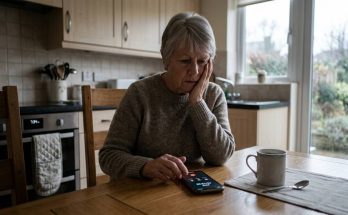
I learned it on a Tuesday morning at 7:15, sitting alone at my kitchen table with a cup of coffee I had barely touched.
My phone lit up beside the sugar bowl.
Vanessa.
My daughter-in-law almost never called that early.
I picked up immediately.
“Vanessa?”
Nothing.
I heard tires rolling over pavement, a radio playing low, and the faint click of something moving inside a car.
Then I heard her voice.
Not the voice she used with me.
This one was sharp, impatient, and entirely free of the sweetness she usually poured over my name.
“Did you bring the folder?”
David answered from the driver's seat.
“It's in the back.”
My son.
I stared at the phone in my hand.
For a moment, I thought about saying something again, just to let them know I was there.
Then Vanessa spoke, and I stayed quiet.
“Please tell me you remembered the brochure, too.”
“It's in the glove compartment.”
“Good.”
She sounded satisfied.
I lowered the phone to the table, keeping the call open.
I was not sure why I did it.
Maybe some part of me already knew that whatever came next would matter.
I reached for the small notepad I kept beside the refrigerator and pulled it toward me.
My husband, Arthur, had always been a man who wrote things down.
Bills. Appointments. Promises.
He used to say that people could argue about what they remembered, but ink had a way of keeping everyone honest.
Arthur had been gone four years.
That morning, I found myself wishing he were sitting across from me.
I clicked my pen.
Vanessa laughed at something David said, though I couldn't make out his words.
Then she said, “You worry too much. She'll sign whatever we put in front of her.”
My pen stopped.
“She always does,” Vanessa continued. “Remember those forms for the flu shots? She didn't even bother reading them.”
My fingers tightened around the pen.
I remembered those forms.
They had visited me after lunch one Sunday, carrying paperwork and talking about how confusing the medical office had made everything.
David had asked me to sign near the little yellow arrows.
I had trusted him.
That was the part I couldn't get past.
Not that Vanessa thought I was foolish.
I had known for years that she considered me old-fashioned, easily distracted, and far too willing to help.
It was hearing my son treated as a partner in the joke that hurt.
I wrote down the time.
7:19.
Then I wrote what I had heard, as closely as I could remember it.
The car continued along the road.
A turn signal clicked several times before Vanessa spoke again.
“What if she decides she wants to read everything first?”
David's answer came after a pause.
“Then what?”
Vanessa sighed as if he had asked her to solve a problem she had already explained a dozen times.
“You take her glasses and say they need cleaning. Honestly, David, sometimes I wonder how you manage without me.”
I looked toward the window above the sink.
The morning light had begun to spread across the counter, touching the little ceramic rooster Arthur had bought me on a trip to the mountains.
Everything in my kitchen looked exactly as it had ten minutes earlier.
The dish towel hung beside the oven.
The clock ticked.
My coffee was cooling.
But something had changed, and I could feel it in my chest.
I wrote another line.
Then Vanessa mentioned the brochure.
“Oak Grove Village,” she said. “My cousin says the place is lovely, and we can get the family rate.”
David made a sound that might have been agreement.
Then they both laughed.
I had heard of Oak Grove Village.
I knew it was a place where older people could live with assistance, though I had never considered moving there.
I was comfortable in my own home.
I had neighbors who knew me, a garden I still tended, and a kitchen where I could find every utensil without looking.
I could climb my stairs.
I could drive to the grocery store.
I could manage my own money.
There had been no conversation about moving.
No discussion about what kind of help I might need.
No doctor telling me I couldn't live alone.
Yet my son and his wife were driving toward my house with a brochure and a folder, discussing where I would live as though I had already agreed.
I kept writing.
At 7:24, David's voice changed.
It became quieter.
“Doesn't this seem a little fast?”
I closed my eyes.
There he was.
For one small moment, I heard the boy who used to come into my bedroom after a bad dream, carrying his blanket and asking if he could sleep beside me.
I remembered the weight of his little hand in mine when we crossed streets.
I remembered Arthur teaching him to ride a bicycle while I stood nearby, frightened he would fall.
My son had always been a cautious person.
He was not cruel by nature, or so I had believed.
Maybe that was why his next words hurt more than Vanessa's had.
She answered him without hesitation.
“Fast? We've been paying for that house for four years.”
I opened my eyes.
The pen moved again.
We've been paying for that house.
I read the words after I wrote them, then drew a line beneath them.
Because there was something wrong with that statement.
Something so wrong that, for several seconds, I wondered if I had misunderstood her.
Nobody had been paying for my house.
Not David.
Not Vanessa.
Not anyone.
Arthur and I had paid off the mortgage in 1998.
I remembered the afternoon we received the final paperwork. Arthur had brought home a bottle of sparkling cider, because we had promised ourselves we would celebrate when the house was ours outright.
We had sat at this same table.
He had raised his glass and said we could finally stop sending money to the bank.
I still had the house.
Every room.
Every door.
Every shingle on the roof.
I had paid the taxes, the insurance, and the repairs from my own accounts.
David and Vanessa had never paid a mortgage installment for me.
What they had received was something else entirely.
Four years earlier, when the twins were born, David had called me late one evening.
He sounded exhausted.
Their rental house was too small, and the expenses were piling up faster than they could manage them.
They needed somewhere more suitable.
They needed money for a deposit, moving costs, furniture, and the other things young parents seemed to need all at once.
I had listened.
Then I had withdrawn forty thousand dollars from my savings and given it to them.
I didn't call it a loan.
I didn't ask them to pay me back.
They were my son, my daughter-in-law, and my grandchildren.
I wanted them to have a stable home.
I wanted David to sleep at night without worrying about money.
At the time, he had hugged me so tightly that my feet nearly left the floor.
“Mom, I don't know what we'd do without you.”
I had believed him.
Now Vanessa was talking as though that gift had somehow turned into a debt I owed them.
I wrote down the time again.
7:26.
The car kept moving.
And I began to understand that the folder on the back seat was not an ordinary family document.
Click here to continue reading: PART 2: The Forty Thousand Dollars I Gave My Son Had Become a Debt in Someone Else’s Mind
The Morning I Learned What My Son and His Wife Really Thought I Was Worth
Part 1 of 12