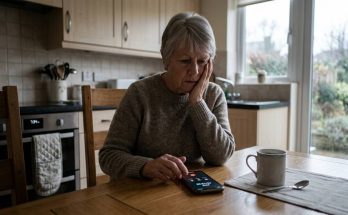
I stood in the kitchen for a long time after they left.
The visitor remained with me for a little while.
He asked whether I was all right, and I told him I was.
It was only partly true.
I was relieved that the papers had not been signed.
I was grateful that I had not been left alone to handle the conversation.
But the relief came with a heaviness I could not shake.
David was my only son.
I had loved him before I knew what his face would look like, and I had spent my life trying to give him a good start.
I had never expected him to be perfect.
I had expected him to remember that I was a person, not a problem he and his wife could solve between themselves.
The visitor gathered his folder.
“You did the right thing by speaking up.”
I nodded.
I wasn't sure I believed him.
Speaking up had been necessary, but that didn't make it easy.
I had spent the morning hearing things I could never unhear.
I had watched my son struggle to look at me.
I had watched Vanessa lose the confidence she had carried into my kitchen.
And I had learned how little it might have taken for them to get what they wanted.
A few papers.
A few reassuring words.
A pen placed near my hand.
I thanked him for coming.
He told me to call if I needed anything else, then left.
After the door closed, I returned to the kitchen.
The notepad was still beside my chair.
I opened it to the page where I had recorded the call.
The handwriting looked different now.
At 7:19, I had written about the glasses.
At 7:21, I had recorded the name of the residence.
At 7:26, I had written down what Vanessa said about selling the house.
At 7:31, I had recorded David's agreement to act sad.
I read the last line twice.
Then I closed the notepad.
I didn't want to spend the rest of my life reading those words.
But I would keep them.
I had learned something important that morning.
Memory could soften a painful moment.
Love could make a person search for kinder explanations.
A written record could remind me that what happened had happened, even if someone later tried to describe it differently.
I put the notepad in the drawer where I kept household documents.
Then I carried the cups to the sink.
I washed them one at a time.
The porcelain was warm beneath the water, and the blue rims caught the light when I turned each cup in my hands.
I dried them carefully and returned them to the cupboard.
The fourth cup went on the same shelf as the others.
I didn't put it away separately.
It belonged with them.
I thought about that as I closed the cupboard door.
There were things I could not change about what had happened.
I could not make David choose differently that morning.
I could not make Vanessa feel remorse.
I could not go back and see every earlier moment clearly enough to know when their attitude toward me had changed.
But I could decide what I would do next.
I could stop confusing help with obligation.
I could stop assuming that because I had given freely once, I had to keep giving whenever someone asked.
And I could refuse to let anyone make decisions about my life without me.
I went to the front window.
The street had returned to its usual quiet.
A neighbor was collecting a newspaper from the driveway.
A car passed slowly, then turned at the end of the block.
Nothing about the neighborhood looked different.
My house looked the same as it had when I woke that morning.
The front steps were solid.
The windows were clean.
The roof was intact.
The stairs inside were still the stairs Arthur and I had walked up and down for decades.
I had bought curtains for the living room with him.
We had argued over the color of the kitchen cabinets.
We had painted the spare bedroom before David was born, then changed it again when he grew older.
Every room carried some part of our life.
The house was not merely a number Greg had offered.
It was not a source of money for a holiday or a boat.
It was the place where Arthur had grown ill, where I had cared for him, and where I had learned to live without hearing his footsteps in the hall.
I was not ready to leave it.
I might never be.
If a day came when I wanted help, I would ask for it.
If a day came when the stairs became too difficult, I would consider my options.
If I ever chose to move, the choice would be mine.
I returned to the kitchen and made another cup of coffee.
This one I drank while it was hot.
My phone sat beside the sugar bowl.
I looked at it several times, expecting David to call.
He didn't.
I couldn't decide whether I was disappointed or grateful.
Part of me wanted him to call immediately and apologize.
Another part of me knew that an apology made out of panic would not answer the questions that mattered.
I wanted him to understand what he had done.
I wanted him to understand that I had not been hurt merely because he had agreed with Vanessa.
I had been hurt because he had allowed himself to treat my trust as something he could use.
That was a different kind of wound.
I thought about the twins again.
I hoped they would never learn to believe that love meant doing whatever the strongest person in the room demanded.
I hoped they would grow up knowing that a gift was a gift, not a contract for future obedience.
I hoped they would understand that being old did not make a person less entitled to dignity.
Those hopes were not things I could guarantee.
All I could do was live by them myself.
I finished my coffee and rinsed the cup.
Then I took the grocery notepad from the drawer and opened it to a clean page.
I wrote down the date.
Underneath it, I made a short list of things I needed to do around the house.
Buy milk.
Call Martha.
Water the plants.
The ordinary tasks steadied me.
They reminded me that my life was still happening, even after the morning had divided it into before and after.
I did not write down what I wanted David to say.
I did not write down what I hoped Vanessa might feel.
I couldn't control either of those things.
Instead, I wrote one sentence at the bottom of the page.
I would not sign anything I had not read, and I would not agree to anything I did not want.
I looked at the sentence for a moment.
Then I underlined it once.
The pen left a dark line beneath the words.
I closed the notepad and put it back in the drawer.
Outside, the afternoon light had begun to soften.
I went upstairs, one step at a time, not because I needed to prove I could climb them, but because I had lived in that house long enough to know every creak beneath my feet.
At the top, I paused beside the bedroom door.
Arthur's photograph sat on the dresser.
I picked it up and brushed a speck of dust from the frame.
“You would have had something to say about this,” I told him.
I could almost imagine his answer.
It would not have been a long speech.
Arthur rarely needed one.
He would have asked whether I was safe, whether I had protected myself, and whether I planned to let David's mistake become the whole story of my life.
I set the photograph back in its place.
“No,” I whispered.
I wasn't going to let it become the whole story.
My son had disappointed me.
His wife had shown me what she thought of me.
But I was still Evelyn.
I was still seventy-three.
I still owned my home.
And I still had the right to decide what happened inside it.
That evening, I sat at the kitchen table again.
The same table.
The same sugar bowl.
The same small notepad beside my hand.
At five o'clock on Sunday, David would usually call and talk to me for eleven minutes.
It wasn't Sunday, and I didn't know when he would call next.
For once, I wasn't going to measure our relationship by the length of a conversation or the regularity of a phone ringing.
I would listen when he was ready to speak honestly.
I would decide what I could forgive when I understood what he was willing to take responsibility for.
Until then, I had a home to care for and a life that still belonged to me.
I turned off the kitchen light and went upstairs.
The house settled around me, familiar and quiet.
For the first time that day, I felt something close to peace.
Not because everything had been repaired.
Because I had finally stopped pretending that nothing was broken.
Click here to continue reading: PART 9: The Next Sunday Came Without an Apology, and I Finally Understood What Our Eleven-Minute Calls Had Been Hiding
The Morning I Learned What My Son and His Wife Really Thought I Was Worth
Part 8 of 12