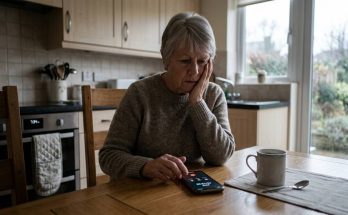
Martha came by the following afternoon.
She carried a small container of soup and set it on my kitchen counter.
“I made too much.”
I looked at the container.
“You always make too much.”
“That's why I have neighbors.”
She took off her coat and sat down.
For a while, we talked about ordinary things.
Her garden needed attention.
My zucchini plants had begun to look tired.
A family down the street had put their house up for sale.
Then Martha looked at me.
“How are you really doing?”
I considered telling her I was fine.
It was the answer I had given people for most of my adult life.
Instead, I sat down across from her and told the truth.
“I'm hurt.”
She nodded.
“I would be too.”
I looked at the table.
The ring from Vanessa's cup had been wiped away, but I could still remember where it had been.
“I keep thinking about the forty thousand dollars.”
Martha folded her hands.
“The money you gave David?”
“Yes.”
“I remember when you did that.”
She had been the first person I told after I transferred the money.
I had been happy for David and Vanessa.
I had wanted them to have a home where the twins could grow up without worrying about another move.
Martha had told me I was generous.
I had laughed and said that was what mothers did.
Now the memory had become tangled with everything I had heard on the phone.
“I don't regret helping them,” I said. “I regret that I never thought I might need to protect myself from them.”
Martha leaned forward.
“Those are two different things, Evelyn.”
I looked at her.
She repeated it.
“You can be glad you helped your son and still be angry about what he did afterward.”
I let that settle.
It was a simple distinction.
I had spent days treating the two feelings as if they had to cancel each other out.
If I was angry, perhaps the gift had been a mistake.
If I wasn't sorry about the gift, perhaps I had no right to complain.
Martha made it clear that neither conclusion was necessary.
I could love David.
I could be proud of the man he had been in better moments.
I could remember the little boy who had ridden his bicycle down our street.
And I could still hold him responsible for the way he had treated me.
I looked at Martha's hands.
They were older than they had been when we first became neighbors.
So were mine.
We had spent four decades watching one another move through the ordinary stages of life.
We had seen children grow up, marriages change, parents die, and houses fill with grandchildren.
We had also watched people become accustomed to being the ones who helped.
Sometimes the people receiving the help forgot that the person giving it had needs of her own.
Martha seemed to understand that without my having to explain it.
After a while, she asked whether I wanted to go through the notes I had written down.
I shook my head.
“Not today.”
“Then don't.”
She reached for the container of soup and opened it.
“Eat something before you start worrying again.”
I laughed.
It was the first real laugh I had managed in days.
We ate at the kitchen table.
The soup was simple, with carrots, potatoes, and enough pepper to make my nose run.
Martha complained that she had put in too much salt.
I told her I liked it.
We talked about the old days.
She remembered David learning to ride his bicycle.
She remembered Arthur standing in the driveway with his hands on his hips, pretending not to be frightened while our son wobbled down the street.
We both laughed at the memory.
Then Martha grew quiet.
“Arthur would have hated what happened.”
I looked toward the photograph on the dresser in the next room.
“Yes,” I said. “He would have.”
“But he would have wanted you to stand up for yourself.”
I nodded.
Arthur had never believed that loving someone meant allowing them to do whatever they pleased.
He could be stubborn, and he was not always right.
But he had understood that respect mattered most when a person was tempted to ignore it.
I had understood that in theory.
I had not always practiced it with my own family.
After Martha left, I washed the bowls and put the remaining soup in the refrigerator.
Then I took the notepad from the drawer.
I didn't reread the whole page.
Instead, I turned to a clean sheet.
I wrote down the questions I wanted answered if David and Vanessa ever returned to discuss the matter honestly.
Had they contacted anyone about selling my house?
Had they made arrangements with Greg beyond the visits I already knew about?
Had they done anything with the documents they had brought?
I didn't know the answers.
I wasn't going to invent them.
I simply wanted to ask.
Then I wrote another line.
No decisions without my consent.
I underlined it.
The phrase looked plain on the page.
It wasn't a legal document or a promise from anyone else.
It was a boundary I could enforce myself.
I could refuse to sign.
I could ask for time to read.
I could take advice before making an important decision.
I could say no without apologizing for it.
The next morning, I placed the notepad beside the telephone.
I made breakfast, watered the plants, and went about my day.
For the first time since Tuesday, I wasn't waiting for the next thing to happen.
I had begun to understand that I could not control whether David became the son I hoped he would be.
I could control how much access I gave him to decisions that belonged to me.
That was not the same as abandoning him.
It was simply refusing to abandon myself.
Click here to continue reading: PART 11: When David and Vanessa Finally Came Back, I Refused to Let Concern Stand in for an Honest Answer
The Morning I Learned What My Son and His Wife Really Thought I Was Worth
Part 10 of 12