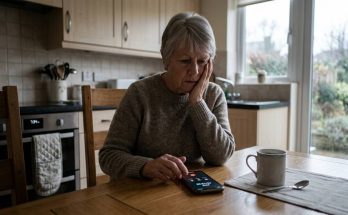
The phone rang at five the following Sunday.
I was sitting at the kitchen table, peeling an apple over a small plate.
David's name appeared on the screen.
For years, I had treated that call as a promise.
No matter how busy he was, no matter what was happening with the twins or Vanessa, he called his mother on Sunday evening.
Five o'clock.
Eleven minutes.
Sometimes he asked about the garden.
Sometimes he told me the children had been doing well at school.
Occasionally, he mentioned work, though he rarely spoke about anything difficult.
I had never complained about the short calls.
I had told myself that a busy son was better than an absent one.
I wiped my fingers and answered.
“Hello, David.”
“Hi, Mom.”
His voice sounded normal.
That was what hurt.
There was no hesitation, no awkward attempt to explain Tuesday morning, no sign that he had spent the week thinking about the folder on my table.
“How have you been?”
“I'm doing all right.”
“How's the house?”
I looked toward the doorway leading to the living room.
“Still standing.”
He gave a small laugh.
I didn't join him.
There was a pause.
Then he asked whether I had seen the twins' latest school pictures.
Vanessa had sent them to me a few days earlier.
I told him I had.
We talked about their clothes, their haircuts, and how quickly they seemed to be growing.
I asked whether they were enjoying school.
He said they were.
The conversation continued along the same familiar path.
Nothing was wrong.
Nothing had happened.
At least, that was the version of our relationship David seemed to prefer.
I glanced at the clock.
Five minutes had passed.
I wondered whether he would mention the morning at my house before the eleven minutes were over.
He asked whether I needed anything from the grocery store.
“No, thank you.”
“Are you sure?”
“Yes.”
Another pause.
I could hear something in the background, perhaps the television.
Then David said he needed to get going.
I looked at the clock again.
Ten minutes and forty seconds.
I had almost laughed at the precision.
Even now, he was keeping to the schedule.
“David?”
“Yeah, Mom?”
“Have you thought about what happened on Tuesday?”
The line went quiet.
I heard a breath.
Then he said, “I knew we'd have to talk about that.”
“Did you?”
“Yes.”
“When?”
He didn't answer.
I waited.
Finally, he said he had been busy.
Work had been demanding.
The children needed things.
Vanessa had been upset.
There had been a lot to deal with.
I listened until he ran out of explanations.
Then I asked him a simple question.
“Do you think what you did was wrong?”
He sighed.
“Mom, I know it looked bad.”
I closed my eyes.
That was not what I had asked.
“I didn't ask how it looked.”
“I know.”
“Then answer me.”
He went quiet again.
I could picture him sitting somewhere with his phone against his ear, looking for the right words.
Perhaps Vanessa was nearby.
Perhaps she wasn't.
I couldn't know.
At last, he said, “I shouldn't have agreed to the plan without talking to you first.”
I looked down at the apple peel curled beside my plate.
It was an answer, but not the whole answer.
“What about the papers?”
“I shouldn't have put you in that position.”
“And the glasses?”
He didn't respond immediately.
“I didn't think she would actually do that.”
“But you heard her say it, and you agreed to go along with the plan.”
“I know.”
I rubbed my thumb along the edge of the plate.
“David, if I hadn't answered that call, what would have happened?”
His breathing changed.
“I don't know.”
I believed him.
That was the frightening part.
He had not thought about the consequences because he had assumed I would cooperate.
He had assumed I would trust him.
He had assumed that my love would carry him past the point where his own conscience should have stopped him.
I had helped create that expectation.
Not the plan itself.
That belonged to him and Vanessa.
But I had spent years teaching him that I would smooth over almost anything if he sounded sorry enough.
I had made it easy for him to avoid difficult conversations.
That realization did not excuse him.
It did explain why I needed to change my own behavior.
“I'm not asking you to agree with every decision I make,” I said. “I'm asking you to remember that the decisions about my life belong to me.”
“I understand, Mom.”
“Do you?”
“Yes.”
I let the silence remain between us.
I wanted to believe him.
I also knew that understanding something during an uncomfortable phone call was not the same as living by it.
David cleared his throat.
“Can we just move forward?”
I looked at the notepad in the drawer.
The page with the nineteen minutes of notes was still there.
“Moving forward doesn't mean pretending it didn't happen.”
“I didn't mean that.”
“Then what did you mean?”
He didn't answer.
The eleven minutes were almost over.
For once, I didn't feel compelled to rescue the conversation.
“I love you, David,” I said.
“I love you too, Mom.”
“But I need you to understand that loving you doesn't mean I'll let you make decisions for me.”
He was quiet.
Then he said he understood.
We ended the call a few seconds later.
I put my phone down beside the sugar bowl.
I didn't cry.
I wasn't angry in the way I had been on Tuesday.
I was tired, and I was beginning to accept that my son might need more than one conversation to understand what he had done.
I finished peeling the apple.
Then I ate it slowly at the kitchen table.
The next Sunday would come.
I would answer if I wanted to.
But the eleven minutes would no longer be proof that everything between us was fine.
Click here to continue reading: PART 10: Martha Came Over With Her Phone, and the Two of Us Talked About the Things We Had Spent Years Ignoring
The Morning I Learned What My Son and His Wife Really Thought I Was Worth
Part 9 of 12