Two days later, Callum called while I was putting away clean laundry.
I finished folding the towel in my hands before answering.
"Hi, Mom."
"Hello."
"Have you got a minute?"
"I do."
He sounded more serious than he had during our last conversation.
"We've finished going through the extra expenses."
I sat on the edge of the bed.
"All right."
"Tessa wanted to make sure we had the numbers right."
I waited.
He told me they'd reviewed the payments for childcare, delivery assistance, and meals they'd bought instead of preparing at home.
There were also transportation costs connected to rearranging the children's activities and getting bakery items where they needed to go.
"We added everything up," he said.
"And?"
He paused.
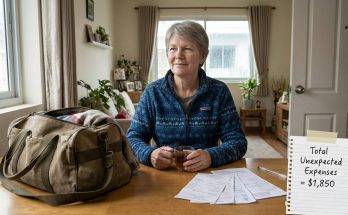
"It comes to almost eighteen hundred and fifty dollars."
I looked at the folded towel in my lap.
For a moment, I didn't say anything.
The amount was large enough to matter to their household.
It was also small enough that they might have avoided noticing it if they'd continued treating my work as something that didn't belong in a budget.
"That's a lot of money," I said.
"It is."
"Can you manage it?"
"We'll have to."
I heard a chair move on his end of the call.
"Tessa's upset about how quickly the expenses piled up."
I understood that.
Money could disappear through a series of ordinary decisions.
A few hours of childcare.
A delivery that needed covering.
Dinner bought because everyone was too tired to cook.
None of those costs looked enormous alone.
Together, they became difficult to ignore.
"Did you know how much time I'd been spending on those things?" I asked.
"Not really."
"You knew I was doing them."
"Yes."
"But you didn't think about what it would cost to replace them."
He took a breath.
"No. We didn't."
I put the towel on the bed beside me.
"That's what the budget missed, Callum. It treated my time as if it didn't have any value."
"I know that now."
I wanted to believe him.
I also knew that understanding something in a difficult week didn't guarantee a person would remember it when life became easier.
"Your father and I used to talk about money all the time," I said.
Callum was quiet.
"Not because we wanted everything to have a price. We wanted to know what we could afford and what we couldn't."
I looked at the doorway.
"When we needed help, we asked. When someone did something for us, we thanked them. We tried not to confuse love with an unlimited supply of labor."
"I wish I'd remembered that."
"So do I."
He let out a long breath.
"Tessa wants to talk to you about the amount."
I felt my shoulders tighten.
"Why?"
"She thinks you should know what the extra help has cost."
"I understand the expenses. But I didn't ask you to pay me."
"I know."
"And I'm not asking for the money."
"I know that, too."
I waited.
He continued.
"We thought it was important for you to understand that we finally see what your help was worth."
That sentence stayed with me.
Not because I needed my son to calculate a price for every meal I'd cooked.
Because I'd spent six weeks doing work that everyone depended on, while the family budget recorded my contribution as nothing.
I had begun to doubt my own sense of proportion.
Maybe I was too sensitive.
Maybe I should have been more patient.
Maybe it was unreasonable to expect recognition for helping my son.
The numbers hadn't created the problem.
They had simply made it harder to pretend the problem didn't exist.
"I'm glad you understand it now," I said.
Callum's voice softened.
"I really am sorry."
"I know."
We talked a little longer.
He told me the children were doing well, and I told him I would call them that evening.
When we hung up, I finished putting away the laundry.
Then I sat at the kitchen table with my tea.
I thought about the twenty-four lunchboxes I'd assembled for the bakery preview.
I remembered the warm kitchen, the unfinished food containers, and the applause I'd heard through the online video.
Maris had received a consulting fee because her work was recognized as work.
I had been given another assignment because mine was called help.
The difference wasn't that one of us had worked harder.
The difference was that one of us had an agreement.
I had never asked for one.
I had assumed my family would notice when I was tired.
I had assumed they would ask before making plans for me.
I had assumed that being loved meant I wouldn't need to explain the value of my time.
Those assumptions had been expensive.
Not just for them.
For me, too.
That afternoon, Tessa called.
I nearly let the phone ring, but I answered.
"Hello, Tessa."
"Hi, Lenora."
She sounded hesitant.
"Callum told you about the expenses?"
"He did."
"We went through everything carefully."
"I understand."
She paused.
"The total was higher than we expected."
I could hear papers moving in the background.
"We had to arrange childcare at short notice. And the bakery deliveries were harder to cover than we thought. There were also several evenings when we ended up buying dinner because we couldn't get home in time."
"I see."
"We're not blaming you for any of that."
I appreciated the clarification.
"Good."
Another pause followed.
"I wanted you to know that we understand now why you were so tired."
I looked at the kitchen window.
The little plant on the sill had grown a new leaf.
"I was tired because I was doing too much," I said. "And because I didn't feel I could say no without disappointing everyone."
Tessa was quiet.
"I didn't mean to make you feel that way."
"I believe you."
I let the silence remain.
Then she said, "When I told you that it was my house and my business, I was trying to get you to understand that I had to make the decisions."
I remembered her standing across the granite island.
Her voice had been calm.
Her words had been clear.
I had nodded because she was right about one thing.
It was her house.
Her children.
Her business.
But the responsibility that came with those things belonged to her and Callum.
"I understood that," I told her. "I just decided to take you at your word."
She exhaled.
"I see that now."
I wasn't sure she did.
But she was at least willing to talk about it.
"I don't want us to be distant," she said.
"Neither do I."
"I want the children to have you in their lives."
"They have me in their lives, Tessa. I'm not going anywhere."
"Then what do we do?"
I thought for a moment.
"We start by asking instead of assuming. And we accept the answer, even when it isn't the one we hoped for."
She didn't respond immediately.
Finally, she said, "All right."
It wasn't a dramatic reconciliation.
There were no tears or promises that everything would be different from then on.
But she had listened.
I took that for what it was.
After the call, I went into the living room and picked up the paperback novel.
I had finished it the previous evening.
I turned it over in my hands and smiled at the blue bookmark tucked inside.
For weeks, that book had been a reminder of all the things I'd intended to do but hadn't had time for.
Now it was simply a finished book.
I placed it on the shelf beside Ray's old collection of mysteries.
Then I called Ruth and told her I was ready for the next book club selection.
We talked about meeting times, snacks, and which members were likely to arrive early.
Ordinary things.
My things.
That evening, Callum sent me a message confirming our visit with the children for the following Thursday.
He asked whether the time worked for me.
I checked the calendar and replied that it did.
Then I put my phone away.
The extra expenses had reached almost $1,850.
The figure mattered because it showed what happened when the work I had been doing for free had to be covered by paid services and other household spending.
But it wasn't a bill I intended to send my son.
It wasn't a punishment.
It was information.
I hoped my family would remember it the next time they were tempted to put my name beside a task without asking.
I hoped I would remember it, too.
Because I had a responsibility in this.
I couldn't control whether other people valued my time.
I could control whether I gave it away without limits.
I took the blue notebook from the table and opened it to a clean page.
I wrote the date.
Then I wrote, "Nearly $1,850."
Underneath, I added one more sentence.
The cost became visible when I stopped hiding it.
I closed the notebook.
For once, I didn't feel the need to explain the words to anyone.
Click here to continue reading: PART 11: My Son Finally Understood That I Had Not Abandoned His Family, but I Could No Longer Prove My Love by Exhausting Myself
I Thought Helping My Son’s Family Would Bring Me Closer to Them, Until a Calendar Began Treating My Time as Their Property
Part 10 of 12