The day I took June and Micah to the park, I arrived at Callum's house a few minutes before the time we'd agreed on.
I rang the doorbell.
Callum opened the door with his car keys in one hand.
"Ready?"
"Almost," he said. "They're putting on their shoes."
I stepped inside and waited near the entryway.
I didn't head into the kitchen to see whether anything needed doing.
I didn't check the calendar.
I didn't ask if someone needed a package collected on the way back.
I was there to spend an afternoon with my grandchildren.
That was the plan.
June came down first, carrying a small backpack.
Micah followed, hopping on one foot while trying to pull his other shoe into place.
Callum crouched to help him.
I watched them together.
There had been a time when I would have stepped forward automatically.
I would have tied the shoe, found the missing jacket, and made sure everyone had everything they needed.
That afternoon, I let Callum handle it.
He was perfectly capable.
When the children were ready, he handed me the backpack.
"There's water and a snack inside."
"Thank you."
He looked at me.
"Have a good time."
"We will."
June took my hand, and Micah ran ahead toward the car.
The park was busy but not crowded.
We walked along the path, watched a group of ducks near the pond, and found a bench where the children could eat their snacks.
June talked about a classmate who had been learning to draw animals.
Micah insisted that the ducks were following him.
I listened.
I laughed.
I took a photograph of the three of us with the pond in the background.
For once, I wasn't thinking about what else I needed to do before the day ended.
I was simply there.
When I returned the children to Callum's house, Tessa was home.
She thanked me for taking them out.
Then she asked whether I wanted to stay for dinner.
I considered it.
"Not tonight, thank you. I've got things to do at home."
She nodded.
"All right."
There was no argument.
No sigh about how difficult the evening would be.
No suggestion that I should change my plans because the family needed me.
I drove home before sunset.
The house was cool when I entered, so I turned on the lamp in the living room.
I put my keys on the counter and took the blue notebook from beside the fruit bowl.
I wrote down the afternoon at the park.
June's stories.
Micah's ducks.
The photograph.
Then I closed it.
The notebook had started as a way to prove to myself that I was exhausted for a reason.
It had become a reminder that my time belonged to me, too.
I didn't need to fill every page.
I didn't need to document every favor.
I simply needed to notice when I was agreeing to something I didn't want to do.
The following week, Callum invited me to dinner.
I accepted.
When I arrived, the kitchen was busy, but I didn't automatically take over.
Tessa was preparing food.
Callum was helping the children set the table.
I sat in the living room and talked with June until they called us to eat.
The meal was ordinary.
Someone spilled water.
Micah complained about the vegetables.
June told a long story that became confusing halfway through.
We laughed.
After dinner, I helped carry my own plate to the sink.
Tessa thanked me.
Then she finished cleaning up with Callum.
I went home feeling something I hadn't felt in that house for a long time.
Like a guest who was welcome.
Not a worker who was expected.
A few days later, Callum called to ask whether I could help with the children on a Saturday afternoon.
He told me the hours and explained why they needed the help.
I checked my calendar.
I already had plans with Ruth.
"I'm sorry, Callum. I can't that afternoon."
He paused.
"Okay. We'll make another arrangement."
That was all.
No guilt.
No argument.
No attempt to make me feel responsible for whatever inconvenience followed.
I sat quietly after the call ended.
It was such a small exchange that someone else might not have remembered it.
I did.
For years, I had thought a refusal would cause a problem that only I could solve.
Now my son was finding another solution.
The world had not ended.
The family had not fallen apart.
They had simply made a different plan.
The next time I visited, Callum told me they'd arranged a regular childcare service for the hours when neither he nor Tessa could be available.
It cost money.
They had to adjust their budget to accommodate it.
But they had also begun planning their work schedules more carefully.
Tessa had changed some of the bakery delivery arrangements, too.
"We're learning to plan ahead," Callum said.
I smiled.
"That sounds sensible."
He laughed.
"We should have done it earlier."
"Yes."
I didn't say it to make him feel bad.
I said it because it was true.
He nodded, accepting the answer.
Then he asked whether I wanted to see the latest photograph of the children from school.
We spent the next few minutes looking at pictures on his phone.
There was no need to turn the conversation into another lesson.
The lesson had already begun to take hold.
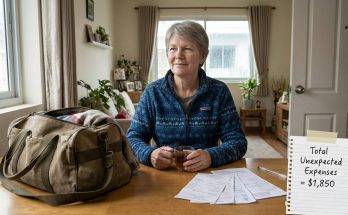
By then, the nearly $1,850 in extra expenses had become part of a larger conversation in the family.
It was the amount they'd calculated after replacing some of the work I'd done during those six weeks.
The childcare.
The deliveries.
The meals.
The other practical things that had once happened without appearing as separate costs.
They hadn't paid me that money.
I hadn't asked them to.
That had never been the point.
The figure mattered because it showed what the household had depended on without properly acknowledging it.
But it wasn't a complete measure of my contribution.
It couldn't count the hours I'd spent waiting for appointments.
It couldn't account for the book I'd carried around unread.
It couldn't put a price on the coffee I'd canceled with Ruth or the feeling of waking up every morning already behind.
And it couldn't measure the quiet hurt of hearing my son admit that he had delayed asking me about December because he thought I might say no.
I didn't want those things converted into an invoice.
I wanted them understood.
Slowly, they were beginning to be.
One afternoon, Tessa and I sat together while the children played in the next room.
She had brought over a container of pastries from the bakery.
I made tea.
For a while, we talked about ordinary things.
Then she said, "I've been thinking about the way I spoke to you that day."
I set my cup down.
"I remember."
"I was wrong to speak to you as if you had to do what I said just because you were staying in our house."
I looked at her.
She seemed uncomfortable, but she continued.
"I should have remembered that you were helping us. You weren't our employee, and you weren't obligated to keep doing more."
I let the words settle.
"Thank you," I said.
She looked toward the doorway.
"I don't want you to feel that you can't tell us no."
"Then you have to let me say no without making me defend it."
She nodded.
"I can do that."
I hoped she would.
We didn't hug dramatically or pretend that the past six weeks had never happened.
We finished our tea.
Then June came in and asked if she could have another pastry.
Tessa told her she could have one small piece.
Micah appeared behind her, hoping the answer would be different for him.
For a moment, everything felt ordinary again.
I liked that.
The relationship didn't need a grand ending.
It needed room to become something healthier.
As the months continued, I kept my own routine.
I attended book club.
I went to the grocery store when I needed groceries.
I read in the evenings.
I called my grandchildren because I wanted to hear their voices, not because I needed to check whether someone had arranged their afternoon correctly.
Sometimes I helped Callum and Tessa.
Sometimes I couldn't.
When I could help, I chose what worked for me.
When I couldn't, they made other plans.
That was what family should have looked like all along.
I still had moments of guilt.
If Callum sounded tired on the phone, I sometimes wanted to offer to take something off his hands.
If Tessa mentioned a busy weekend at the bakery, I sometimes remembered how easily I could run an errand or prepare a meal.
The old habits didn't disappear overnight.
But I had learned to pause before offering.
I asked myself whether I genuinely wanted to do the task.
I considered how much time it would take.
I thought about the plans I already had.
Then I answered honestly.
Sometimes the answer was yes.
Sometimes it was no.
Neither answer changed how much I loved them.
One evening, I sat at my kitchen table with the blue notebook open beside my tea.
The first pages were crowded with lists from those six weeks.
School pickups.
Meals.
Laundry.
Bakery errands.
Appointments.
The handwriting grew smaller toward the bottom of each page, as though I had been trying to fit more work into less space.
I turned to the last filled page.
Then I looked at the clean pages that followed.
I didn't need to erase the old entries.
They reminded me how easily I had allowed my own life to disappear behind everyone else's needs.
But I didn't need to keep adding to them.
I closed the notebook and placed it in the drawer beside the table.
The hallway clock ticked.
The refrigerator hummed.
I washed my cup and turned off the kitchen light.
Then I went upstairs, where the paperback novel sat on my bedside table beside the blue bookmark.
I picked it up and began reading.
The house was quiet, just as it had been before I went to Callum's.
But I no longer heard that quiet as proof that I wasn't needed.
I heard it as space.
Space to rest.
Space to make plans.
Space to be a mother and a grandmother without surrendering every part of myself to those roles.
I had left my son's house because I finally accepted the responsibility he and Tessa had placed before me.
Their home was theirs.
Their children were theirs to raise.
Their bakery was theirs to manage.
I could love them through all of it.
I could help when I chose to help.
But I could no longer make their lives work by pretending my own didn't matter.
The nearly $1,850 they spent after I left was real money.
It showed them what some of my unpaid work had been worth in practical terms.
The greater cost had been harder to calculate.
It was the time I had given away without being asked.
It was the resentment I had hidden behind a smile.
It was the distance that grew when I felt useful but not respected.
And it was the trust that had to be rebuilt once I stopped saying yes.
I was glad we had found a better way forward.
I was glad my grandchildren still reached for my hand.
I was glad my son had begun to understand that asking for help was different from planning someone else's life.
Most of all, I was glad I had returned home before I lost the ability to recognize my own needs.
I turned another page in my book.
For the first time in a long while, I wasn't waiting for the next person to need me.
I was simply living.
The End
Read more original stories on Feel Every Story.
I Thought Helping My Son’s Family Would Bring Me Closer to Them, Until a Calendar Began Treating My Time as Their Property
Part 12 of 12