The following Thursday, I drove to Callum's house to see June and Micah.
I had arranged the visit with him three days earlier.
The time was written on my calendar, and nothing else had been added to it.
That detail gave me more comfort than it probably should have.
I was learning to appreciate simple things.
June opened the door before I had finished knocking.
"Grandma!"
She threw her arms around me.
Micah came running from the living room and asked whether I'd brought anything.
I held up my handbag.
"Just myself."
He looked at it as though he suspected I'd hidden something inside.
Then he grinned and pulled me toward the living room.
I spent the afternoon listening to stories about school.
June showed me a drawing she was particularly proud of.
Micah demonstrated another complicated arrangement of toy cars.
I sat on the floor and helped him build a bridge from blocks.
It collapsed twice.
The third time, he made the supports wider.
"There," he said. "Now it won't fall."
I smiled.
"That was a good idea."
He looked pleased with himself.
I wondered how many times I'd tried to hold up my family's household with the equivalent of two narrow blocks.
I had kept adding more weight without asking whether the structure could bear it.
When the children went to wash their hands before dinner, Callum sat beside me on the sofa.
"Can we talk for a minute?"
"Of course."
He looked toward the kitchen, then back at me.
"I've been thinking about what you said."
"Which part?"
"About how you felt you couldn't say no."
I waited.
"I think I got used to you saying yes."
He rubbed his palms against his jeans.
"You were always there when I needed something. When the kids were little, when work was busy, whenever we had a problem."
"I wanted to help."
"I know. But I stopped thinking about whether you wanted to do it."
His words were quiet.
I felt a familiar ache in my chest.
Not anger this time.
Sadness.
Because he was my son, and I could remember all the years when helping him had been one of the happiest parts of my life.
"I liked being there for you," I said.
He nodded.
"I know."
"But liking it didn't mean I could do everything."
He looked down.
"I should have asked."
"Yes."
"And I shouldn't have put you in the budget."
"No, you shouldn't have."
He swallowed.
"I was afraid you'd say no."
I remembered the conversation we'd had in his home office.
He had admitted that he knew I might refuse if he asked me to stay until December.
So he had waited until the children were accustomed to having me around.
He had counted on my reluctance to disrupt their routine.
That was what had hurt most.
Not the laundry.
Not the meals.
Not even the bakery errands.
He had understood that my love for the children would make leaving difficult, and he had allowed that to influence his decision.
"I wish you'd trusted me enough to tell me the truth," I said.
"I wish I had, too."
We sat quietly.
Then he asked, "Do you think you can forgive me?"
I looked at him.
"Yes, Callum. But forgiveness doesn't mean we go back to the way things were."
He nodded slowly.
"I understand."
"I hope so."
I didn't want to make him feel that one mistake would define our relationship forever.
But I also didn't want forgiveness to become another way of erasing the consequences.
We could love each other and still need different boundaries.
We could move forward without pretending nothing had happened.
Tessa joined us after dinner.
She had been working at the bakery all day, and she looked tired.
She sat in the armchair across from me.
"I've been thinking about our conversation," she said.
I waited.
"I was under a lot of pressure before the opening. I thought if we could just get through those weeks, everything would settle down."
I understood that kind of thinking.
People often convinced themselves that one difficult period justified asking for more than they could reasonably expect.
"And then the weeks kept getting added to the plan," I said.
She nodded.
"I should have asked you before I put anything on the calendar."
"Yes."
"I also shouldn't have spoken to you the way I did in the kitchen."
I looked at her.
"Thank you for saying that."
She folded her hands.
"I was frustrated, and I took it out on you."
I appreciated the honesty.
But I needed to say something she might not want to hear.
"When you told me it was your house, your children, and your business, I understood that I didn't get to make those decisions for you."
She looked at me.
"But I also understood that I didn't have to carry the responsibility for them."
Tessa's eyes dropped to her hands.
"I didn't think of it that way."
"I know."
For a moment, none of us spoke.
Then Callum said, "We're going to keep the childcare arrangements separate from the bakery schedule. If we need help, we'll ask, and we'll make other plans if Mom isn't available."
Tessa nodded.
"That's what we should have done from the beginning."
I felt something inside me loosen.
Not because they had finally said the perfect words.
Because they were discussing a practical change instead of asking me to promise that I would be there whenever they needed me.
We talked about future visits.
I agreed to take June and Micah to the park one afternoon the following week, provided the weather was good.
We chose a day and wrote it down.
Nothing else was attached to it.
No errands.
No deliveries.
No expectation that I'd spend the rest of the day managing the household.
When I left, Tessa walked me to the door.
"Thank you for coming," she said.
"Thank you for inviting me."
She hesitated.
"I hope you know we love you."
I looked at her.
"I do."
It was true.
Their behavior had hurt me, but I didn't believe they had stopped loving me.
What I had learned was that love didn't automatically make people fair.
Sometimes people needed to be told where their responsibilities ended and someone else's began.
Sometimes they needed to feel the consequences of their choices before they understood why a change was necessary.
And sometimes the person who had been giving too much needed to stop before anyone else was willing to admit there was a problem.
At home, I placed my keys on the kitchen counter.
The blue notebook was beside the fruit bowl.
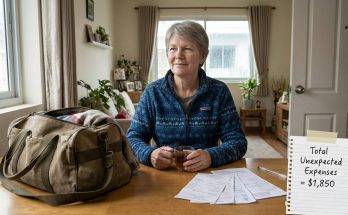
I opened it and looked at the page where I'd written the cost of the extra expenses.
Nearly $1,850.
Below it was the sentence about making the cost visible.
I turned to another page and wrote about the visit.
June's drawing.
Micah's bridge.
Callum's apology.
Tessa's promise to ask before adding anything to my schedule.
I didn't know whether every promise would be kept.
I knew that I would pay attention.
The next morning, I called Ruth and arranged our next book club meeting.
Then I went for a walk.
The air was cool, and the sidewalks were still damp from overnight rain.
I walked at my own pace.
No one was waiting for me to finish so I could start another task.
When I returned home, I made lunch and sat down with my book.
I read until the afternoon light began to fade.
For years, I had believed that being needed was one of the surest signs that I belonged.
If someone called, I answered.
If something went wrong, I fixed it.
If a family member was overwhelmed, I found a way to take one more thing off their hands.
I had rarely asked what happened to me when I did that.
Now I was learning that I could be useful without being endlessly available.
I could be generous without being responsible for everything.
I could be a grandmother without becoming the household's unpaid staff.
And I could be a mother without agreeing to every request my son made.
That evening, Callum sent a photograph of June and Micah sitting together on the sofa.
He wrote, "They asked when you're coming over again."
I smiled.
I replied that I would see them at the park the following week.
Then I put the phone down and returned to my book.
I was glad they missed me.
I was glad I missed them.
But I no longer believed that the only way to prove those feelings was to give away every free hour I had.
Click here to continue reading: PART 12: I Returned to My Own Quiet Home, and the Family Learned That Love Could Remain Without One Person Carrying Everything
I Thought Helping My Son’s Family Would Bring Me Closer to Them, Until a Calendar Began Treating My Time as Their Property
Part 11 of 12