By the time I went to see June and Micah on Wednesday, I had been home for nearly two weeks.
I brought them a small bag of apples from the grocery store and a book I'd found while sorting the photographs.
June met me at the door.
"Grandma!"
She wrapped her arms around my waist, and I held her close.
Micah appeared behind her, asking whether I had brought anything to eat.
I laughed.
"I brought apples."
He looked disappointed.
"Not cookies?"
"Not today."
He accepted the answer and took the bag into the kitchen.
For the first time since leaving, I was able to enjoy being with them without wondering what task would come next.
We sat together in the living room.
June showed me a drawing she'd made at school.
Micah explained a game involving toy cars and a cardboard bridge.
I listened to both of them.
Callum made coffee.
Tessa was at the bakery, so the house felt calmer than it had during the weeks before the opening.
After a while, Callum sat across from me.
"How have you been?"
"Good."
He looked at me carefully.
"Really?"
"Yes. I've been reading again. I saw Ruth. I went to the book club."
He nodded.
"I'm glad."
I could tell he wanted to say something else.
Eventually, he leaned forward.
"We've been trying to work out the household schedule."
I kept my expression neutral.
"How is that going?"
"Not very smoothly."
I waited.
He rubbed his hands together.
"We didn't realize how many little things you were handling."
I thought about the notebook.
The school runs.
The laundry.
The groceries.
The errands.
The hours spent waiting for someone who might arrive sometime between one and four.
"I did a lot," I said.
"More than I realized."
I looked at him.
"You had the budget in front of you, Callum. You knew what you'd assigned me."
He looked down.
"I knew the tasks. I didn't understand how they added up."
That answer was more honest than some of the ones he'd given me before.
I didn't let it erase what had happened.
But I appreciated the difference.
"That's why I started writing everything down," I said.
He glanced toward my handbag.
"The blue notebook?"
I nodded.
"I needed to see it for myself."
He was quiet for a while.
Then he said, "Tessa has had to pay for some extra help."
I didn't respond.
"We've had to rearrange deliveries, too. And we've been buying more meals than we used to."
I thought about the budget.
The childcare line had been set to zero because my name was beside it.
The household had been built around the assumption that my time would continue to cost nothing.
Now they were discovering that the tasks still existed when I wasn't there to perform them.
"That sounds difficult," I said.
He gave a small, tired laugh.
"It is."
I wasn't pleased that they were struggling.
I didn't want the bakery to fail or the children to feel unsettled.
But I wasn't going to volunteer to take the burden back simply because the family had finally noticed it.
Callum looked at me.
"I think we saved more than we understood by having you here."
I rested my hands in my lap.
"You saved money because I was doing the work."
He nodded.
"Yes."
"And because I wasn't being paid."
He looked uncomfortable.
"Yes."
I didn't need to say anything else.
For the first time, he had acknowledged the arrangement without describing it as a misunderstanding.
We talked about the children for a while.
Then I helped June find her library book and listened to Micah explain why his cardboard bridge needed another support.
When it was time to leave, I hugged them both.
Callum walked me to the door.
"Can we talk again soon?"
"Of course."
He hesitated.
"I want to make this right."
I looked at him.
"Then start by not making plans for me without asking."
He nodded slowly.
"I will."
I drove home feeling cautiously hopeful.
Not because everything had been fixed.
It hadn't.
But because the conversation had finally moved beyond whether I was being unreasonable.
That evening, I made dinner and opened my blue notebook.
I didn't write down the tasks I'd completed that day.
Instead, I wrote a few words about the visit.
June's drawing.
Micah's bridge.
Callum's apology.
I wanted to remember the parts of family life that made me happy.
The next morning, I received a message from Tessa.
She said the bakery had been busy, and the extra staffing arrangements were becoming expensive.
Then she asked whether I might reconsider helping with deliveries on Saturdays.
I read the message slowly.
There was no mention of a change in the arrangement.
No suggestion that the work would be paid.
No acknowledgment that I'd left because I had been treated as though my time belonged to someone else.
I replied that I wasn't available for regular deliveries.
She called shortly afterward.
"Lenora, I'm trying to find a way to make everything work."
"I understand."
"We have staff costs, supplier bills, and the children. It all adds up."
"I'm sure it does."
"You're good at organizing things. You know the bakery routes better than most people."
I listened.
She was telling me why I was useful.
She wasn't asking what I wanted.
"I can visit the children," I said. "But I'm not returning to the role I had before."
Her voice tightened.
"So you're not willing to help at all?"
"I didn't say that."
"It feels that way."
I took a breath.
"Tessa, I helped for six weeks because Callum asked me to stay for six weeks. I did not agree to become permanent childcare or unpaid bakery staff."
She didn't answer.
I continued.
"If you need someone to do deliveries, you'll need to arrange that as a job."
There was a silence.
Then she said, "We can't afford to pay someone for every little thing."
I looked toward the kitchen counter, where the blue notebook lay open.
"Then you'll need to decide which things are necessary and which things can wait."
She sounded frustrated.
"I don't think you understand how much pressure we're under."
"I do understand that you're under pressure. I also understand that I was under pressure, and nobody seemed particularly concerned about that."
The words came out quietly.
I hadn't planned to say them.
But once they were spoken, I knew I didn't need to take them back.
Tessa ended the call a few minutes later.
I sat at the table and let myself feel the disappointment.
I had hoped the conversation with Callum would lead to a different kind of conversation with her.
Instead, she still saw my refusal as a problem to overcome.
I couldn't change that by explaining myself another ten times.
That afternoon, I went grocery shopping.
When I returned, there was a voicemail from Maris.
She said she wanted to discuss the bakery's staffing needs and asked whether I might be available to help with a few errands the following week.
I didn't call back immediately.
I made tea.
I watered the plant by the window.
Then I listened to the message again.
It occurred to me that Maris had a paid consulting arrangement because she had established one.
She had decided what her work was worth, and the family had agreed to those terms.
I had never done the same for myself.
I had offered help without limits, then felt hurt when people treated it as something they could count on indefinitely.
That wasn't entirely their responsibility.
I had participated in the arrangement by never saying what I could and couldn't do.
But I could change my part now.
The next morning, I returned Maris's call.
"I appreciate you asking," I told her. "But I'm not available for bakery errands."
She paused.
"Even occasionally?"
"I may choose to help with something from time to time, but I won't be part of the regular operating plan."
She sounded cool.
"That's disappointing."
"I understand."
We ended the call politely.
I didn't feel victorious.
I felt clear.
Later that day, Callum called again.
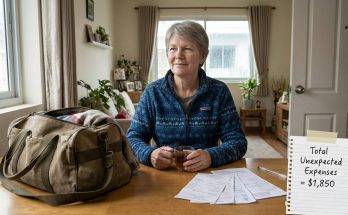
He told me that the family had reviewed their recent expenses and realized how much additional help they needed to pay for since I had gone home.
He mentioned childcare, transportation, and the cost of getting meals when nobody had time to cook.
I listened without interrupting.
Then he said something I hadn't expected.
"We put the amount down as zero because we thought of you as family. But the work didn't disappear when you left."
I looked at the notebook.
"No," I said. "It didn't."
He was quiet.
"I should have thought about that before."
"Yes, you should have."
The words felt blunt, but they were true.
I didn't soften them.
He apologized again.
This time, I accepted the apology without promising that everything would immediately return to normal.
We agreed that I would keep visiting the children and that any requests for help would be discussed with me beforehand.
It wasn't a perfect solution.
It was a beginning.
That evening, I sat at my kitchen table with the blue notebook open beside my tea.
I thought about the money they had saved by treating my time as free.
I thought about the money they were now spending to replace the work I'd done.
I also thought about the hours I'd lost with Ruth, the unfinished novel, and the afternoons I'd surrendered because I was afraid someone might be disappointed in me.
The costs had never been limited to dollars.
But dollars had finally made the arrangement visible.
I closed the notebook.
Then I turned off the kitchen light and went upstairs.
I had no delivery route to plan for Saturday.
No school pickup to remember.
No family calendar waiting for my name.
For the first time in months, I could look at the weekend and see my own life waiting there.
Click here to continue reading: PART 9: I Stopped Treating Every Family Problem as My Responsibility, Even When the People I Loved Made That Choice Difficult
I Thought Helping My Son’s Family Would Bring Me Closer to Them, Until a Calendar Began Treating My Time as Their Property
Part 8 of 12

One Comment on “PART 8 – Two Weeks After I Left, the Family Finally Counted the Costs They Had Never Included in Their Budget”