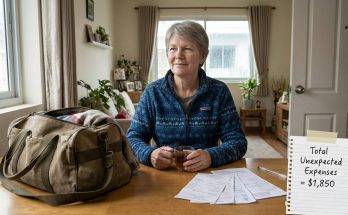
The following Saturday, I woke up at seven and reached for my phone before I remembered what day it was.
For six weeks, Saturday had meant deliveries, children, errands, and a list of things that needed to happen before anyone else had time to notice them.
That morning, there was nothing waiting for me.
I made coffee and sat by the window.
The blue notebook lay open on the table, its pages slightly curled at the corners.
I had used it to record everything I did at Callum's house.
Now I was trying to use it for something else.
My own life.
I wrote down the book club meeting, a grocery trip, and a reminder to call the pharmacy.
Three ordinary things.
They looked almost embarrassingly small beside the pages filled with other people's obligations.
Still, I left them there.
I had decided that if I was going to keep a record, it should include the things I did for myself, too.
Around nine, Callum called.
"Morning, Mom."
"Good morning."
"Are you busy today?"
I glanced at the notebook.
"Not particularly. Why?"
"Tessa and I wanted to talk to you about the schedule."
I knew what that meant.
They had been paying for extra help, and the costs had begun to press on their household budget.
I could hear the question before he asked it.
"Could we come over this afternoon?"
"Of course."
He sounded relieved.
"We'll bring something for lunch."
"You don't have to."
"I know. We want to."
I let that stand.
At noon, I made a pot of tea and put three cups on the table.
I didn't prepare a large meal.
I didn't start cleaning rooms that nobody would enter.
I didn't change my plans to make the visit look more impressive.
They were coming to see me.
That was enough.
Callum arrived first, carrying a paper bag from a sandwich shop.
Tessa followed him with a folder tucked under her arm.
She looked tired.
There were faint shadows beneath her eyes, and she kept rubbing one thumb over the edge of the folder.
We sat at the kitchen table.
For a few minutes, we talked about the children.
June had a school project due the following week.
Micah had misplaced one of his shoes again.
Those were familiar problems, and I found myself smiling.
Then Tessa opened the folder.
"We've been reviewing the expenses from the last couple of weeks."
I folded my hands around my cup.
"All right."
She took out a sheet of paper.
"We've had to arrange additional childcare, pay for more delivery coverage, and order meals on days when neither of us could get home in time to cook."
Callum looked at the paper.
"We're trying to understand where we can make changes."
I waited for them to reach the point.
Tessa finally looked up.
"We wondered whether you might be willing to help with certain things if we asked in advance."
There it was.
A more polite version of the old arrangement.
I considered my answer before speaking.
"I'm willing to spend time with the children. I'm willing to visit. And there may be an occasional favor I can do when it works for me."
Tessa nodded, but her expression remained guarded.
"What we can't do," I continued, "is return to a schedule where everyone assumes I'm available."
"We wouldn't assume that," she said.
I looked at her.
"Tessa, the calendar had my name on it through December. Nobody asked me whether I wanted to stay through December."
She lowered her eyes.
Callum shifted in his chair.
"We know that was wrong, Mom."
"I hope you do."
The room went quiet.
I wasn't trying to make them feel ashamed.
But I wasn't going to rush in and rescue them from the discomfort of hearing what they had done.
Tessa turned a page in the folder.
"We've been trying to work out what the help is actually costing us."
I glanced at the figures.
There were amounts for childcare, transportation, delivery assistance, and prepared meals.
Some were estimates.
Others were expenses they'd already paid.
The numbers were higher than I expected.
I didn't say so.
"These are the things we had to replace," Callum explained.
"Yes," I said.
He looked at me.
"We should have included them in the budget."
I nodded.
That was the heart of it.
The work had always been necessary.
Only the person doing it had changed.
Tessa closed the folder.
"I don't want this to become something that damages our family."
"Neither do I."
"Then I think we need to find a way forward."
"We do."
I took a breath.
"But it has to be a way forward that doesn't depend on me giving up my own life."
She looked toward the window.
For the first time since I'd known her, I saw her struggle to find an answer that wasn't another request.
"I didn't realize how much you were doing," she said at last.
I believed she hadn't understood the full extent of it.
But she had seen me cooking, cleaning, driving, and waiting.
She had watched me put my plans aside.
Understanding wasn't the same as noticing.
"I didn't realize how much I was doing until I wrote it down," I told her.
She looked at the blue notebook.
"Is that what you used to keep track?"
"Yes."
"Of everything?"
"Everything I could remember."
She ran a finger along the folder's edge.
"I suppose we should have kept a better record ourselves."
I didn't disagree.
We talked for another half hour.
We agreed that visits with the children would be arranged directly, not added to a shared calendar without my permission.
We agreed that any request for help would be a request, not an assignment.
And we agreed that I would not be included in the bakery's operating schedule.
No one signed anything.
No one made a grand speech.
It was simply a conversation that should have happened before I packed my suitcase.
When they left, Callum hugged me at the door.
"Thank you for hearing us out."
"I wanted to hear you."
He held the hug a moment longer.
"I'm sorry, Mom."
This time, I didn't tell him it was all right.
I told him I appreciated the apology.
There was a difference.
After they drove away, I returned to the kitchen.
Three cups stood beside the sink.
I washed them and put them away.
Then I took the folder they'd left behind from the table and placed it near the door so I could give it back the next time I saw them.
I didn't need to keep their budget in my house.
That evening, I called Ruth.
She asked whether I wanted to meet for coffee on Tuesday.
I checked the notebook.
Tuesday was open.
"Yes," I said. "Let's do that."
We arranged a time and ended the call.
I looked at the calendar again.
There was a small square around Tuesday, and my handwriting inside it.
Coffee with Ruth.
Nothing more.
The following morning, Tessa sent me a message.
She thanked me for meeting with them and said they would work on a better arrangement.
I replied that I appreciated the conversation.
Then I put the phone down.
I didn't ask whether they had found childcare.
I didn't ask whether the bakery was short-staffed.
I didn't ask whether the new arrangements were working.
Those questions weren't forbidden.
I simply no longer needed to ask them before anyone asked me anything.
Later that week, I visited the children.
June showed me her school project, and Micah insisted on demonstrating how he could build a taller tower with his blocks.
I sat on the floor with them until it was time to go.
Callum walked me to the door.
"Would you like to come again next week?"
"Yes, if we arrange a day."
"How about Thursday?"
I checked my calendar.
"Thursday afternoon works."
He wrote it down on his phone.
I watched him do it.
For the first time, my name was being added to a plan after I'd agreed to it.
It was such a small change.
But I noticed.
On my way home, I stopped at the grocery store and bought a loaf of bread, apples, and a small jar of honey.
I carried them into my kitchen and put them away.
Then I made myself a cup of tea.
The house was quiet.
The clock ticked.
The refrigerator hummed.
I opened my notebook and wrote one sentence beneath the week's appointments.
I can love my family without being responsible for every part of their lives.
I read it once.
Then I closed the book.
I didn't need to make the sentence more complicated than it was.
Click here to continue reading: PART 10: The Receipts Added Up to Nearly Eighteen Hundred and Fifty Dollars, but the Money Was Only Part of What They Had Lost
I Thought Helping My Son’s Family Would Bring Me Closer to Them, Until a Calendar Began Treating My Time as Their Property
Part 9 of 12