I used to think there were some things people in a small farming town simply didn't do.
Then I watched a man who had known my mother for years take something from her without even feeling the need to apologize properly.
It wasn't money.
It wasn't land.
It was twenty bags of cattle feed.
And the part I still have trouble explaining is that my mother let him do it.
The morning started like any other first week of November in our part of Iowa.
The cold had settled in, but the ground hadn't surrendered to winter yet.
There was frost on the windshield when I went outside, and I had to scrape it away before I could see enough to back out of the driveway.
Mom was already waiting.
At seventy-four, she didn't move as quickly as she once had, but she never liked keeping people waiting.
She stood near the passenger door with her coat fastened and her purse tucked under one arm.
I lowered the window.
"Ready?"
She looked at the windshield, then at me.
"I was ready ten minutes ago."
That was Mom.
She didn't waste words when a person ought to have been paying attention.
I got out, opened her door, and waited while she climbed in.
She thanked me.
Then she asked whether I had brought the list.
I held it up.
Twenty bags.
That was all we needed.
We weren't trying to stock up for the whole winter or take advantage of a sale.
We needed enough feed to get through the week, and we had planned our supplies around the cattle we already had.
On a farm, the little decisions aren't always little.
You can put off buying a new coat.
You can stretch a few groceries.
You cannot tell a hungry animal that the person responsible for feeding it has been inconvenienced.
Mom understood that better than anyone I knew.
She had spent most of her life making sure the work got done, even when the people doing it were tired or worried or short on time.
My father had been gone for eight years by then.
My younger brother and I had taken on more of the physical work as the years passed, but Mom still had her say in the decisions that mattered.
Nobody on our farm would have thought to change that arrangement.
She knew what we needed.
She knew when we needed it.
And she knew the difference between buying something because it was convenient and buying it because there was no sensible alternative.
That morning, there wasn't much to debate.
We needed the feed.
The store was our usual place to buy it.
The drive into town wasn't long enough to make conversation necessary, so we didn't talk much.
I watched the road.
Mom looked out the window.
The fields on either side had that late-autumn appearance I had known since childhood, with the last of the season's color giving way to brown stalks and bare patches of earth.
I remember thinking about the weather forecast.
Freezing rain was expected later that afternoon.
It wasn't a storm yet, and it wasn't a reason to panic, but it was enough to make me want the feed loaded and the truck headed home before conditions changed.
Mom had probably been thinking the same thing.
She didn't mention it.
She rarely explained a practical decision she had already made.
When we reached the farm supply store, I parked near the loading area.
The building looked as it always had.
Nothing about it suggested that the morning would become a memory I would carry around for years.
There were supplies stacked near the entrance, equipment arranged along the walls, and the familiar signs advertising products that farmers needed at different times of the year.
I had been coming there for as long as I could remember.
Mom had been shopping there longer than that.
She didn't need help finding the feed.
The bags were stacked on a pallet near the loading area, and she walked straight toward them.
I followed her.
She bent enough to examine the label on the nearest bag.
Then she checked another one.
Same brand.
Same mixture.
Same weight.
There was nothing unusual about the shipment, and nothing about the bags suggested that we had arrived too late.
Mom straightened.
"These are the ones."
I nodded.
We had bought that feed many times before.
There was no reason to start experimenting with something different in the middle of the season.
She turned toward the employee working nearby.
"We need twenty of these."
He looked at the pallet and nodded.
"All right."
He brought a cart over and began moving the bags.
I stood beside Mom while he worked.
There was nothing to argue about.
We had asked for a product the store carried, and the employee was preparing our order.
For a few moments, everything proceeded exactly as it should have.
Then a door opened behind the counter.
A man stepped out of the office.
The manager.
He had grown up only a few farms away from us, and he knew who my mother was without needing to check a name or ask a question.
He knew our family.
He knew where we lived.
He knew we had been customers for years.
He also knew we weren't the sort of people who came into town looking for a fight.
He walked toward the loading area and looked at the cart.
"Stop that for a moment."
The employee took his hands off the next bag.
Mom turned to face the manager.
He didn't seem embarrassed to interrupt us.
If anything, he looked as though he expected the matter to be settled quickly.
"Those bags aren't available anymore," he told her.
Mom glanced toward the pallet.
Then she looked back at him.
"What changed?"
He paused just long enough for me to notice.
"They've been promised to another buyer."
I waited for him to explain.
Mom did too.
He said a larger commercial customer had contacted the store a few minutes earlier.
That customer wanted the remaining inventory and had offered more money for it.
The manager had decided to accept the offer.
I looked at the bags on the cart.
The employee had already started loading our order.
We hadn't come in asking the store to hold something for us until the end of the day.
We were standing there buying what we needed, and the store had begun preparing it.
Now the manager was telling us that another customer's money had changed the arrangement.
Mom didn't raise her voice.
"But we've already started our purchase."
He gave a small shrug.
The gesture bothered me more than I expected.
It was so casual.
Like the matter was too ordinary to deserve another thought.
He said the store had to look after its business.
I felt my jaw tighten.
There are moments when anger comes with a clear explanation.
You know what has happened, you know why it is wrong, and you know exactly what you want to say.
This wasn't quite like that.
I knew we needed the feed.
I knew the weather could make the drive home more difficult later.
I knew the next supplier was nearly forty miles away.
But standing there, I also knew that any argument I made would have to pass through a man who had already decided our needs mattered less than somebody else's offer.
I wanted to tell him what I thought of that.
I wanted to ask whether being a regular customer counted for anything at all.
Mostly, I wanted to ask how he could look at my mother and act as though she were a stranger who had wandered into the wrong store.
I didn't say any of it.
Looking back, I am not proud of that silence.
I was angry, but I was also waiting for Mom to decide what happened next.
She had always been better than I was at knowing when words would accomplish something.
The manager looked at her.
He seemed to expect an objection.
Maybe he thought she would remind him how long she had been shopping there.
Maybe he expected her to demand that he honor the order.
I couldn't tell.
Mom glanced once more at the pallet.
Then she gave a small nod.
"All right. You've got a business to run."
The manager's expression changed.
He smiled as if she had just agreed that he had made the sensible choice.
"I'm glad we understand each other."
I remember those words.
Not because they were especially cruel, but because they were so easy for him to say.
He had made a decision that left us with a problem, and he seemed relieved that my mother wasn't going to make him uncomfortable about it.
He turned toward the employee.
The employee looked at the cart.
Then he began removing the bags.
One at a time.
He had just spent several minutes loading them for us.
Now he was putting them back.
I watched him lift the first bag away.
Then the next.
The manager returned his attention to whatever business waited inside his office.
Mom stood quietly beside me.
She didn't complain.
She didn't ask the employee to stop.
She didn't look at me to see whether I would speak for her.
I had never felt so useless standing next to my own mother.
Twenty bags.
That was the whole problem.
Twenty bags of feed, sitting within reach, at the store where we had bought them for years.
The manager had decided that somebody else's willingness to pay more was enough to make our purchase disappear.
And my mother, who had spent a lifetime making sure other people kept their promises, had accepted his answer without giving him the argument I wanted to have.
I thought the matter was finished.
I thought we would have to leave, find another supplier, and deal with the consequences of losing time on a cold November morning.
I was already working out what we could do next.
Then Mom turned back toward the counter.
She had noticed something I hadn't.
Or perhaps she had been waiting for the right moment all along.
She looked at the manager's desk.
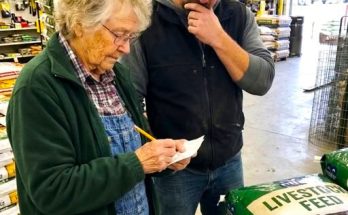
Then she asked him for a pencil.
Click here to continue reading: PART 2: My Mother Asked for Something Small Enough to Fit in Her Hand, and I Had No Idea Why the Manager Suddenly Stopped Smiling
I Thought Being a Good Customer Meant Something Until a Man Behind a Counter Decided Our Family Wasn’t Worth the Money
Part 1 of 8