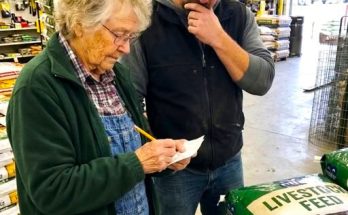
The manager looked at her as though he hadn't heard correctly.
Mom waited.
She wasn't impatient.
She didn't repeat herself or explain why she needed it.
She simply stood there with her purse tucked under her arm and gave him time to respond.
He found a pencil and handed it across the counter.
I watched the exchange without understanding it.
We had come to the store for cattle feed.
The feed was no longer ours to buy, according to the manager, and I was still trying to work out what we should do about that.
A pencil wasn't going to solve our problem.
At least, that's what I thought.
Mom took the receipt the manager had started preparing and turned it over.
The paper was thin.
She held it against the counter to keep it steady.
Then she began writing.
I couldn't see the numbers clearly from where I stood.
I could tell there were six of them.
She wrote slowly and deliberately, with the same careful hand she used when filling out a check or making a note she expected to keep.
When she finished, she put the pencil down.
Then she pushed the receipt toward the manager.
"Would you look these up in the older account books for me?"
He glanced at the paper.
At first, he barely seemed interested.
His eyes moved over the numbers, and I thought he might ask her what they meant.
Instead, he looked again.
His expression changed so slightly that I almost missed it.
The smile disappeared first.
Then his eyes returned to the paper.
He picked up the receipt.
"Where did you get these?"
His voice was different now.
Not louder.
Not angry.
Just suddenly careful.
Mom didn't reach for the receipt.
She didn't explain the numbers or offer to show him anything else.
She looked directly at him.
"Your father gave them to me."
The manager stared at her.
"My father?"
Mom nodded.
She told him it had been thirty-two years earlier.
That was all she offered.
No long explanation.
No story about the past.
No attempt to persuade him that the numbers were important.
The manager looked down at the receipt again.
I watched him turn the paper slightly, as if changing the angle might help him understand what he was seeing.
Then he looked at Mom.
For the first time that morning, he seemed unsure of himself.
He asked another question, but he didn't finish it.
His attention had already shifted toward the office.
He took the receipt with him and walked away from the counter.
Then he disappeared through the door.
I turned to Mom.
"What did you write down?"
She didn't answer immediately.
She kept her eyes on the office door.
I tried again.
"Those numbers. What are they?"
She folded her hands in front of her.
For a moment, I thought she might tell me.
Instead, she said that my father had made a promise with her a long time ago.
It was a promise they had agreed not to use unless the need became serious enough.
I waited for her to say more.
She didn't.
The store seemed unusually quiet.
The employee who had been unloading the cart kept working.
A bag shifted against the others with a dull sound.
Somewhere beyond the counter, a door closed.
I looked at the receipt.
Mom had written only six numbers.
Whatever they meant, they had been enough to send the manager into the back office without another word.
I had questions.
More than I could have asked without sounding as confused as I felt.
Why had my father given those numbers to Mom?
Why had she kept them for so long?
Why had the manager reacted as though the paper carried something he couldn't afford to ignore?
And why had she waited until this particular morning to use them?
I knew my father had been gone for eight years.
I knew Mom had managed the years after his death without asking us to carry every burden for her.
I knew she didn't make a habit of bringing up old family matters simply because she wanted to remember them.
But I knew nothing about the promise she had just mentioned.
That bothered me.
Not because I believed she owed me every detail of her life.
She didn't.
It bothered me because I had spent so much time working beside her and still had no idea what had just happened.
The manager knew something.
Mom knew something.
I was standing between them, close enough to see the paper and too far from the truth to understand it.
I looked at her again.
She seemed calm.
Not pleased with herself.
Not frightened.
She had the same expression she wore when she was waiting for a measurement to be checked or a calculation to be confirmed.
I wanted to ask whether she had expected this reaction.
Instead, I asked whether she thought the manager would come back.
She said he would.
There was no drama in the way she said it.
She sounded as certain as she had when she told the employee which feed to load.
I looked toward the office.
The door remained closed.
I had known the manager for years, though not as well as Mom had.
He was a familiar face in a familiar place.
He knew our family, and we knew his.
His father had been part of the store's history long before the younger man took over the day-to-day business.
I had heard people speak of the older man over the years, but I had never imagined that anything connected to him would matter to us on an ordinary morning.
Thirty-two years.
Mom had held on to those numbers for thirty-two years.
She had carried them through seasons of planting and harvest, through ordinary trips into town, through the years when Dad was alive and the eight years after he was gone.
Whatever the numbers meant, she hadn't used them casually.
That was the part I couldn't get past.
Mom had just watched a manager take away something our farm needed.
She hadn't argued about fairness.
She hadn't threatened to take our business elsewhere.
She hadn't even demanded that he reconsider.
She had asked for a pencil.
Then she had written six numbers.
I wondered whether Dad had expected a day like this to come.
The thought felt strange.
My father had been gone too long for me to imagine him standing in that store again.
Yet his name had changed the entire atmosphere of the room.
Not because Mom had raised her voice.
Not because she had made a scene.
She had only told the manager where the numbers came from.
I thought about the way he had looked at her.
He hadn't looked at her like a customer anymore.
He had looked at her like someone who had just reminded him of something he wished he could forget.
I couldn't be sure of that interpretation.
I only knew what I had seen.
His smile was gone.
His questions had stopped.
And he had hurried away with a piece of paper that meant nothing to me.
I turned toward Mom.
She was watching the office door.
I tried to imagine the conversation taking place on the other side of it.
Perhaps the manager was checking an old account.
Perhaps he was trying to find an entry in a ledger that had been sitting untouched for years.
Perhaps he had recognized the numbers but needed to see the original record before he could believe what they meant.
I had no way of knowing.
All I could do was wait.
The cart beside us was nearly empty now.
The bags were back on the pallet, arranged as though we had never asked for them.
The employee finished unloading the last one and wheeled the cart away.
I watched him go.
Then I looked at the pallet again.
The feed was still there.
The same bags.
The same labels.
The same twenty bags we had come to buy.
A few minutes earlier, the manager had treated our purchase as a simple matter of money.
Now he had left the floor to examine six numbers written on the back of a receipt.
I began to understand that my mother hadn't accepted his decision in the way I had assumed.
She had listened to him.
She had let him finish.
Then she had made her own decision.
And whatever she intended to find in those old records, it had nothing to do with persuading him to be nicer to us.
She wanted an answer.
That much I could tell.
She wasn't asking him to do us a favor.
She wasn't trying to make him feel guilty about the feed.
She had come to the store with a specific need, and something about the manager's response had led her to take a step she had avoided for thirty-two years.
I looked at her hands.
They rested quietly against the edge of the counter.
No shaking.
No nervous movement.
She wasn't searching her purse for another document or trying to remember what she had written.
She knew the numbers.
She knew why she had brought them.
I was the only person there who had no idea what was happening.
I asked her whether Dad had told her to keep them safe.
She considered the question.
Then she said that he had given them to her with instructions about when they might matter.
I asked what those instructions were.
She turned her head toward me.
"You'll understand when we know what the book says."
That was as much as she would tell me.
I wanted to push her.
I wanted to remind her that I was her son, that I had known Dad all my life, and that whatever was happening seemed to concern our family.
But I also knew the look she gave me when she had answered a question as fully as she intended to.
So I stopped.
The office door remained closed.
The clock above the counter kept moving.
The morning was getting later, and the weather hadn't improved while we stood there.
I thought again about the drive home and the freezing rain forecast for the afternoon.
Those were ordinary worries.
They were the kinds of things I understood.
I could calculate the distance to the other supplier.
I could think about how much time we had before the weather turned.
I could work out what the cattle would need for the next several days.
But I couldn't make sense of six numbers on a receipt.
And I couldn't explain why my mother, who had spent the morning accepting a man's refusal without a single complaint, now seemed more certain of herself than I had seen her in a long time.
I had thought she was letting the manager win.
I was beginning to suspect that I had misunderstood her completely.
Click here to continue reading: PART 3: The Minutes Stretched While We Waited, and Every Glance Toward the Office Made Me Wonder What My Father Had Left Behind
I Thought Being a Good Customer Meant Something Until a Man Behind a Counter Decided Our Family Wasn’t Worth the Money
Part 2 of 8