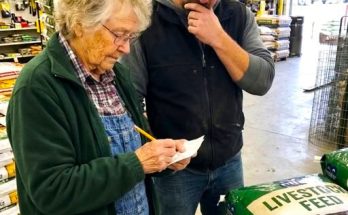
Five minutes passed before I realized how long we had been standing there.
Then five more.
The manager still hadn't returned.
Mom didn't ask the employee to find him.
She didn't call through the office door.
She waited beside the counter as though she had brought something in for repair and expected the person responsible to finish examining it.
I shifted my weight.
The cold from outside had begun to leave my coat, but I could still feel it in my hands.
I rubbed them together and glanced at the clock.
Ten minutes wasn't an unreasonable amount of time to search through old paperwork.
That was what I told myself.
Still, I couldn't stop thinking about the manager's face when Mom said who had given her the numbers.
He had looked genuinely startled.
It hadn't been the expression of a man who was annoyed about being interrupted.
It was the expression of someone who had encountered a piece of information he hadn't expected to see.
I wondered how many records a farm supply store could keep from thirty-two years earlier.
I imagined rows of ledgers, old account books, and papers that had survived changes in staff and ownership.
I didn't know what the manager was looking for.
I only knew that Mom expected him to find it.
That expectation made me more uneasy than if she had seemed uncertain.
I had grown up believing that most old business matters eventually became just that.
Old business.
People retired.
Records moved from one office to another.
Names disappeared from invoices.
A store might remember a family that had been buying from it for decades, but that didn't mean anyone remembered every transaction.
Yet Mom had given the manager six numbers and asked him to check them against an old ledger.
She had chosen her words carefully.
She hadn't asked whether he recognized the numbers.
She hadn't asked him to explain what his father had done.
She had asked him to look.
That suggested she expected something specific to be written down.
I wanted to know what.
The employee passed through the loading area again.
He didn't look at us for long.
I couldn't blame him.
He had been told to stop loading our feed, and he had done what the manager asked.
Whatever the manager was doing in the office wasn't his responsibility.
I knew that.
But I was still bothered by the sight of our bags back on the pallet.
I could have walked out and driven to the other supplier.
The sensible thing might have been to do exactly that.
Instead, I stayed because Mom stayed.
I had spent years relying on her judgment, and I wasn't about to abandon her now simply because I didn't understand the situation.
Besides, she had given no indication that she wanted to leave.
She stood quietly, watching the door.
I asked whether she was worried.
She shook her head.
I asked whether she knew what the numbers would show.
She took a moment before answering.
"I know what your father told me."
That wasn't the same thing.
I understood the distinction.
She knew what Dad had said, but she didn't yet know what the manager would find in the records.
I had the feeling she wanted to keep those two things separate until she could see the evidence for herself.
That sounded like my father.
He had believed that promises mattered, but he also believed that a person ought to know exactly what he was agreeing to.
He didn't like vague assurances.
He preferred things that could be written down and checked.
I remembered that about him, though I couldn't remember every detail of the way he had handled business.
I had been younger when the numbers were given to Mom.
Thirty-two years earlier meant a time when I was far less concerned with account books and commercial agreements than I was with the ordinary demands of growing up.
I hadn't paid attention to everything the adults discussed.
There were things my parents had handled privately, and I had accepted that without questioning them.
Now one of those private matters had appeared in front of me, written on the back of a receipt in my mother's handwriting.
I wondered how many other things I had never understood.
The thought made me uncomfortable.
Not because I believed my parents had hidden something shameful.
Because I had assumed that knowing people for a long time meant knowing most of what mattered about them.
I had lived with Dad.
I had worked beside him.
I had watched him make decisions that affected our farm and our family.
Yet he had given Mom six numbers and a promise that had lasted longer than his life.
I had never heard about it.
Perhaps he hadn't wanted me to know.
Perhaps there had never been a reason to tell me.
I couldn't decide which possibility bothered me more.
Mom shifted her purse to the other arm.
Then she looked at the office door again.
I followed her gaze.
Still closed.
I imagined the manager searching one ledger after another, trying to match the numbers she had written.
If he had grown up three farms away from us, as he had, he might have known my father as a neighbor rather than merely as a customer.
He might have heard stories about him.
He might have known that Dad was the sort of man who kept his word.
But knowing someone personally wasn't the same as knowing what had been recorded in a business ledger.
The paper would have to speak for itself.
That was what Mom seemed to be waiting for.
I remembered how quickly the manager had dismissed our purchase.
He had acted as if the matter needed no thought beyond the extra money offered by the larger customer.
At the time, I had taken his confidence as a sign that he didn't care what happened to us.
Now I wondered whether he had ever considered that the store's past might contain obligations he knew nothing about.
I didn't want to make excuses for him.
He had still told us the feed was no longer available after the employee had begun loading it.
Whatever the old records might show, that decision had been his.
But there was a difference between understanding a man's choice and understanding the full situation in which he had made it.
I had spent the first part of the morning thinking about the former.
Now I was waiting to learn about the latter.
Another minute passed.
Then another.
I looked at the receipt in my mind, trying to picture the six numbers in the order Mom had written them.
I couldn't.
I had seen them only briefly, and I hadn't paid enough attention to memorize them.
That small failure irritated me.
I had been standing right beside her.
I had watched her write them.
Yet I couldn't have repeated a single one with confidence.
Mom, meanwhile, appeared to remember every detail.
She didn't look as though she were trying to recall something from the past.
She looked as though she were waiting for someone else to catch up with it.
I thought about asking whether Dad had ever mentioned the store's old ledgers.
I decided against it.
If she wanted to tell me more, she would.
That had always been the way with Mom.
She didn't explain a decision just to make the people around her comfortable.
She explained what they needed to know when they needed to know it.
Sometimes I had found that frustrating.
That morning, I began to see the value in it.
The manager had refused us because he believed the matter was straightforward.
Mom had asked him to check the facts before deciding what those facts meant.
She hadn't tried to win an argument with a louder voice.
She had put a question in front of him that he couldn't answer without going back thirty-two years.
I wondered what Dad would have thought of the scene.
He wouldn't have enjoyed watching the manager take the feed away from us.
But I could imagine him standing beside Mom, waiting without complaint while someone checked an old record.
He had never been impressed by a person who sounded certain merely because nobody had challenged him.
He wanted to know what was true.
I had inherited some of that stubbornness, though I often used mine less wisely.
I could be quick to react.
I could take a slight personally and spend the rest of the day thinking about what I should have said.
Mom was better at keeping her attention on the matter itself.
The manager had made a choice.
She had responded by asking him to examine something.
Now the question was whether the record would confirm what she remembered.
I looked toward the window.
The sky had that flat November color that made the day feel shorter than it was.
The freezing rain was still a concern.
I could almost feel the minutes slipping away while we stood inside.
But I didn't urge Mom to leave.
I didn't ask whether this was worth the time.
She had waited thirty-two years to use those numbers.
I could wait a little longer to learn why.
At last, I heard movement behind the office door.
A chair scraped across the floor.
Something heavy was shifted.
Then came the sound of footsteps.
Mom straightened slightly.
I did too.
The door opened.
The manager emerged carrying a thick binder.
Dust marked its cover, especially around the edges.
He held it carefully, with both hands, as though he had found something that required more attention than he had expected to give it.
He didn't return the receipt to Mom.
He didn't explain what he had discovered.
He walked directly to the counter and placed the binder in front of us.
For the first time since we had entered the store, I had the feeling that the twenty bags of feed were no longer the main reason any of us was standing there.
Click here to continue reading: PART 4: When He Opened the Dusty Binder and Turned to the Entry He Needed, My Mother’s Silence Finally Made Sense in a Way I Couldn’t Yet Explain
I Thought Being a Good Customer Meant Something Until a Man Behind a Counter Decided Our Family Wasn’t Worth the Money
Part 3 of 8