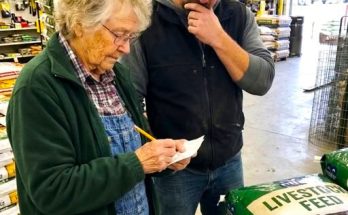
The manager stood behind the counter for a long moment.
Then he told the employee to prepare our order again.
The employee looked toward the pallet.
He didn't ask why the instruction had changed.
He wheeled the cart back to the bags and began loading them.
I watched him lift the first one.
The sound of it settling onto the cart was ordinary.
So was the next.
Yet I felt something in me loosen as the stack began to shrink.
We had come for twenty bags.
That was still what we needed.
The old ledger hadn't changed the number of cattle waiting at home.
It hadn't changed the weather forecast.
It hadn't made the drive shorter or the morning warmer.
But the manager was no longer sending us away.
Mom stayed beside the counter while the employee worked.
She didn't smile as though she had won.
She didn't look at me for approval.
She waited until the order was ready.
The manager remained near the open binder.
He seemed to have forgotten about his office for the moment.
He looked from the receipt to the ledger, then back to Mom.
I could tell he wanted to ask more questions about his father.
I could also tell he understood that the feed needed to be dealt with first.
When the cart was loaded, the employee moved it toward the loading area.
I followed him to help.
Mom came along more slowly.
The bags were heavy, and I was glad to have something practical to do with my hands.
We loaded them into the truck one by one.
The cold had sharpened while we were inside.
I could feel it through my sleeves as I reached for each bag.
I thought about the freezing rain again.
We still had to get home.
The cattle still needed feeding.
The day's work hadn't paused just because we had found an old account entry.
When the last bag was in place, I shut the truck bed.
Mom stood beside the passenger door, watching me check the load.
I asked whether she was ready to leave.
She nodded, but she didn't climb in immediately.
She turned toward the store.
The manager had come outside.
He stopped a short distance away and asked if he could speak with her before we went.
Mom looked at me.
I understood that she wanted to hear what he had to say.
So I waited by the truck.
The manager spoke quietly.
He told her he wanted to examine the record more carefully and make sure he understood the agreement his father had entered into.
Mom said that was reasonable.
He asked whether she could return at another time to discuss it.
She agreed.
There was no argument over what the entry meant.
No sudden declaration that everything had been settled.
The record had been found, but the manager still needed to understand it.
Mom wasn't going to pretend otherwise.
I appreciated that more than I could explain.
The morning had already shown me how easy it was to make a decision before knowing enough.
The manager had done it when he chose the larger customer's offer over ours.
I had done it when I assumed Mom's silence meant she had nothing more to say.
Now we were all being asked to wait until the facts were clearer.
The manager thanked her for bringing the numbers.
Mom said she hoped the old records would help them understand what had happened.
Then she got into the truck.
I climbed behind the wheel.
For a little while, neither of us spoke.
The bags shifted slightly when I pulled away from the store.
I checked the mirror and turned toward the road home.
The town passed around us in its familiar way.
There were buildings we had known for years, a few vehicles on the road, and the gray sky hanging low over everything.
I kept thinking about the binder.
I wanted to ask Mom what she believed the entry meant.
I wanted to ask why she hadn't told us about the numbers before.
But I knew she had already answered the questions she was ready to answer.
So I asked something simpler.
"Did you expect him to find it?"
She looked out the window.
"I hoped he would."
That was the same answer she had given before.
I asked whether she thought the record would change anything beyond that morning.
She was quiet for a while.
Then she said that depended on what the manager learned from it.
I drove.
There was no point pushing for certainty she didn't have.
The road home looked the same as it had that morning, but I felt different sitting behind the wheel.
I had thought the manager's refusal was the kind of thing a person remembered because it was unfair.
Now I knew I would remember the pencil.
I would remember the receipt turned over on the counter.
I would remember the manager's face when Mom told him where the numbers had come from.
And I would remember the binder, its dusty cover resting beside the paper as though thirty-two years had suddenly become part of the day's business.
When we reached the farm, the weather was still holding.
I parked near the place where we usually unloaded supplies.
We had work to do.
My brother would need to know the feed had arrived, and the cattle couldn't wait while I tried to make sense of an old promise.
Mom got out and helped me with what she could.
We moved the bags where they needed to go.
The work was ordinary.
That helped.
Afterward, Mom washed her hands and put the receipt away with the other things she intended to keep.
I noticed her doing it.
She didn't leave it on the kitchen table or toss it into a drawer.
She folded it carefully and placed it somewhere safe.
I thought about asking to see it.
I didn't.
That evening, I found myself replaying the morning while I went through the day's remaining chores.
I kept returning to the moment when the manager had told Mom that the feed was no longer available.
I had wanted her to fight him.
I had wanted her to make him admit that what he was doing was wrong.
But she had done something I hadn't thought of.
She had asked him to look at the past before deciding what the present required.
I didn't know yet what the old agreement would mean in the long run.
Neither did she.
But we had our feed, the cattle had what they needed, and the manager had agreed to examine the record further.
For that day, it was enough.
Click here to continue reading: PART 8: Years of Keeping Quiet Had Brought My Mother to One Old Page, and What Remained Was Learning When a Promise Had to Be Spoken Aloud
I Thought Being a Good Customer Meant Something Until a Man Behind a Counter Decided Our Family Wasn’t Worth the Money
Part 7 of 8