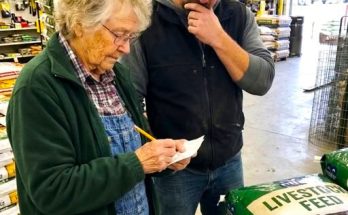
The freezing rain arrived later than the forecast had suggested.
By then, the feed was safely stored, and the cattle had been taken care of.
I remember looking out at the first drops and thinking how much worse the day would have been if we had needed to make that long drive to the other supplier.
That was the practical problem Mom had solved.
The other problem was still waiting.
The manager had promised to examine the ledger more closely.
Mom intended to return and hear what he had learned.
She didn't turn the matter into a daily conversation at home.
She went on with the work.
She checked what needed checking, made decisions about the farm, and carried herself as she always had.
But I noticed that she kept the receipt where she could find it.
The six numbers were still there.
I didn't ask to see them again.
A few days later, Mom went back to the store.
I went with her.
The weather had cleared enough for an ordinary drive into town, and the roads were no longer the concern they had been on the first morning.
The manager was expecting us.
He had the binder ready.
This time, he didn't look surprised to see Mom.
He took us into the office and laid the old ledger on the desk.
The room smelled of paper and dust.
I stood beside Mom while he opened the book to the same entry.
He explained that he had reviewed the record and compared it with the information he could find in the store's older files.
He had wanted to be certain that he understood what he was looking at before speaking to her again.
Mom listened.
She asked him to show her the entry.
He turned the binder so she could read it.
She studied the writing slowly.
I watched her face, hoping it would tell me something.
She looked neither surprised nor pleased.
She looked like someone checking an answer against a calculation she had carried in her head for a long time.
The manager explained what he believed the record established.
He was careful with his words.
He didn't pretend to know every detail of what his father had intended.
He didn't claim that the old entry answered every question about the arrangement.
But he acknowledged that the record was real and that the numbers Mom had given him led directly to it.
That mattered.
The manager had not dismissed her memory.
He had not told her that the old business was irrelevant simply because his father was gone.
He had looked at the evidence.
Mom thanked him for checking.
Then she asked whether he understood why she had brought the numbers forward.
He said he did.
She reminded him that she had not come to create trouble for him or his store.
She had come because the decision he made that morning had forced her to consider whether a promise from the past still had a place in the present.
She wanted to know what the record said before deciding what to do about it.
The manager nodded.
He admitted that he should have handled the original purchase differently.
He had seen the chance to make more money from a larger customer and had treated that offer as the only thing worth considering.
He hadn't asked whether the decision was fair to the people already buying from him.
He hadn't considered what his father might have written down years earlier.
And he hadn't stopped to think about the consequences for our farm.
Mom let him finish.
She didn't tell him that he was a terrible man.
She didn't pretend his decision had been harmless.
She said she appreciated his willingness to acknowledge it.
Then she looked at the ledger once more.
I watched her close the cover.
For thirty-two years, she had kept the numbers because Dad had asked her to.
For eight years after his death, she had carried them without him there to explain them again.
She had never used them simply because she could.
She had waited until there was a reason to find out what the old record meant.
I finally understood something about her silence that I had missed on the first morning.
She wasn't quiet because she had nothing to say.
She was quiet because she wanted to know what she was saying before she said it.
I had mistaken that patience for surrender.
I would remember that mistake longer than I would remember the manager's smile.
When we left the office, the store was carrying on with its usual business.
People came in to buy supplies.
Employees moved products around the loading area.
The pallet where our feed had been stacked was no longer the center of anyone's attention.
The morning that had seemed so important to me had become another day in the store's history.
But I knew it hadn't been ordinary for Mom.
She had brought an old promise into the present and made sure it was examined rather than ignored.
The manager had been forced to consider something beyond the immediate value of a sale.
And I had learned that a person could stand quietly without agreeing to be treated unfairly.
On the drive home, I asked Mom whether she regretted keeping the numbers for so long.
She looked at me as though the question required more thought than I had expected.
Then she said she didn't.
She had kept them because Dad had trusted her to do so.
That trust had been enough.
She hadn't known whether the record would still exist or whether the manager would understand it.
She had only known that the time had come to check.
I asked whether she thought Dad would have wanted her to use them that morning.
She looked out at the fields.
"I think he would have wanted me to know what was written down."
That answer stayed with me.
She hadn't used the numbers to punish the manager.
She hadn't used them to prove that she was more important than another customer.
She had used them to ask a question that deserved an honest answer.
I thought about the way I had stood beside her when the manager first refused us.
I had been angry on her behalf, but I hadn't known what to do with the anger.
I had wanted her to speak more loudly because I believed that was what strength looked like.
She had shown me another kind.
The kind that doesn't rush.
The kind that remembers.
The kind that knows when a question needs to be checked against the facts before anyone can claim to understand it.
We reached the farm with the afternoon still ahead of us.
There were chores waiting, and my brother had work of his own.
Mom put her purse away and went about the rest of her day.
She didn't ask anyone to admire what she had done.
She didn't tell the story as if she had defeated the manager.
She had found the answer she needed, and that was enough for her.
I still think about the twenty bags of cattle feed.
They were ordinary bags, stacked on an ordinary pallet in a store we had known for years.
They should never have become a test of whether a regular customer mattered less than a bigger offer.
But the refusal had brought us to the old ledger, and the ledger had reminded me that business was made up of more than the money changing hands that morning.
There were records.
There were promises.
There were people who had trusted one another long before I understood what that trust might require.
My father had left us many things when he died, though most of them were the ordinary things a family carries forward.
Mom had kept one small part of his past because he had asked her to.
She didn't know when she would need it.
She didn't know whether she ever would.
But when the moment came, she remembered where to look.
I used to think a person had to argue to stand up for themselves.
I don't believe that anymore.
Sometimes a person needs to argue.
Sometimes a person needs to walk away.
And sometimes the first thing they need is a pencil, a receipt, and the patience to ask someone to check an old record.
Mom had done exactly that.
She had gone to town for twenty bags of feed.
She had come home with them.
And she had reminded me that the quietest person in a room might be the one who knows which question needs answering.
The End
Read more original stories on Feel Every Story.
I Thought Being a Good Customer Meant Something Until a Man Behind a Counter Decided Our Family Wasn’t Worth the Money
Part 8 of 8