The manager kept the binder open between himself and Mom.
He asked her to tell him what she remembered about the agreement.
She took a breath.
Then she explained that his father had given her the numbers years earlier, when the older man and my father had been dealing with a matter of business.
She didn't dress it up.
She didn't claim to remember every word of their conversation.
She told him only what she knew.
I listened closely.
This was the first time I had heard her speak about the matter beyond the fact that Dad had given her the numbers.
Even then, she wasn't telling me everything.
She was answering the manager's questions because he was the person who had access to the record.
I understood that.
Still, I wished she would turn toward me and explain the whole thing.
I wanted to know what my father had promised.
I wanted to know what the manager's father had agreed to.
I wanted to know why six numbers had survived thirty-two years when so many other details from that period had faded.
But Mom kept her attention on the binder.
The manager listened without interrupting.
When she finished, he looked down at the entry again.
He seemed to be comparing her account with what he could see on the page.
I watched his face, waiting for the moment when the two pieces would fit together.
It didn't happen all at once.
He read the writing again.
He checked the numbers.
Then he leaned back and looked at Mom.
He said he had never known about this.
Mom told him she understood.
That answer seemed to trouble him more than an accusation would have.
He had inherited the store's responsibilities, but he hadn't known about every arrangement his father had made.
I could see that he was trying to decide how much of that ignorance excused him.
I wasn't ready to make that decision for him.
He had still chosen to give the remaining feed to the customer willing to pay more.
He had done so without asking whether the arrangement already in place with us deserved to be honored.
The old ledger might explain why Mom had come to him with those numbers.
It didn't erase what had happened that morning.
I knew the difference.
Mom knew it too.
She didn't use the old entry to shame him.
She asked whether he understood what the record established.
He looked down before answering.
He said he thought he did.
Then he stopped.
He wasn't entirely certain.
That mattered.
For years, I had thought of the store as a place where business was conducted in the ordinary way.
You chose what you needed.
You paid the price.
You took it home.
I had never imagined that a decision about a pallet of feed might lead us into a record of an agreement made when I was younger.
I had never considered that a promise between two men could remain relevant long after one of them was gone.
Yet there it was.
My father had left the numbers with Mom.
She had kept them.
The manager's father had left a written entry in the store's records.
And the younger manager had been unaware of the connection until that morning.
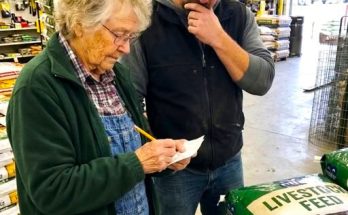
I looked at the receipt.
It seemed almost ridiculous that something so small could have brought us to this point.
A scrap of paper.
A pencil.
Six numbers.
Nothing about those things looked powerful.
But the manager had stopped talking about the feed as though it were the only thing that mattered.
He had started asking questions.
Mom waited for each one.
When he asked whether she had ever used the numbers before, she said she had not.
He asked why she had waited so long.
She looked at him for a moment.
Then she told him there had been no reason to bring them forward.
She had kept the promise because she believed that was what Dad wanted.
She had not come to the store looking for a dispute.
She had come to buy feed for the cattle.
I felt ashamed again.
I had been so focused on the insult that I had assumed Mom's quietness meant she was accepting it.
I had thought she was being too polite.
Maybe I had even thought she was being weak.
But she hadn't been waiting for permission to be angry.
She had been deciding whether the moment required something more important than anger.
The manager lowered his eyes.
He apologized for not knowing about the old arrangement.
Mom accepted that he hadn't known.
She didn't tell him that everything was fine.
She didn't tell him that his decision had been fair.
She simply acknowledged what he had said.
That was another thing I had to learn from her.
Accepting an explanation wasn't the same as pretending nothing had happened.
The manager closed the binder carefully.
He didn't move it away.
He left it on the counter beside the receipt.
Then he asked Mom what she wanted to happen next.
She looked toward the pallet again.
I followed her gaze.
The twenty bags were still there.
They had not been loaded onto the larger customer's truck.
They had not been moved out of sight.
They were still the same bags we had come to buy.
Mom looked back at the manager.
She reminded him that we needed the feed that day.
She didn't demand special treatment.
She didn't raise the question of who could afford to pay more.
She told him what our situation was.
The manager glanced toward the loading area.
For the first time, I saw him consider the practical problem rather than the money he might make from it.
He asked the employee to come over.
The employee appeared at the counter.
The manager looked at him, then at the pallet.
He seemed about to give an instruction.
But before he spoke, he turned back to Mom.
He asked whether she was prepared to discuss the old record with him after the immediate matter was settled.
Mom said she was.
She had not brought the numbers to leave him confused.
She had brought them because she wanted to find out what the record said.
Now that it had been found, she intended to understand it properly.
I looked at the binder again.
The cover was still dusty.
The receipt lay beside it, its six numbers dark against the paper.
I had spent the morning thinking about the feed.
Now I was thinking about Dad.
He had been gone for eight years, but something he had done long before his death had brought his name into a conversation none of us expected to have.
I wished I could ask him what he had meant.
I wished I could hear him explain why the numbers mattered and why he had asked Mom to keep them.
But he wasn't there.
Mom was.
And she had carried the promise long enough to bring it to the one person who could check the record.
Click here to continue reading: PART 7: The Feed Was Still Sitting Where We Had Found It, but I Could No Longer Pretend the Morning Was Only About Twenty Bags
I Thought Being a Good Customer Meant Something Until a Man Behind a Counter Decided Our Family Wasn’t Worth the Money
Part 6 of 8

One Comment on “PART 6 – I Had Thought My Father Left Us Only Memories, but the Numbers on That Receipt Suggested He Had Left One Promise Unfinished”