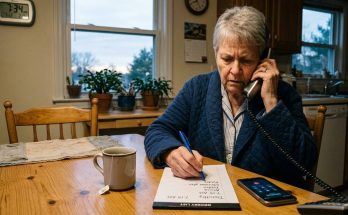
The following Sunday, my phone rang at five minutes past five.
I was in the garden trimming dead leaves from the rosemary when I heard it through the open kitchen window. For a moment, I simply stood there with the shears in my hand. For four years, Sundays had carried the same rhythm. Mark called at five. We spoke for eleven minutes. Then he said he had to go.
This time, I let the phone ring twice before answering.
“Hello?”
“Hi, Mom.”
His voice was quieter than usual.
“How are you?”
“Fine. How are you?”
“I'm okay.”
Neither of us said anything for several seconds.
Then he asked, “Can I tell you something?”
“You can tell me anything.”
“I went through our finances.”
I leaned against the kitchen counter.
“And?”
“We're worse off than I admitted.”
I closed my eyes.
He told me about the business expenses, the credit cards, the loan they had taken out when the twins were younger, and the bills that had accumulated because each month they had paid one problem by borrowing against another.
I listened without interrupting.
When he finished, he said, “Alicia thought the house would fix everything.”
“And you?”
“I thought it would make everything disappear.”
“That isn't the same thing.”
“I know.”
He sounded tired.
Not theatrically tired.
Actually tired.
I poured myself some water.
“Have you talked to Alicia?”
“Yes.”
“And?”
“She thinks I betrayed her.”
I frowned.
“How?”
“She says I changed sides.”
“You're not supposed to have sides.”
“I know.”
There was a long pause.
“She said you turned me against her.”
“I didn't.”
“I know.”
“Then what did you tell her?”
“That the house isn't ours.”
The sentence was simple.
It was also the first time Mark had said it without hesitation.
I looked through the window toward the backyard.
“Good.”
He gave a small laugh.
“You sound like Dad.”
That made me smile.
“Your father would have said it much more loudly.”
“I miss him.”
“So do I.”
We stayed quiet.
Then Mark said, “Mom, I need to ask you something.”
“What?”
“Do you think I can fix this?”
I did not answer immediately.
“You can't fix what happened.”
“I know.”
“But you can decide what happens next.”
“How?”
“Stop hiding.”
He breathed out slowly.
“I've been hiding from Alicia too.”
“That isn't fair to her either.”
“I know.”
“Then tell her the truth.”
“What if she leaves?”
I looked at Raymond's photograph.
“What if she stays because you finally stopped lying?”
He didn't answer.
That was the end of our conversation that evening.
It lasted twenty-seven minutes.
After I hung up, I stood in the kitchen and looked at the clock.
For the first time in four years, the Sunday call had not ended because Mark needed to leave.
It ended because neither of us had anything left to say.
That felt different.
Two weeks later, Alicia came to my house again.
She arrived without calling first.
When I opened the door, she held a paper grocery bag.
“I brought muffins.”
I looked at the bag.
“Blueberry?”
“Your favorite.”
“They are.”
She smiled faintly.
“Can I come in?”
I stepped aside.
She placed the bag on the kitchen counter and removed a small plastic container.
“I made the glaze myself.”
I almost laughed.
“You never made the muffins before.”
“I know.”
“Then why start now?”
She looked at me.
“Because I didn't know how else to come back.”
That answer made me pause.
We sat at the kitchen table.
The same table.
The same chairs.
But there was no folder this time.
No brochure.
No papers hidden under anything.
Alicia folded her hands.
“I owe you an apology.”
“You've apologized before.”
“I know.”
“Then why another one?”
“Because the first one was about getting caught.”
She looked down.
“This one is about what I did.”
I listened.
“I treated your house like a solution.”
“Yes.”
“I treated you like a problem standing between me and that solution.”
I said nothing.
“And I used Mark's fear to make him go along with it.”
My fingers tightened around the mug.
“That part hurt him too.”
“I know.”
She swallowed.
“I don't expect you to forgive me.”
“I don't know if forgiveness is the question.”
“What is?”
“Trust.”
She nodded.
“I understand.”
I looked at the muffins.
“You really made those?”
“Yes.”
“They're probably terrible.”
She laughed.
“I burned the first batch.”
“That sounds more like you.”
She smiled for the first time.
I cut one in half.
It was too sweet.
But not terrible.
We ate in silence.
It was not reconciliation.
Not yet.
But it was the first conversation we had shared that did not contain a hidden request.
When she left, she hugged me.
I did not immediately hug her back.
Then I did.
Not because everything was repaired.
Because I wanted to acknowledge that she had finally told me the truth.
That evening, Mark called.
“You talked to Alicia?”
“Yes.”
“What did she say?”
“She apologized.”
He exhaled.
“Really?”
“Yes.”
“What did you say?”
“I told her trust takes longer than an apology.”
He was quiet.
“She said you were right.”
“That sounds like her.”
“No,” I said. “It sounds like someone who is finally listening.”
He didn't answer.
Then he said, “We're trying.”
“Good.”
“It's messy.”
“Most important things are.”
He laughed.
“You really do sound like Dad.”
“Your father would be pleased.”
There was another pause.
Then he asked, “Can I bring the twins over next Sunday?”
“You don't have to ask.”
“I want to.”
“Then yes.”
That Sunday, the twins arrived with muddy shoes and loud voices.
They ran through the house as though nothing had ever changed.
One of them stopped beside the pantry door and traced the old pencil marks with a finger.
“Grandma, what's this?”
“Your dad's height.”
“Was he really that small?”
“Smaller.”
Mark laughed from the doorway.
“I was not.”
“You were.”
The twins argued over whose height was taller.
For ten minutes, the house sounded like it had when Mark was young.
I stood in the kitchen and watched them.
The house was not an asset.
Not really.
It was a container for memory.
That was something I had forgotten when the argument began.
Mark came to stand beside me.
“I get it now,” he said.
“What?”
“Why you didn't want to leave.”
I looked at him.
“I never needed you to understand why.”
“I know.”
“But I'm glad you do.”
He nodded.
The twins shouted from the hallway.
“Dad!”
He turned.
“Coming.”
Then he looked back at me.
“Mom?”
“Yes?”
“Thank you for not giving up on me.”
I smiled.
“I haven't.”
“But you could have.”
“Yes.”
He nodded.
“I'll remember that.”
I watched him walk away.
And for the first time since the accidental call, I believed that the house was no longer the center of the story.
The center was the choice he made after he realized what he had done.
That mattered more.
Click here to continue reading: PART 6: When Mark Asked Me to Help With the Debt, I Gave Him an Answer He Never Expected From the Mother Who Had Always Rescued Him
The Call That Was Never Meant for Me Revealed Why My Son and His Wife Suddenly Wanted Me Out of My Own Home
Part 5 of 12