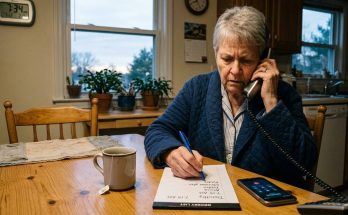
The decision came on an ordinary Tuesday.
I was not ill.
Nobody had argued with me.
Mark had not asked for anything.
Alicia had not mentioned the house in months.
There was no crisis.
I simply woke up knowing I needed to make a decision.
I walked downstairs.
The morning light came through the kitchen windows.
I made tea.
Then I sat at the same table where Alicia's folder had once rested.
I opened the locked drawer.
Inside were the property documents.
The old grocery pad.
Raymond's notebook.
The Silver Meadows brochure I had once thrown away and later retrieved.
And the envelope containing my current instructions.
I placed everything on the table.
Then I called the adviser.
When he arrived, I told him what I wanted.
“I don't want to sell.”
He nodded.
“I don't want to move yet.”
He nodded again.
“But I want the house prepared for the possibility that I will.”
“That can be arranged.”
“I want repairs done.”
“Which ones?”
“The roof first.”
He smiled.
“That is practical.”
“Raymond would approve.”
“I think so.”
I made a list.
Roof.
Heating system.
Back steps.
Bathroom railings.
Lighting in the hallway.
Not because I was surrendering.
Because I wanted the house to remain mine without pretending I would never age.
That distinction mattered.
When Mark came that weekend, I told him.
He looked at the list.
“Can I help?”
“Yes.”
“With what?”
“The back steps.”
He smiled.
“I can do that.”
“You'll need to hire someone.”
“I know.”
“You're not rebuilding them yourself.”
He laughed.
“Dad would have.”
“Your father was reckless.”
“I know.”
We spent the afternoon measuring.
Mark held the tape.
I wrote the numbers.
It was strangely satisfying.
No secrets.
No hidden agenda.
Just work.
At sunset, we sat on the porch.
Mark looked at me.
“Are you thinking about moving?”
“Someday.”
“Do you want me to help you choose somewhere?”
“Yes.”
“Even Silver Meadows?”
“Maybe.”
He smiled.
“Okay.”
I looked at him.
“Don't make that face.”
“What face?”
“The one where you think you're being tested.”
He laughed.
“I still do that sometimes.”
“I know.”
“I'm trying not to.”
“I can tell.”
That evening, Alicia called.
“How did the repairs go?”
“Fine.”
“Mark said you're thinking about moving someday.”
“Yes.”
She was quiet.
“Are you upset?”
“No.”
“You're not?”
“No.”
“Why?”
“Because it's your choice.”
I smiled.
“You finally understand.”
“Yes.”
The conversation lasted only a few minutes.
When it ended, I realized something.
The family had finally reached the point where my decisions did not frighten them.
That was freedom.
Not only for me.
For them too.
The repairs took several weeks.
The house changed slowly.
The new back steps were safer.
The hallway was brighter.
The bathroom was easier to use.
The roof stopped leaking.
None of the changes erased Raymond.
They made the house more capable of holding whatever years remained.
One afternoon, I found Mark standing in the garage.
He was holding one of Raymond's old screwdrivers.
“I remember this.”
“You should.”
“I broke it once.”
“You did.”
“I thought Dad would kill me.”
“He nearly did.”
Mark smiled.
Then he looked serious.
“Mom?”
“Yes?”
“Can I ask you something about the future?”
“You can.”
“If you move someday, what happens to this place?”
“I don't know.”
“Okay.”
“You don't need to know yet.”
“I know.”
He put the screwdriver down.
“I think I finally understand.”
“What?”
“That not knowing doesn't mean something is being kept from me.”
I smiled.
“Exactly.”
He nodded.
The twins came over that evening.
They ran through the house.
Emma stopped at the pantry.
“Grandma!”
“What?”
“I'm taller!”
She stood beside her pencil mark.
She was right.
I measured her again.
Then Noah.
Mark watched them.
Alicia took photographs.
I looked at the pantry door.
Three generations.
Three sets of marks.
A house full of time.
I realized then that the house had never been the true inheritance.
The real inheritance was the permission to become yourself without being owned by the people who came before you.
Raymond had given that to me.
I had tried to give it to Mark.
Now I was watching him give it to his children.
That was enough.
That night, after everyone left, I opened Raymond's notebook.
There was one more page I had never noticed.
It was near the very end.
He had written a list.
Not of property.
Not of money.
Just names.
Mine.
Mark's.
And, beneath Mark's name, a blank space.
I smiled.
He had probably intended to fill it with the names of future grandchildren.
He never got the chance.
I wrote Emma's name.
Then Noah's.
I closed the notebook.
The next morning, I made an appointment at Silver Meadows.
Not to move.
To ask about future arrangements.
I wanted to know what options existed if I ever needed them.
I wanted information without pressure.
When I arrived, the woman who had shown me around months earlier recognized me.
“Back again?”
“Yes.”
“Thinking about moving?”
“Thinking about planning.”
She smiled.
“That's different.”
I laughed.
“Yes.”
We walked through the garden.
I asked questions.
What happens if someone needs more assistance?
Can couples stay nearby?
What happens to belongings?
How much notice is required?
What services are optional?
I wrote everything down.
Then I drove home.
I felt calm.
The house no longer represented a battle.
It represented a choice.
That evening, Mark came over.
I told him where I had been.
He nodded.
“I'm glad.”
“You are?”
“Yes.”
“Why?”
“Because now you're planning for your future instead of waiting for someone else to plan it for you.”
I looked at him.
“That is exactly right.”
He smiled.
Then he handed me a small box.
“What is this?”
“Open it.”
Inside was Raymond's old fishing reel.
Mark had cleaned it.
“I thought you should keep it.”
“I gave you the rods.”
“I know.”
“But you kept this.”
“I changed my mind.”
I smiled.
“Good.”
He sat beside me.
For several minutes, we said nothing.
Then he said, “I remember that morning.”
“So do I.”
“I wish I could go back.”
“You can't.”
“I know.”
“But you can remember what you learned.”
He nodded.
“I do.”
“And?”
“Never make decisions about someone else's life because you're afraid to ask them what they want.”
I smiled.
“That will do.”
He laughed.
Outside, the evening settled over the yard.
The house stood quietly around us.
Nothing had been solved by a dramatic gesture.
There had been no magical restoration.
There had only been choices.
Mine.
Mark's.
Alicia's.
And the children's, waiting in the future.
I looked at my son.
“Are you happy?”
He thought about it.
“More than I was.”
“That's honest.”
“I think that's enough.”
I nodded.
“It is.”
He stood.
“I'll call Sunday.”
“I'll answer.”
He smiled.
Then he left.
I remained by the window until his car disappeared.
The old grocery pad was still in the drawer.
I took it out one last time.
The handwriting recorded the moment I had first understood what was happening.
I folded the paper carefully.
Then I tore it into small pieces.
Not because I wanted to forget.
Because I no longer needed proof.
I knew what had happened.
More importantly, I knew what had happened afterward.
That was the part I wanted to remember.
Click here to continue reading: PART 12: Years Later, I Finally Understood Why That Accidental Call Had Happened, and What Remained Was Far More Valuable Than the House
The Call That Was Never Meant for Me Revealed Why My Son and His Wife Suddenly Wanted Me Out of My Own Home
Part 11 of 12