At 7:15 that morning, my daughter-in-law called me by accident. By the time she realized what she had done, I already knew enough to understand that the conversation I had just overheard could change my relationship with my son forever.
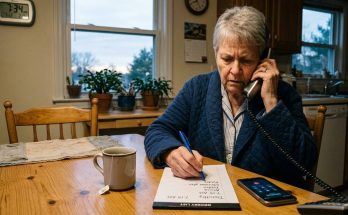
I was sitting at the kitchen table with a cup of tea beside my elbow. The house was quiet in the particular way it became quiet after my husband, Raymond, died. Four years had passed, but there were still mornings when I caught myself listening for the scrape of his chair across the floor.
My phone buzzed against the table.
Alicia.
I almost answered with a smile. She had a habit of calling me “Mother D,” usually in the bright, sugary tone she used when she wanted something. Still, she was my daughter-in-law, and I had never been interested in keeping score over small things.
“Alicia?”
No answer came.
Instead, I heard the muffled hum of a car moving through traffic. A turn signal clicked steadily. Somewhere nearby, a radio played softly beneath the road noise.
Then Alicia spoke.
“Did you bring the folder?”
I stopped moving.
A man's voice answered from farther away.
“It’s in the back seat.”
Mark.
My son.
For several seconds, I simply stared at the phone.
They had not realized I was there.
I could have said hello. I could have coughed loudly, called Alicia’s name again, or hung up and waited for her to call back properly. Any of those would have been easier.
Instead, I lowered the phone onto the table without ending the call.
I don't know whether it was instinct or something older and quieter inside me, but I reached for the grocery pad beside my purse. Raymond had always kept scraps of paper around the house for notes. Whenever something mattered, he told me to write it down before memory softened the edges.
“Dot,” he used to say, “when something matters, write it down.”
So I picked up a pen.
“What about the brochure?” Alicia asked.
“Glove compartment.”
“Good.”
There was a small laugh between them.
Then Alicia said, “Relax. She'll sign.”
My fingers stopped.
Mark didn't answer immediately.
“She signs everything we put in front of her,” Alicia continued. “Remember those forms when she got her flu shot? She didn't even read them.”
The pen touched the paper.
I wrote the sentence as carefully as I could.
My tea was still warm, but I no longer tasted it.
I had spent seventy-three years learning that people revealed themselves most clearly when they thought nobody was listening. It wasn't always malicious. Sometimes people complained. Sometimes they exaggerated. Sometimes they said things in anger they regretted ten minutes later.
But this did not sound like an argument.
It sounded organized.
It sounded rehearsed.
At 7:19, Mark finally spoke.
“What if she asks to read it first?”
My heart gave one hard beat.
Alicia answered without hesitation.
“Then you take her glasses and tell her you're getting them cleaned.”
I stared at the kitchen wall.
She said it as though she were discussing where to buy groceries.
“Honestly, Mark,” she added, “do I have to think of everything?”
I wrote that down too.
My hand felt strangely steady.
A minute later, Alicia mentioned Silver Meadows.
I knew the name.
It was a senior living community on the other side of town. I had passed its brick entrance many times, with its neat shrubs and large stone sign. I had never visited.
Alicia said her cousin worked there.
“They can get us a family discount,” she said. “It'll make everything easier.”
Everything.
That word bothered me more than the name of the place.
Mark was silent again.
Then Alicia laughed.
“You're worrying too much.”
“It just feels fast,” he said.
For one brief moment, I heard something familiar in his voice.
Not the grown man sitting in a car with his wife.
My boy.
The child who had once come through the front door with mud on his knees after falling off his bicycle. The teenager who had eaten half a pie before dinner and then denied it while crumbs clung to his shirt.
Then Alicia spoke again.
“Fast? We've been paying for that house for four years.”
My pen stopped.
That was a lie.
Nobody had been paying for my house.
Raymond and I had paid off the mortgage in 1998. I still remembered the afternoon we received the final paperwork. Raymond had opened the envelope at the kitchen counter, read it twice, and then danced badly enough to make me laugh.
The house was ours.
Entirely ours.
Four years earlier, Mark and Alicia had been expecting twins. Their rent had gone up, their savings were thin, and Mark had been working longer hours. I gave them forty thousand dollars to help them get stable.
I never called it a loan.
I never asked for it back.
I had done it because he was my son.
Apparently, they had given that gift a meaning I had never intended.
At 7:26, Alicia said something that made the room seem suddenly smaller.
“And once she's settled at Silver Meadows, we put the house on the market.”
Mark said nothing.
“Bruce says we can get one-eighty, easy.”
My stomach tightened.
Bruce was a realtor they knew.
He had visited my house twice.
The first time, Alicia told me he was helping them understand the local market.
The second time, he stood in my living room and admired the crown molding.
I had believed her.
Now Alicia continued.
“That pays for the lake trip. And the boat.”
The pen in my hand moved again.
Lake trip.
Boat.
My house.
I looked around the kitchen.
The old wooden cabinets Raymond had refinished himself were still there. The clock above the pantry still ran two minutes slow. The little dent in the floor beside the refrigerator had been there since Mark dropped a cast-iron pan when he was seventeen.
They were not discussing a building.
They were discussing my home.
At 7:31, Alicia's voice dropped.
“Let me handle the talking.”
A pause.
“You just look sad.”
Another pause.
“Can you manage sad?”
Mark answered quietly.
“Yeah.”
That one word hurt.
Not because Alicia had made a plan.
Because my son had agreed to perform it.
The call continued for another few minutes, but I barely wrote anything after that. The important pieces were already on the paper.
Silver Meadows.
The folder.
My glasses.
Bruce.
The house.
The money.
The lake.
The boat.
At 7:34, the call ended.
I kept staring at the phone.
For another minute, I did nothing.
Then I folded the grocery pad in half.
I did not cry.
I did not call Mark.
I did not call Alicia and demand an explanation.
Instead, I made two phone calls.
The first was to Eleanor.
She had lived next door for forty years. She had seen Mark grow from a boy into a man and knew enough about our family to understand when something didn't add up.
When she answered, I said, “Eleanor, I need your kitchen window and your phone camera for about an hour.”
There was a pause.
Then she said, “Finally.”
She hung up before I could ask what she meant.
My second call was to a man Raymond had trusted for decades.
He had helped my husband with important documents and knew the history of the house better than almost anyone outside our family. I told him what I had heard.
He did not interrupt.
When I finished, he said, “I'll be there.”
I thanked him.
Then I stood and looked at the kitchen.
There was no reason to panic.
I hadn't caught them stealing anything.
I hadn't been threatened.
I had simply heard a plan.
And I had every right to decide what happened to me.
I put out the good cups.
Then I sliced the banana bread Alicia always complimented.
She never actually ate it.
That morning, I cut four pieces instead of three.
I set three places at the table.
Then I added a fourth chair.
The house felt different as I waited.
At 8:40, a car turned into my driveway.
I recognized Mark's vehicle.
I moved behind the curtain.
Alicia was in the passenger seat, checking her lipstick in the mirror.
Mark sat behind the wheel.
Then I saw him look toward the house.
His face changed.
He appeared nervous.
Alicia said something to him.
He nodded.
Then, to my surprise, he practiced an expression.
A sad one.
My hand tightened around the curtain.
I had heard that conversation less than two hours earlier.
Now I was watching the performance begin.
The doorbell rang.
I counted to ten.
Then I opened the door with the warmest smile I could manage.
“What a surprise.”
Alicia smiled brightly.
“Mother D.”
She held a folder against her chest.
“We were just in the neighborhood.”
“Of course you were.”
I stepped aside.
“Come in. I have banana bread.”
Mark entered without meeting my eyes.
Alicia kissed the air beside my cheek.
“You're always so welcoming.”
“I try to be.”
They sat across from me.
Alicia placed the folder beside the butter dish.
Casually.
Almost carelessly.
But I knew exactly what it contained.
She rested one hand over mine.
“Mother D, Mark and I have been thinking about what's best for you.”
I smiled.
“How thoughtful.”
“This house is getting to be a lot.”
“The stairs?”
“Yes.”
“The stairs.”
She nodded.
“Exactly. We worry about you being here alone.”
Mark looked down.
I watched him for several seconds.
“Do you?”
His head lifted.
“Mom…”
Alicia squeezed my hand.
“We just want you safe.”
“Safe from what?”
Her smile faltered.
“From being alone in a house that's too much for one person.”
Mark's face had become solemn.
The expression he had practiced in the car.
I almost laughed.
Instead, I asked, “Then why did you bring a folder?”
Alicia's fingers tightened around the pen.
“Oh, this?”
She opened it.
“Just some information. Nothing complicated. You don't need to read every—”
The doorbell rang.
Alicia stopped.
She looked toward the hallway.
“Are you expecting someone?”
I stood.
“Oh,” I said. “Didn't I mention?”
I opened the door.
Eleanor stood there with her phone in one hand.
Beside her was Raymond's longtime adviser.
Both of them stepped inside.
Mark went completely still.
Alicia's face lost its color.
Eleanor gave me a small nod.
Then she moved where she could see the table and raised her phone.
Alicia stared at it.
“What is this?”
I closed the door.
“A witness.”
She looked at me as though I had suddenly become a stranger.
“Mother D, what are you doing?”
I returned to my chair.
“I'm making sure everyone understands what is happening in my house.”
Mark pushed his chair backward.
“Mom, this is unnecessary.”
“Is it?”
He didn't answer.
Alicia folded her arms.
“We came here to discuss your future.”
I looked directly at her.
“No. You came here with papers.”
She glanced at the folder.
“Those papers aren't what you think.”
“Then you won't mind telling me what they are.”
“It's information about Silver Meadows.”
“And the other papers?”
“Nothing final.”
I nodded slowly.
“Then why did you tell Mark to take my glasses away?”
The silence that followed was immediate.
Alicia looked at Mark.
Mark looked at her.
“What?” he asked.
“You heard me.”
He shook his head.
“You said that?”
Alicia opened her mouth.
Nothing came out.
I placed both hands flat on the table.
“I heard the whole conversation.”
Mark's face drained.
Alicia stared at me.
“You heard us?”
“Every word I could.”
The room seemed to shrink.
“The brochure,” I continued. “The family discount. Bruce's estimate. Selling the house. The lake trip.”
Mark looked toward the floor.
Alicia's expression hardened.
“You weren't supposed to hear that.”
“No,” I said quietly. “I wasn't.”
And for the first time that morning, nobody in the room pretended this was about my safety.
Click here to continue reading: PART 2: The Folder on My Table Was Supposed to Make Me Obedient, Until the Papers Beside It Exposed What They Had Misunderstood
The Call That Was Never Meant for Me Revealed Why My Son and His Wife Suddenly Wanted Me Out of My Own Home
Part 1 of 12