I knew something was wrong before my son had even stepped inside the house. Ethan stood on my porch with his two-month-old son strapped into a gray carrier, his eyes fixed on the driveway instead of my face. He looked as though he had rehearsed what he meant to say during the drive over and had forgotten every word the moment he reached my door.
“Mom, I need you to watch Noah for a few hours.”
I moved aside, expecting him to bring the carrier into the hallway. Instead, he handed it to me with a sharp, hurried motion and passed over a navy diaper bag embroidered with his initials. The bag was expensive, like nearly everything in his household, but the way he clutched its handles before releasing them made the gesture feel less like a simple handoff than an attempt to get something dangerous out of his possession.
“Of course,” I said. “What's happened? Is Lauren all right?”
“She’s out.”
“Out where?”
He rubbed his palm against his trousers. “Just out. She has things to do.”
I was sixty-four years old, had raised three children, buried my husband ten years earlier, and learned that adults rarely became nervous without a reason. Ethan had always been the most composed of my children. Even as a teenager, he could explain a broken window, a failed examination, or a terrible decision in a voice so reasonable that I sometimes forgot how young he was. Now his hair was untidy, his collar sat crookedly against his neck, and sweat shone along his forehead despite the cool October afternoon.
Then he gave me an instruction that made no sense.
“Don't take Noah's onesie off. Whatever you do, leave it on.”
I glanced at the baby. He wore a plain white cotton outfit, the kind of soft clothing I had bought for my own children decades earlier. His face was turned toward the carrier's padded side, and one small hand rested beside his cheek.
“Why would I take his clothes off?”
“Just promise me.”
“Ethan, babies spit up. They get dirty. If he needs changing, I'm going to change him.”
“No.” The word came out harder than he intended. He looked toward the road, then back at me. “Please, Mom. Just don't remove it.”
I reached for his arm. He recoiled before I could touch him.
That small movement frightened me more than his words. My son had never been afraid of my hands. I had held those hands when he was learning to walk, cleaned scraped palms after bicycle accidents, and clasped them at his father's funeral when he could barely stand. Seeing him pull away from me as though a touch might hurt him left a hollow ache beneath my ribs.
“Where's Lauren really?” I asked.
“She's not here.”
“That's not an answer.”
He stared at the carrier. For one fleeting second, his expression changed. Fear gave way to something that looked almost like an apology. Then his face tightened again.
“I need you to do this for me.”
He stepped backward onto the porch.
“Ethan, wait. At least come in and have some tea.”
“I can't.”
“Why not?”
He didn't answer. He turned, hurried down the steps, and got into his sedan. By the time I had carried the baby across the threshold, the engine was already running. I watched through the narrow glass panel beside the front door as he reversed out of the driveway and disappeared around the corner without looking back.
The house fell quiet.
I set the carrier on the living-room rug and unfastened its straps. Before I could lift Noah, he began to cry. At first, I thought he was hungry. I had raised three babies and helped with enough grandchildren to know that newborns announced their needs without much concern for the inconvenience of anyone around them.
But this cry was different.
It rose sharply, broke, and rose again. Noah's face reddened until the skin around his eyes looked almost purple. His little fists clenched against his chest, and his body stiffened when I slid one arm beneath him.
“Easy, sweetheart. Grandma's here.”
I lifted him carefully, supporting his head and neck. He arched backward, letting out a sound so raw that I instinctively checked whether I had accidentally pressed against his fingers or caught his clothing on the carrier.
Nothing explained it.
I warmed a bottle, tested a drop of formula on my wrist, and brought the nipple to his mouth. He turned away, crying harder. His diaper was dry. I walked the length of the living room, humming the lullaby I used to sing to Ethan when thunderstorms frightened him as a little boy.
Noah only grew more distressed.
Then my hand passed across his abdomen.
I felt an unnatural firmness beneath the cotton, followed by a slight swelling that did not belong on the soft, rounded stomach of a healthy infant. When I tried to reposition him, he screamed with such sudden force that my arms nearly gave way.
I remembered Ethan's warning.
Don't take his onesie off.
For several seconds, I simply stood there, rocking a child who seemed to be hurting with every breath. I tried to invent an innocent explanation. Perhaps a medical bandage lay beneath the fabric. Perhaps he had been fitted with some kind of monitor. Perhaps Ethan had forgotten to explain a condition that required special care.
But my son had not mentioned a medical appointment, a rash, or even an upset stomach. He had looked at me as though he was afraid of what I might discover.
I carried Noah to the couch and laid him on a folded blanket, keeping one hand beneath his head. My fingers trembled as I opened the snaps at the bottom of his onesie. I paused once, listening to the thin, desperate sounds coming from his throat.
“I'm sorry, baby,” I whispered. “I need to see.”
I eased the fabric upward.
The bruise covered much of his little belly. Deep violet and almost black in places, it spread across his skin with patches of yellow near the edges. Four distinct indentations stood out against the discolored flesh, arranged like the marks left by someone's fingers gripping him too tightly.
For a moment, the room seemed to lose its shape.
I had seen bruises before. My children had fallen off playground equipment, collided with furniture, and returned home with scraped knees and swollen elbows. Those injuries belonged to childhood, to movement and accidents and the occasional foolish risk.
This was not that.
Noah's abdomen was swollen and hot. When I touched the fabric beside the injury, he cried out again. I pulled my hand away so quickly that I knocked the bottle from the coffee table.
“Oh, God.”
The words escaped before I could stop them.
I wrapped him in a thick fleece blanket, leaving his face uncovered, and reached for my keys. I didn't change my clothes, turn off the kettle, or lock the back door. I carried the diaper bag to the car, secured Noah as carefully as I could in his carrier, and drove straight to St. Vincent's pediatric emergency department.
The trip usually took twenty minutes. That afternoon, every red light felt like a personal cruelty. I kept checking the rearview mirror, terrified that Noah's cries would stop before we reached the hospital. When his screaming dwindled to weak, exhausted whimpers, I began talking to him continuously, telling him about the trees along the road and the little house where I would read him stories when he was older.
I had no idea whether he could hear me.
I only needed him to remain alive long enough for someone to help him.
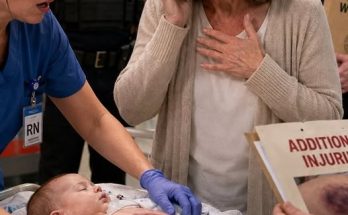
At the emergency department, I hurried through the sliding doors and approached the triage desk. A nurse with tired eyes and a clipped, efficient manner asked what had happened. I couldn't explain it in a coherent sentence. Instead, I lowered the blanket enough to show her the bruising.
Her expression changed immediately.
She called another nurse without taking her eyes off Noah. Within seconds, a second member of staff appeared, followed by a doctor who asked me to place the carrier on the examination scale.
They moved quickly after that. Noah was taken through a set of doors, and I was asked to follow while someone brought a hospital blanket and a small monitor. I watched a nurse place a sensor against his foot. The screen filled with numbers I couldn't interpret.
“What's wrong with him?” I asked.
“We're assessing him now,” the doctor replied. “We need to understand the extent of his injuries.”
“Can you make him comfortable?”
“We're doing everything we can.”
He said it gently, but his eyes had already shifted toward another member of the medical team.
A nurse asked whether Noah had fallen, whether he had been ill, and whether anyone had noticed him in distress earlier that day. I told her what I knew. My son had dropped him off. He had ordered me not to remove his clothing. I had found the bruising and driven straight here.
Then the nurse asked where Noah's parents were.
“I don't know,” I admitted. “His mother was supposedly out. My son left before I could ask anything else.”
A doctor listened to Noah's chest while another carefully examined his abdomen. Their voices grew quieter, and one of them asked for imaging. I caught fragments of their conversation: internal trauma, possible fractures, bruising that might not have occurred at the same time.
My knees weakened.
Bruising from different incidents meant that someone might have hurt him more than once. It meant the injury I had discovered could be only the most visible part of something much worse.
A uniformed police officer arrived while the staff prepared Noah for further examination. He introduced himself as Officer Davis and asked whether I could answer a few questions. I looked past him toward the doors where my grandson had disappeared.
“Please tell me he's going to be all right first.”
“I wish I could give you that assurance,” he said. “The doctors are working on it.”
I gripped the edge of the counter until my fingers hurt.
That was when my phone began vibrating in my coat pocket.
Ethan's name appeared on the screen.
I answered immediately. “I'm at the hospital. Noah's hurt. What happened to him?”
He didn't ask what the doctors had found. He didn't ask whether the baby was conscious. He didn't even ask which hospital I had chosen.
Instead, he whispered, “You took his clothes off?”
I stared at the red emergency telephone mounted beside the nurse's station. A nurse had just lifted the receiver and begun speaking in a low, urgent voice.
“Yes,” I said. “I took his onesie off. Ethan, what did you know?”
Silence.
Then he said, “You have to leave. Take Noah and go somewhere else. Right now.”
“Are you out of your mind? He's receiving medical treatment.”
“Mom, listen to me. Lauren knows he's with you.”
“How could she know that unless you told her?”
His breathing grew ragged. In the background, I heard a car horn and what sounded like a distant siren.
“She knows,” he repeated. “She knows you've seen it.”
“Seen what? What happened to my grandson?”
The answer came so quietly that I almost missed it.
“It's too late. She's already set the fire.”
The call ended.
I stood holding the phone against my ear, waiting for him to call back, while two uniformed officers entered the emergency department. One spoke to the receptionist. The other scanned the waiting room until his eyes settled on me.
Behind the doors, Noah's monitor continued to sound.
And for the first time in my life, I was afraid not only of what my son might have done, but of what someone else might do to keep the truth from coming out.
Click here to continue reading: PART 2: The Doctors Found Injuries That Could Not Have Come From One Accident, and the Detective Asked About a Night I Had Tried to Forget
The Afternoon My Son Left His Baby Behind, and the Warning That Made Me Question Everything I Thought I Knew
Part 1 of 12