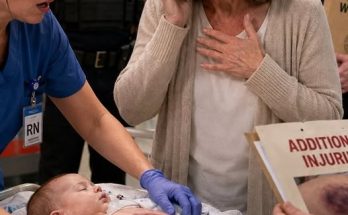
Mark arrived at the hospital shortly before nine that evening. My youngest child lived in Cincinnati, about two hours away, and I knew from the way he came striding through the ward doors that someone had told him only enough to frighten him.
His cheeks were flushed, his jacket hung open, and his phone remained clenched in one fist.
“Where's Ethan?”
I rose from my chair. “Mark, keep your voice down. Noah's resting.”
“I'm not asking about Noah. I'm asking where my brother is.”
Claire stood beside the window with her arms folded tightly across her chest. She had barely spoken since telling Detective Morales what she had heard at the baptism. Every so often, she glanced toward Noah's bed, as though she needed to reassure herself that he was still there.
“Ethan is in police custody,” I said.
Mark stared at me. “Why?”
“Because the police need to establish what happened to his son.”
“Did he hurt the baby?”
“Noah's injuries are being investigated. We believe Lauren may be responsible.”
Mark looked past me through the glass panel in the door. His expression changed when he saw the little body beneath the blanket. For a second, his anger disappeared, leaving only grief. He rubbed his face with both hands and turned away.
“Jesus, Mom.”
I led him to a small waiting alcove at the end of the corridor. Claire followed, and I explained everything I could: Ethan's strange visit, the bruising, the call, the note, and the missing camera card.
Mark listened without interrupting. His face grew harder with every sentence.
When I finished, he stared at the floor.
“So he knew.”
“He was afraid of her.”
“He knew his baby was being hurt, and he stayed in that house?”
“He says she was blackmailing him.”
Mark gave a short, disbelieving laugh. “And that makes it all right?”
“No. I didn't say that.”
“Then why are you defending him?”
“Because I am trying to understand what happened, not excuse it.”
He paced the narrow alcove, running a hand through his hair. I could see the struggle in him. He loved his brother, but he had always been the one who spoke first when someone needed to be confronted. Ethan avoided arguments; Mark charged into them. Their differences had caused trouble since childhood, and now they were facing a crisis neither temperament could solve on its own.
“He should have taken Noah and walked out,” Mark said. “He should have called the police. He should have come to you. Anything but leaving that child there.”
“I know.”
“Do you?” His eyes filled, and he looked away before the tears could fall. “Because if I'd known, I'd have driven over there myself.”
I reached for his arm, but he stepped back.
“I can't talk about this yet, Mom.”
He went to the cafeteria and returned with a cup of coffee he barely touched. Claire sat beside me, holding both hands around a paper cup of water. None of us knew what to say. We had spent years arguing about holidays, birthdays, money, and the small grievances families collect when they assume there will always be time to settle them.
Now the future of our family seemed to depend on questions we had never thought to ask.
Around midnight, the ward grew quieter. Nurses moved between rooms, checking charts and adjusting medication. I sat outside Noah's door, listening for changes in the rhythm of his monitor.
My phone vibrated.
The screen displayed an unfamiliar number.
I remembered Detective Morales's warning and hesitated before answering. An officer was standing at the far end of the corridor, but I didn't want to draw attention to myself if the call was harmless. I pressed the green button and held the phone to my ear.
For several seconds, there was only static.
Then a woman spoke.
“Hello, Carol.”
I recognized Lauren immediately.
Her voice was soft and measured, the same pleasant voice she used when greeting guests at dinner or explaining to me why Noah needed another brand of organic formula. Hearing it now made my skin prickle.
“Where are you?” I asked.
She laughed lightly. “That's the first thing you want to know?”
“Your baby is in intensive care.”
“Our baby,” she corrected. “And I know exactly where he is. Ethan made certain everyone knew where to look.”
“Lauren, what happened to him?”
“You've always thought I was a bad wife.”
“I'm not discussing your marriage. I'm asking about Noah.”
“You never liked me. You didn't like that Ethan chose me. You didn't like that I wanted a life of my own instead of spending every weekend at your house.”
I gripped the phone more tightly.
“This is about a two-month-old child who is injured and frightened. Whatever problems you think we have, they have nothing to do with him.”
“Don't pretend you care about me, Carol.”
“I care about Noah. I care about what happened to him. If you hurt him, you need to turn yourself in.”
The softness vanished from her voice.
“Ethan hurt him. He has been unstable for months. He can't cope with being a father, and he resents me for wanting to work again. He's been obsessed with proving that I'm a terrible mother.”
I thought of the note in the diaper bag. I thought of the bruises and the way Ethan had flinched when I reached for him.
“Why did he leave Noah with me?” I asked.
“Because he knew you'd believe anything that made me look bad.”
“Then why did he tell me not to remove the baby's clothes?”
Silence.
I could hear her breathing, slow and controlled. For a moment, I wondered whether the connection had failed.
Then she said, “You shouldn't have done that.”
The words were quiet, but they carried no concern for Noah's pain. She sounded angry that I had discovered something she wanted concealed.
“What did you do to him, Lauren?”
“You have no idea what Ethan is capable of.”
“Then let the police investigate.”
“They're already investigating. That's the point.” Her voice became sharper. “He has recordings. He has been collecting things to make me look dangerous. Ask yourself why he needed a camera in the nursery. Ask yourself why he didn't stop me if he knew I was hurting the baby.”
My stomach tightened.
I had been trying to understand Ethan's fear, but Lauren was forcing me to look at the other possibility: that his silence had not been entirely passive. Perhaps he had watched more than he admitted. Perhaps he had waited for evidence because he wanted something from her, or because he was too frightened to act without proof.
“Why don't you explain that to Detective Morales?” I asked.
Lauren gave another small laugh.
“Ask your son why he watched. Ask him why he waited.”
The call ended.
I lowered the phone slowly. The corridor seemed unnaturally bright, and the floor beneath my feet felt unsteady.
An officer approached me immediately. I told him who had called and repeated as much of the conversation as I could remember. He radioed for assistance, then asked whether Lauren had mentioned her location.
“No. She wanted me to doubt Ethan.”
Detective Morales arrived about twenty minutes later. Her hair had begun to loosen from its tight knot, and the collar of her jacket was creased. She took my phone and asked me to describe the call again, recording every detail.
“She's trying to establish a narrative,” Morales said when I finished. “That doesn't prove her allegations are false, but we need to examine them alongside the physical evidence and any recordings we can recover.”
“Could Ethan have hurt Noah, too?”
“That's a question we'll have to answer through evidence, not assumptions.”
I looked toward the room where my grandson was sleeping.
“I don't want to believe either of them could do this.”
“Belief won't help us here, Mrs. Bennett. Facts will.”
She asked me to unlock my email on a hospital tablet so the technical team could examine a message that had just arrived from an unfamiliar account. The message had no text, only three video attachments.
The first file was several years old. It showed a nursery in an unfamiliar house, with a toddler standing in a crib. A woman entered the room, approached the child, and hurt him with a sudden, deliberate movement. The toddler began screaming. The woman looked toward the doorway, then reached for him as though she intended to soothe him. The video stopped abruptly.
I covered my mouth.
The woman looked like Lauren.
She was younger in the footage, with a slightly different hairstyle and a face that seemed less polished. But the shape of her eyes and the expression she wore when she looked down at the child were unmistakable.
“Who is that baby?” I asked.
“We're working on identifying him,” Morales said.
The second video showed Ethan in Noah's nursery. He was sitting on the floor with his knees drawn to his chest, his face wet with tears. Lauren stood nearby holding Noah, who was crying loudly.
She told Ethan to make the baby stop. When he failed to move, she threatened to drop Noah.
Ethan begged her not to.
The scene lasted less than a minute, but it left me shaken. He looked terrified, barely able to speak. Lauren's voice remained calm, almost playful, as she used his fear to control him.
When the video ended, I sat perfectly still.
“Was he recording that?” I asked.
“We don't know who made this particular recording,” Morales replied. “We need the original files and their metadata.”
I wanted to defend my son. I wanted to tell the detective that the man in the video could not possibly be the same boy who once stood up to a bully twice his size. But the footage showed what it showed. Ethan had been frightened into obedience, and Noah had been placed in danger while his father watched.
Fear explained something. It did not erase the consequences.
Morales asked the technical officer to examine the first video and search for any records associated with Lauren's previous identities. The officer worked quickly, cross-referencing the image with available records.
A few minutes later, he found a possible match.
The woman in the older footage had been known as Sarah Jenkins. She had worked as an au pair for an affluent family in Chicago and had been charged with child abuse after a toddler suffered serious injuries. The case had collapsed when the child's father withdrew his statement and claimed the injuries were accidental.
Two months after the charges were dropped, Sarah Jenkins changed her name to Lauren Davis. She later moved to Ohio, where she met Ethan.
Morales leaned closer to the screen.
“That's a significant lead,” she said. “But we'll need the original case records and independent confirmation before we can establish that the woman in this footage is the same person.”
I looked at Lauren's frozen face on the tablet.
She had built a new identity, a new home, and a public image that made people trust her. She had married my son and brought a child into a household that appeared safe to everyone who saw it from the outside.
And now the same questions that surrounded the old case were gathering around Noah.
Morales's radio crackled.
An officer had searched the floorboards in the master bedroom of Ethan's house and discovered a concealed safe. It contained almost nothing, except for a first-class ticket to Zurich, scheduled to depart from Chicago O'Hare at six the following morning.
The time on the wall clock read three.
Morales stood so quickly that her chair scraped backward.
“Notify the relevant authorities,” she ordered. “We need to establish whether she's planning to leave the country.”
She turned to me.
“Mrs. Bennett, if Lauren is the person in those recordings, she may have done this before. And if she knows we have evidence, she may be preparing to disappear.”
I thought of the old case in Chicago, the father who had recanted, and the child whose suffering had apparently gone unanswered.
Then I thought of Noah, lying in a hospital bed while strangers worked to understand what had happened to him.
Lauren had built a life on the assumption that people would believe the version of events she presented. This time, however, there were injuries, a hidden note, and recordings that could not be explained away with a carefully chosen smile.
Morales headed for the door.
I caught her arm before she reached it.
“If you find her,” I said, “don't let her talk her way out of this.”
She looked at me, her expression steady.
“We won't make decisions based on what she says, Mrs. Bennett. We'll make them based on what we can prove.”
Then she left to coordinate the search, and I remained beside my grandson, watching the monitor and wondering how many other people had been persuaded to doubt what they saw.
Click here to continue reading: PART 4: The Photograph of My House Revealed That Lauren Had Been Watching Us, and Her Next Message Changed the Meaning of Everything
The Afternoon My Son Left His Baby Behind, and the Warning That Made Me Question Everything I Thought I Knew
Part 3 of 12