The morning after the recording was recovered, Detective Morales arrived at the hospital with a new set of questions for Ethan. The audio specialists had made a preliminary comparison between the woman's voice on Daniel's device and verified samples of Lauren speaking.
The results were consistent with Lauren's voice, though the specialists cautioned that further analysis was necessary before the recording could be used to support a definitive identification.
Morales explained that the recording had been preserved and that investigators were examining the circumstances under which it was made. They were also comparing it with the original medical records and Daniel's statements.
“Does it prove she hurt the child?” I asked.
“Not by itself,” she replied. “It provides evidence of a threatening conversation and may help explain why Daniel withdrew his statement. We still need to establish the underlying facts.”
I understood the distinction, though part of me wanted the recording to settle every question at once. I wanted something undeniable, something that would prevent Lauren from turning the story around and making everyone doubt what they had seen.
But the investigation was not a story with a single revelation that explained everything. It was a collection of events, decisions, and pieces of evidence that had to be examined together.
At nine, Ethan's attorney arranged a formal interview with Detective Morales and another investigator. Ethan would provide a detailed account of his relationship with Lauren, including what he had learned about her previous identity and when he first became concerned about Noah's safety.
Morales asked whether I wanted to hear the interview. I declined. I needed to remain focused on Noah, and I knew that hearing every detail would not necessarily help me understand what had happened.
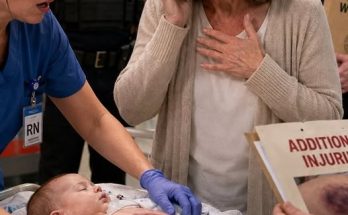
Instead, I sat beside my grandson while Claire read him a picture book. He was awake for longer periods now, occasionally moving his fingers or turning his head toward a familiar voice.
The doctors remained cautious, but his progress gave us hope.
Around eleven, the social worker returned with a preliminary recommendation. My home had passed the initial safety assessment, and the child-protection team was prepared to consider placing Noah with me once the medical team approved his discharge.
I felt my eyes fill with tears.
“Thank you,” I said.
The social worker smiled gently. “We'll continue working through the arrangements. There will be follow-up visits and appointments, and you'll have support available.”
“I'll do whatever he needs.”
“I know. We just want to make sure everything is in place before he leaves.”
After she left, Claire hugged me. Mark, who had come in carrying another bag of clothes, stood beside us with his hands in his pockets.
“We'll help,” he said. “You won't have to do this alone.”
For the first time, the prospect of Noah coming home felt real enough to touch.
Then my phone vibrated.
The message came from an unfamiliar account. It contained no greeting, only a photograph of a document laid across a wooden table.
I recognized the handwriting immediately. It was the same careful script I had seen on the note from the hotel.
Beneath the photograph was a short message.
You have only half the truth.
I stared at the screen.
Morales was in the corridor, speaking with the technical officer. I called her back into the room and showed her the message.
She examined the photograph, then asked the officer to preserve the original data and record the time it had arrived.
“Do you recognize the document?” she asked.
I enlarged the image. The page appeared to be a handwritten list of dates and names, similar to the list recovered from the storage unit. But this version included an additional line at the bottom.
The original is not the only copy.
I felt a chill move through me.
“Does that mean Lauren has another recording?” I asked.
“It could mean several things,” Morales replied. “We won't assume the message is authentic or that it came from Lauren. But we will investigate it.”
She asked whether I had received any other messages from the same account. I checked the thread. There were no earlier messages, and the account had been created recently.
The message could have been a warning, a bluff, or an attempt to redirect the investigation. We had no way of knowing yet.
Morales sent the image to the technical team and asked them to compare the handwriting with the documents recovered from the storage unit and the hotel.
While they worked, I returned to Noah's bedside. He had fallen asleep again, his breathing soft and regular.
I wanted to protect him from every threat, every uncertainty, and every consequence of the adults' decisions. But I knew that the only way to do that was to let the investigation proceed carefully, even when the answers came slowly.
At one-thirty, Morales returned with a preliminary result. The handwriting in the photograph appeared similar to the notes found in the storage unit, but the comparison was not conclusive. The technical team was also examining the image's metadata to determine whether it had been taken recently or copied from an older file.
“Could this be a message from Lauren?” I asked.
“Yes. But it could also be someone else with access to the documents. We need more evidence.”
Morales then told me that Ethan's interview had produced an important admission. He had known about the old recording before Noah was born, and he had deliberately kept that information from the police because he wanted to use it as leverage against Lauren.
He had believed that if he could force her to leave, he could protect Noah without exposing himself to the consequences of his own conduct.
“Did he ever tell her he had the recording?” I asked.
“Yes. He says he confronted her with a copy of the audio and threatened to expose her if she didn't agree to leave the marriage.”
I sat back.
“So they were both trying to control each other.”
“That appears to be part of what happened,” Morales said. “But we still need to establish the sequence of events and whether Ethan's account is supported by the evidence.”
The admission changed how I understood my son's behavior. He had not simply been too frightened to act. At some point, he had tried to use the information he possessed to bargain for a result he wanted. He had turned the evidence into a weapon rather than using it to seek protection for his child.
That choice had not made him responsible for every injury Noah suffered, but it had helped keep the family trapped in a dangerous situation.
“Did he say why he didn't call the police when the threats began?” I asked.
“He said he believed he could resolve the situation privately. He was also afraid of the consequences if the recordings became public.”
I looked toward Noah's bed.
“He was thinking about himself.”
“He was thinking about several things,” Morales replied. “Fear, reputation, access to his son, and control over the situation. That doesn't excuse the delay. It helps us understand his decisions.”
At three, the hospital's child-protection specialist met with me to discuss the conditions that would apply if Noah were placed in my care. I would need to keep records of medical appointments, report any attempted contact from Lauren, and follow the safety plan established by the authorities.
I agreed without hesitation.
The specialist also explained that Ethan's access to Noah would be subject to review. Until the investigation progressed and the relevant authorities made a decision, I should not arrange any private meeting between father and son.
I understood. I wanted Ethan to have a chance to repair what he had damaged, but that chance could not come at Noah's expense.
At four-thirty, the technical team identified a possible connection between the anonymous message and an account used to store the old recordings. The account had been accessed from a device associated with a public internet connection in Chicago.
The location was not precise enough to identify a person, but it suggested that whoever sent the message might have access to material from the old case.
Morales immediately contacted the Chicago investigators.
They had found another item in the storage unit: a small notebook containing a list of passwords and references to several online accounts. One entry matched the account that had been used to store the recovered nursery recordings.
Another entry referred to a folder labeled ORIGINAL.
The folder had not been recovered from the devices already examined.
“Could it contain the missing recording?” I asked.
“Possibly,” Morales replied. “We're trying to determine whether the folder existed on another device or whether it was stored remotely.”
She explained that the investigators were pursuing the necessary legal requests to recover the account information. It would take time, and there was no guarantee that the files still existed.
I looked at the photograph on my phone.
You have only half the truth.
The message might have been designed to frighten me, but it had also pointed toward a real question. Someone had kept a second copy of the documents, or at least wanted us to believe that such a copy existed.
The investigation was no longer limited to recovering what Lauren had left behind. It now had to determine whether the missing material could establish something that the available evidence could not.
At six, Ethan's attorney called with another update. Ethan had agreed to provide the investigators with a full copy of the audio he had used to confront Lauren. He had kept it on a separate device, and his attorney believed it could help establish the timeline of their arguments.
Morales asked that the device be transferred through the proper channels.
“Is Ethan cooperating fully now?” I asked.
“He has agreed to provide additional evidence,” Hale replied. “The investigators will decide whether his account is complete.”
I thanked him and ended the call.
I was relieved that Ethan had finally begun sharing what he knew, but I could not forget how long he had withheld it. The evidence might help explain his fear and Lauren's threats, yet it would not erase his failure to seek help when Noah needed him.
I returned to the bedside and sat quietly until the nurse came to check Noah's monitor. His breathing remained steady, and he stirred when she touched his foot.
I held his hand.
“You're going to have a home where people tell the truth,” I whispered. “Even when it's difficult.”
Outside, the evening lights came on across the parking lot. Somewhere in Chicago, investigators were searching for a missing folder. Somewhere else, Lauren might still be deciding whether to leave the country or attempt to recover the evidence she had lost.
I did not know which possibility frightened me more.
At eight, Morales received a final update before leaving the hospital. The technical team had traced the anonymous message to an account that appeared to have been created using information from a public computer. The account's activity suggested that the sender had access to at least some of the documents from the storage unit.
The investigators still could not identify the sender.
But the message had arrived shortly after Ethan disclosed that he had used the old recording to pressure Lauren.
Morales looked at me.
“Someone may be reacting to what Ethan has told us. We need to find out who had access to that information.”
I nodded.
The investigation had exposed the threats, the hidden recordings, and the decisions that had allowed the danger to continue. Yet the final message suggested that the person behind the account still possessed something the police had not found.
I watched Noah sleeping beneath the hospital blanket.
The truth was coming into view, but it was not complete.
And until the missing evidence was recovered and Lauren was found, none of us could know whether the next revelation would finally close the case—or force us to confront something even more difficult.
The End
Read more original stories on Feel Every Story.
The Afternoon My Son Left His Baby Behind, and the Warning That Made Me Question Everything I Thought I Knew
Part 12 of 12