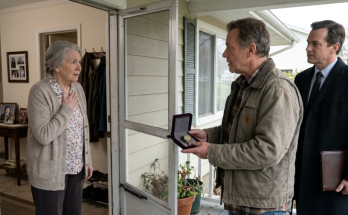
Mr. Cole spent the next two days trying to locate Patricia Whitaker.
The name was common, and the address listed in the old police file was no longer current. The telephone number had been disconnected decades ago.
We knew Daniel had a wife and daughter when he disappeared.
We knew Patricia had reported him missing.
And we now knew she had visited Dad years later and taken the old filing cabinet from our garage.
But we didn't know whether she was still alive.
On Wednesday afternoon, Mr. Cole called with a lead.
He had located a public record indicating that Patricia had moved to a town about two hours away. The address was old, but a relative had confirmed that Daniel's daughter still lived in the area.
Her name was Laura Whitaker.
Mr. Cole contacted her and explained that we were trying to understand what had happened to her father.
She agreed to meet us.
Mom wanted to come.
I offered to drive.
We left early the next morning, carrying copies of the ledger entries, the photograph, and the small key from Dad's toolbox.
The road took us through several quiet towns before opening onto a stretch of farmland. The sky was clear, and the fields were beginning to turn gold.
I wondered what Laura had been told about her father.
She had been a child when he disappeared.
She might have grown up hearing that he had abandoned her.
Or she might have been told the truth, whatever that truth was.
When we arrived, Laura was waiting on the porch of a modest brick house.
She was in her late forties, with dark hair tied loosely behind her head. She looked at Mom first, then at Mr. Cole.
“You're Harold Brennan's family?”
Mom nodded.
“I'm his wife. This is my daughter, Jenny.”
Laura stepped aside and invited us in.
The living room was filled with family photographs.
One showed a young girl sitting on a man's shoulders beside a lake.
I recognized the man's serious expression from the newspaper clipping.
Daniel.
Laura noticed me looking.
“That was taken when I was four,” she said. “A year before he disappeared.”
Mom sat down carefully.
“I'm sorry we didn't come sooner.”
Laura's expression softened.
“You didn't know where to find us.”
She was right.
We had only recently learned that Daniel had a family.
Mr. Cole explained that we had recovered a ledger from the old mill and found documents suggesting Daniel had been falsely accused of financial wrongdoing.
Laura listened without interrupting.
When he mentioned Robert Vale, her hands tightened around her cup.
“I remember that name,” she said.
I leaned forward.
“Your mother knew him?”
“My mother knew his wife. Eleanor used to visit us sometimes.”
Mom exchanged a look with me.
We had found the woman from the photograph.
Laura continued.
“After Dad disappeared, Eleanor came to see my mother. She told her that the company had been asking questions about some missing money and that my father might have gotten himself into trouble.”
“Did your mother believe her?” I asked.
Laura looked toward the family photographs.
“Not entirely. My mother always said Dad was afraid of something, but she didn't believe he would leave us without a word.”
She took a breath.
“After a while, people stopped asking questions. The police kept the file open for some time, but there were no new leads. My mother had to work, raise me, and pay the bills. She couldn't spend every day waiting for someone to explain what had happened.”
Mom lowered her eyes.
“I can't imagine how hard that must have been.”
Laura nodded.
“Dad had been a good father. He fixed things around the house, took me fishing, and read to me at night. He wasn't perfect, but he loved us.”
She paused.
“That's why it hurt when people said he had run away.”
I felt the words like a blow.
Daniel's disappearance had not been a line in an old report.
It had left a little girl growing up without her father, a wife struggling to keep their household together, and a family living with an accusation they could never fully answer.
Dad had known that.
Perhaps that was why he had kept the evidence.
I showed Laura the photograph of the three men.
She examined it for a long time.
Then she pointed to Eleanor in the background.
“My mother kept a picture of her.”
Mom leaned closer.
“Did Eleanor ever tell your mother why she was at the mill?”
“No. But she came to our house shortly after Dad disappeared. She asked my mother whether he had left any papers behind.”
Mr. Cole wrote something in his notebook.
“What did your mother tell her?”
“She said she had nothing except the letters Dad had sent her.”
Laura looked at us.
“Eleanor seemed relieved. At the time, I thought she was trying to help. I was too young to understand why she would care about my father's papers.”
I thought of the signature on the payment authorization.
Eleanor's connection to the mill was still unclear.
She might have been involved in the accounting.
She might have known what Robert had done.
Or she might have been trying to help Daniel's family while hiding something of her own.
We had no proof.
Laura stood and went to a cabinet near the hallway.
She returned carrying a small cardboard box.
“My mother kept these things after Dad disappeared. She died six years ago, and I couldn't bring myself to throw them away.”
Inside were several letters, a work badge, and a folded sheet of paper.
Laura handed the paper to Mr. Cole.
It was a receipt for a filing cabinet.
The date was fifteen years earlier.
The buyer's name was Patricia Whitaker.
The delivery address was our old house.
I stared at the receipt.
“That's the cabinet Mom remembers.”
Laura nodded.
“My mother told me she gave it to Harold because he said he wanted to keep some of Dad's work papers safe. She didn't know what was in it.”
“Did she ever ask for it back?” I asked.
“No. She believed Harold was trying to help.”
I looked at Mom.
Dad had not simply kept the cabinet.
He had received it from Daniel's widow and retained a key to something inside it.
We still didn't know whether the cabinet had contained the original accounting records, Daniel's personal documents, or something entirely different.
But we now had a direct link between the key and Patricia.
Laura examined the small key Mr. Cole had brought.
“I remember seeing one like that,” she said. “My mother kept a similar key on a ring with Dad's work badge.”
She searched the box and found a small envelope.
Inside was another key.
It was nearly identical to ours.
Laura held them side by side.
“My mother must have kept a spare.”
Mr. Cole carefully photographed both keys.
“Do you know where the filing cabinet went after your mother gave it to Harold?”
Laura shook her head.
“No. But I remember her telling me that he promised to return anything that belonged to Dad if she ever asked.”
Mom's eyes filled.
“Harold would have meant that.”
Laura nodded.
“I think he did.”
For a moment, we sat quietly.
Then Laura asked the question that had brought us together.
“Did Harold ever find out what happened to my father?”
Mom looked down at the watch in her handbag.
“I don't know. But he spent the rest of his life trying to preserve the evidence.”
Laura's eyes glistened.
“Then maybe he never stopped looking.”
I thought of Dad in the garage, sitting alone after dinner.
I thought of the hidden note and the years he had worn the watch without replacing it.
Perhaps he had never stopped hoping that someone would eventually discover what had happened.
Before we left, Laura gave Mr. Cole permission to copy the letters and the receipt. She kept the originals, along with the spare key.
She asked us to call when we learned more.
“I don't expect you to bring my father back,” she said. “I just want to know what happened to him.”
I promised we would do everything we could.
The drive home felt longer than the drive there.
Mom held the watch in her lap, rubbing the scratched casing with her thumb.
“Harold must have felt responsible,” she said.
“For what?”
“For not being able to bring Daniel home.”
I thought about the statement Dad had withdrawn, the letter demanding accountability, and the evidence he had hidden.
“Maybe he thought he could still help by keeping the records safe.”
Mom looked out the window.
“Sometimes keeping something safe isn't the same as putting it right.”
I knew what she meant.
The ledger might prove that Daniel had been falsely accused.
It might expose the person who had manipulated the accounts.
But it could not give Laura back the years she had lost with her father.
And it could not undo the silence that had separated Dad from Mom for most of their marriage.
When we reached home, I called Mr. Cole to ask about the cabinet.
He had already contacted the person who bought our old garage contents.
The man remembered the cabinet but had sold it years earlier at an estate auction.
He did not remember the buyer.
Mr. Cole said he would search the auction records.
I sat at the kitchen table after the call ended.
The small key lay beside Dad's watch.
For the first time, I wondered whether the cabinet was the place Dad had originally intended the evidence to remain.
Perhaps he had moved the records to Locker 214 when he realized the cabinet might be found.
Perhaps he had kept the key because he hoped to retrieve something later.
Or perhaps the cabinet held another part of the story he had never been able to tell.
I couldn't know.
But the receipt had established one thing.
Patricia had trusted Dad with her husband's papers.
She had believed he was trying to help.
And whatever he had done with those papers, he had kept the key for years.
That evening, Scott came by again.
He brought no excuses this time.
He sat at the table while I explained what Laura had told us.
When I finished, he looked at the watch.
“Dad really did try to help him.”
“It looks that way.”
Scott rubbed his hands together.
“I keep thinking about what he told me at the diner. That doing the right thing could cost a person more than he had to give.”
I nodded.
“Maybe he was talking about Daniel.”
“Maybe.”
Scott stared at the table.
“I wish I'd asked him what he meant.”
“So do I.”
He looked at Mom.
“I'm sorry I didn't protect the watch.”
Mom reached across and squeezed his hand.
“I know.”
They sat quietly for a while.
Then Mom picked up the watch and placed it in Scott's palm.
He looked startled.
“Mom?”
“Hold it for a moment.”
He turned it over carefully, as if it might break.
“This was your father's,” she said. “He trusted you with it, and you failed him. I can't change that.”
Scott's eyes filled.
“But you can decide what you do now. Help us find the truth. Don't run away from it.”
He closed his fingers around the watch.
“I won't.”
Mom took it back and returned it to the velvet box.
I watched my brother carefully.
I didn't know whether he would keep his promise.
But for the first time, he seemed to understand that the watch had never been worth forty dollars.
Its value was in what Dad had trusted us to do with it.
And the more we learned, the more I understood that the real inheritance Dad had left behind was not money or property.
It was a responsibility he had carried alone for far too long.
Now it belonged to all of us.
Source: psndaily.xyz
Click here to continue reading: PART 9: The Cabinet That Was Never Meant to Be Found
My Father Had Been Dead Three Months When a Forty-Dollar Mistake Brought His Hidden Past to Our Front Door
Part 8 of 12