Mr. Cole arranged for the documents to be examined by a handwriting specialist and an accountant familiar with old corporate records.
He also contacted Laura Whitaker.
She agreed to meet us again, this time at her home.
Mom asked whether she could come.
“Of course,” Laura said over the phone. “These were my parents' papers. You shouldn't have to go through them without me.”
The next Saturday, we drove to Laura's house with copies of the documents in a folder on the back seat. The original papers stayed with Mr. Cole.
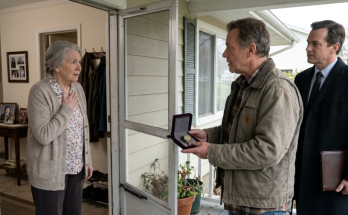
Laura met us at the door.
She had Daniel's eyes, though I couldn't have explained that to anyone who hadn't seen the photograph. There was the same directness in the way she looked at a person, the same pause before answering a difficult question.
She led us into a small living room with books stacked beside the sofa and framed family photographs on the mantel.
One picture showed Daniel holding Laura when she was a baby.
He looked younger than the man in the mill photograph. His shirt collar was open, and he was smiling down at her rather than at the camera.
Mom stopped in front of it.
“Your father looks happy there,” she said.
“He was,” Laura answered. “At least, that's what my mother always told me. She said he worried too much about work, but he never made me feel like a burden.”
Laura took the copies from me and sat down.
She read Daniel's letter in silence.
When she reached the line about not leaving Patricia and their daughter, she held the page with both hands.
“My mother needed to hear this,” she said.
“Did she ever doubt that he would come back?” Mom asked.
Laura thought about it.
“She waited for him. For years, she kept his side of the closet clear. Then she stopped doing that, but she never told me she believed he had abandoned us.”
She looked down at the letter.
“She was angry, too. She was angry that everyone treated his disappearance like an inconvenience. The company wanted the paperwork settled. The police wanted a simple answer. People in town wanted to stop talking about it.”
“Did she ever tell you what she thought happened?” I asked.
“She thought he had discovered something dangerous. But she never knew who was responsible.”
Laura went to a cabinet near the dining room and returned with a small tin box.
She placed it on the coffee table.
“These were my mother's personal papers. I went through them after she died, but I couldn't bring myself to sort everything. I thought I had saved the important things.”
She opened the lid.
Inside were photographs, old birthday cards, and envelopes held together with string.
There were also two letters from Harold Brennan.
Mom's hands tightened in her lap.
Laura lifted the first letter.
It was dated several months after Daniel disappeared. Dad had written that he was sorry he could not offer Patricia an explanation, and that he would continue trying to find out what happened.
He did not name Robert.
He did not describe the invoices.
He said only that Daniel's case had been treated as closed by people who had not examined all the records.
Mom read it twice.
“Your father wrote to my mother?” Laura asked.
“Yes,” Mom said. “He never told me.”
Laura passed her the second letter.
It was shorter and had been written years later. Dad said he had located a document that might be relevant, but he was afraid it would be destroyed if it were handled carelessly.
He promised to keep a copy safe.
There was no date on the document itself, only an envelope postmarked in the late 1990s.
“That's around the time he gave the cabinet back to my mother,” Laura said.
“Fifteen years ago,” I replied. “He told us he'd been keeping Daniel's papers.”
Laura nodded.
“He returned the cabinet, but he kept writing to her.”
Mom stared at the letter.
“Why wouldn't he tell me?”
No one answered immediately.
Then Laura spoke.
“Maybe he thought he was protecting you. Maybe he was ashamed. Maybe he was afraid that if he told you one thing, he'd have to tell you everything.”
Mom's expression changed.
Not anger, exactly.
Recognition.
“That sounds like him,” she said.
We sorted the tin box carefully.
Most of the papers were ordinary family memories. There were receipts from a repair shop, a school photograph of Laura, and a Christmas card signed by someone whose name none of us recognized.
Then Scott found a narrow envelope with Eleanor Vale's name on the return address.
It had been sent to Patricia in 1982.
Laura looked surprised.
“I've never seen that before.”
Mr. Cole had told us not to separate or discard anything, so we photographed the envelope and asked Laura if she was willing to let him examine it.
She agreed.
Inside was a brief note from Eleanor.
She wrote that she was sorry Patricia had been left without answers. She said Daniel had been under pressure at work, and that people had spoken about him in ways that were unfair.
Then she wrote something more troubling.
“Robert says the matter is finished. I do not believe that is the same as saying the truth is known.”
The note ended there.
No explanation.
No accusation.
No promise to help.
Laura sat back against the sofa.
“My mother kept this all those years and never mentioned it.”
“Maybe she didn't know what to make of it,” I said.
“Or she didn't want to make an accusation she couldn't support.”
Mom studied Eleanor's handwriting.
“Did your mother ever meet Eleanor again?”
“Once, that I know of. Eleanor came to the house after Daniel disappeared and asked whether there were any papers he might have taken home. My mother told her she had only letters.”
“That matches what you told us before,” I said.
“Yes. But now I wonder whether my mother was being completely honest.”
Laura looked uncomfortable.
I understood why.
It was hard to discover that someone you loved had withheld information. Even when the reason might have been fear, the silence could still feel like a door shut in your face.
Mom reached across the table and touched Laura's hand.
“Your mother had to live with this without knowing what we know now. We shouldn't judge every choice she made from where we're sitting.”
Laura swallowed.
“I know.”
She looked again at the note.
“Eleanor knew Robert was saying it was finished. She also knew that wasn't the same as the truth being known.”
Mr. Cole arrived later that afternoon to collect the newly discovered letters. He examined the envelope, took photographs, and made a note of the postmark.
He told us the documents could help establish a pattern of communication between Dad, Patricia, and Eleanor.
“But we should be careful,” he said. “A letter can show what a person said or believed. It doesn't automatically prove that everything in it was true.”
“I understand,” Laura replied.
She handed him the tin box so he could inventory the remaining papers, then asked that everything be returned when the examination was complete.
He promised he would.
Before we left, Laura walked Mom to the front door.
“I used to think my father disappeared because he didn't want to come home,” she said. “I knew it didn't fit the person my mother described, but I couldn't prove anything else.”
Mom took her hand.
“Now you have his own words.”
Laura nodded.
It wasn't a complete answer.
It was more than she had before.
On the drive home, Mom kept Eleanor's note in her mind, though the original was with Mr. Cole.
“Robert says the matter is finished.”
She repeated the words softly.
“Your father must have heard that same kind of thing.”
“Probably,” I said.
“He was being told to leave it alone. Daniel was being told to sign. And I was being left to believe there was nothing more to learn.”
Scott leaned forward from the back seat.
“Maybe Dad thought he could keep the truth alive without putting us in danger.”
Mom looked at him.
“Maybe. But he also left us with years of questions.”
Scott lowered his eyes.
“I know.”
We drove the rest of the way without speaking.
That evening, Mr. Cole called to tell us that the handwriting specialist had made preliminary findings.
The signature on the payment authorization was likely not Mom's. The writing appeared to have been copied from a different document, and the pressure marks suggested the signature might have been traced or transferred.
It was not yet a final report.
But it supported what we had suspected.
Someone had used Mom's name without her knowledge.
The accountant had also found that the questionable equipment payments did not match the mill's normal purchasing records. Several entries lacked receiving signatures, and one payment appeared to have been directed to a private account connected to Robert Vale.
Mr. Cole said he needed more time to determine whether the records could establish who had authorized the payments.
“Does it prove Daniel was innocent?” Mom asked.
“It strongly supports his claim that the accounts were irregular,” Mr. Cole said. “But we should distinguish between evidence that contradicts an accusation and evidence that identifies the person responsible.”
Mom thanked him and hung up.
She sat at the kitchen table for a long time.
I made tea.
She didn't touch it until the steam had almost disappeared.
“Your father tried to correct the record,” she said. “But he didn't tell me what he had done.”
“No.”
“And he kept the papers hidden.”
“Yes.”
She rubbed her thumb over the rim of the cup.
“I want to believe he was trying to protect us. I do believe that, in part. But I don't want to use that belief to excuse every silence.”
I sat beside her.
“You don't have to.”
She looked at me, tired but steady.
“Neither do you.”
For the first time, I felt we were no longer trying to decide whether Dad had been a good man or a coward.
He had been a person caught between fear, responsibility, and a truth he could not make himself speak aloud.
That did not erase the harm his silence had caused.
It did help us understand why the papers had survived.
He had kept them because he couldn't bring himself to destroy them.
And he had hidden them because he couldn't bring himself to reveal them.
Both things were true.
Source: psndaily.xyz
Click here to continue reading: PART 11: The Signature Beneath the Numbers
My Father Had Been Dead Three Months When a Forty-Dollar Mistake Brought His Hidden Past to Our Front Door
Part 10 of 12