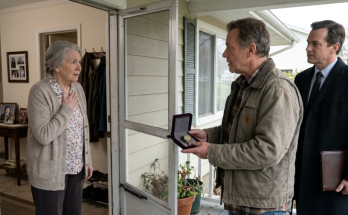
Mr. Cole called on a Thursday morning while I was making coffee.
He had a name for us.
The filing cabinet had been purchased at an estate auction three years earlier by a retired school principal named Martin Hayes. Martin remembered it because one drawer had been difficult to open, and the auctioneer had warned him that the cabinet was being sold as-is.
“He says he still has it,” Mr. Cole told me. “He used it in his basement for a while, then moved it into a storage room.”
I set the coffee pot down.
“Did he find anything inside?”
“He hasn't opened every drawer. But he remembers a folder with a name written on it.”
I looked toward Mom's kitchen table.
The photograph of Dad, Daniel Whitaker, and Robert Vale was still there, tucked inside a clear plastic sleeve. Mom had placed it beside Dad's recovered watch, as though keeping them together might make the past easier to understand.
“What name?” I asked.
“Whitaker.”
I called Mom before Mr. Cole had finished explaining the arrangements.
She listened without interrupting. When I told her the cabinet might still contain Daniel's papers, she sat down so quickly that the chair scraped against the floor.
“Your father said he would keep those papers safe,” she whispered.
“He did.”
“And then he let me believe they were gone.”
I didn't know how to answer.
We had learned enough by then to understand that Dad's silence had not been simple. He had hidden things, but he had also left us clues. He had corrected his statement about Daniel, preserved letters, and written to Robert Vale demanding that the original invoices be kept.
Whatever else he had done, he had not entirely surrendered.
Mom touched the watch.
“Let's go,” she said.
We drove to Mr. Hayes's house the next morning. Scott came with us, sitting in the back seat and holding a paper bag containing sandwiches Mom had made, though none of us had mentioned being hungry.
The drive took a little over an hour.
Mom watched the road through the passenger window. Every so often, she pressed her thumb against the edge of her handbag, where she had placed Dad's letter and the photograph.
Scott broke the silence first.
“I keep thinking about the watch.”
Mom turned slightly.
“What about it?”
“I sold it because I thought it was worth forty dollars. I didn't ask why Dad had kept it all those years.”
“You were trying to get money quickly,” she said.
“That doesn't make it right.”
“No,” Mom replied. “It doesn't.”
He nodded and looked down at his hands.
“I just don't want us to keep doing that. Finding something difficult and pretending it doesn't matter.”
Mom turned back toward the window.
“Then don't.”
She didn't say it harshly.
That made it harder for Scott to look up.
Mr. Hayes lived in a modest house with a narrow driveway and a line of trimmed shrubs beneath the front windows. He was waiting for us when we arrived, wearing a gray sweater and holding a set of keys.
He shook Mom's hand first.
“Mr. Cole explained some of the history,” he said. “I'm sorry your family has carried this for so long.”
“Thank you for keeping the cabinet,” Mom answered.
“I nearly gave it away when I cleared out my garage. Something told me not to.”
He led us downstairs.
The basement smelled of cardboard, laundry detergent, and old wood. A workbench stood beneath a small window, and a row of plastic storage bins lined the wall.
The filing cabinet was at the far end.
It was taller than I expected, with four metal drawers and a faded green finish. Rust had gathered around the lower corners. One drawer sat a fraction of an inch out of alignment.
Mr. Hayes handed Mr. Cole the keys.
“I tried the top drawer once. It opened easily. The second one stuck, and I didn't want to force it.”
Mr. Cole pulled gently.
The drawer moved a little, then stopped.
He examined the runners and shifted the cabinet away from the wall. After several careful attempts, the drawer slid open with a rough metallic scrape.
Inside were old envelopes, several empty folders, a broken pencil, and a stack of papers bound with a yellowed elastic band.
There was also a small key ring.
Mom reached toward it, then stopped herself.
“May I?” she asked.
Mr. Cole nodded.
She lifted the ring from the drawer.
One key was ordinary and silver-colored. The other was dark with age, its teeth worn smooth at the edges. Attached to the ring was a faded plastic tag with no number on it.
Mom stared at the darker key.
“This looks like the one your father kept in his toolbox.”
“The number 214 key?” I asked.
She nodded.
“But Dad's key didn't fit the locker.”
“Maybe it wasn't meant for the locker,” Scott said.
Mr. Cole set the keys aside in a clear evidence sleeve he had brought. Then he began examining the papers.
Most were routine business documents. There were old utility bills, warranty cards, and receipts from the early 1980s. A few had Daniel's name typed across the top.
Then Mr. Cole found a brown envelope.
It had been folded once and sealed with yellowing tape. Written across the front in Daniel's handwriting were the words: For Patricia. If I cannot bring this home.
Mom covered her mouth.
I felt the room tighten around us.
Mr. Cole didn't open it immediately. He photographed the envelope, noted its condition, and asked Mr. Hayes whether he was comfortable with us examining the contents.
“That's why I kept it,” Mr. Hayes said. “I figured somebody might need it.”
Mr. Cole carefully loosened the old tape.
Inside was a folded letter, two carbon copies of invoices, and a sheet of paper covered in handwritten figures.
The letter began with Daniel's name and the date September 17, 1981.
The day before the notation in the ledger said Dad's statement had been withdrawn pending verification.
Mr. Cole read silently for a minute, then looked at us.
“This appears to be a letter Daniel wrote to his wife. It refers to the accounting discrepancies and names Robert Vale.”
“Read it,” Mom said.
Mr. Cole unfolded the page.
Daniel wrote that he had found payments recorded against equipment that had never arrived at the mill. Some invoices carried signatures from people who had not approved them. Others listed deliveries to a storage site he had never seen.
He had asked Robert for the original records.
Robert had told him the matter was being handled.
Daniel wrote that he was no longer willing to sign a statement accepting responsibility for the missing money.
Near the bottom of the letter, he had written a sentence twice, as though he wanted to make certain he remembered it.
I will not let them put my name on something I did not do.
I looked at the invoice copies.
One listed a payment to a private account associated with Robert Vale. The other recorded equipment that had supposedly been delivered to the mill, though the receiving line was blank.
On the margin of the second invoice, Daniel had written three initials.
H.B.
D.W.
R.V.
Harold Brennan.
Daniel Whitaker.
Robert Vale.
Mom leaned closer to the page.
“Your father knew,” she said.
“He knew there was a problem,” I replied. “We still don't know exactly what he knew or when.”
She looked at me.
“I know. I'm trying not to make the answer fit what I want it to be.”
That was the first time I had heard her say it so plainly.
Mr. Cole placed the papers in separate sleeves. There was another folded sheet beneath the letter, but it wasn't a business record.
It was a list of dates.
September 10.
September 12.
September 14.
September 17.
Beside each date were short notes about meetings, invoice numbers, and conversations. Beside September 17, Daniel had written: “R says the statement must be signed before Friday.”
The next line was shorter.
“Asked H.B. to keep originals.”
Mom looked at Dad's initials.
“He was asking your father to help him.”
“Or asking him to preserve the records,” Scott said.
“Maybe both,” I replied.
The date on the following line was September 18.
There were only four words beside it.
“Statement withdrawn. R furious.”
Mr. Cole read the line again.
“That's important,” he said. “But we need to establish when these notes were written and whether they were all written by Daniel. The handwriting appears consistent, but that isn't the same as formal verification.”
He was careful not to promise us more than the papers could prove.
I appreciated that.
We had spent too many years living with other people's certainty.
At the bottom of the drawer, beneath a bundle of receipts, we found a thin envelope addressed to Harold Brennan.
It had never been mailed.
The paper had softened at the folds, and the flap had come loose. Inside was a single page.
Daniel thanked Dad for keeping copies of the invoices. He said he had been told the company would make the discrepancy disappear if he signed the statement.
He also wrote that he feared someone was trying to turn a bookkeeping problem into a criminal accusation.
The final paragraph was brief.
“If I cannot speak to you again, please tell Patricia I did not choose to leave her. And please do not let them use your name to make a lie look official.”
Mom closed her eyes.
For a moment, I thought she might cry. Instead, she drew a slow breath and reached for Dad's letter, which she had brought from home.
She placed it beside Daniel's.
Dad had written that no employee should be blamed for an order issued by someone above him.
Daniel had written that he would not let anyone put his name on something he had not done.
They were not the same words.
But they were pointing toward the same fear.
Mr. Cole asked Mr. Hayes whether the cabinet had come with any additional items. Mr. Hayes remembered a flat cardboard box that had been left on the bottom shelf when he bought it.
He had placed it in the storage room because it contained old stationery.
We found the box behind a stack of folded chairs.
Inside were several blank forms, a mill directory, and a small notebook with a cracked blue cover.
The notebook belonged to Daniel.
His name was written inside the front cover, followed by an address and a telephone number that no longer existed.
Most of the pages were filled with work notes. But toward the back, a few entries had been written in darker ink.
One referred to a conversation with Eleanor Vale.
“E.V. says she saw copies in the office. Doesn't know who moved them.”
Another entry, dated September 18, read:
“Harold says he corrected the statement. He says he will not sign anything else without originals.”
I looked at Mom.
She was holding herself very still.
The last entry was dated September 19.
It said only:
“Must speak to Patricia before they get to her.”
There was no explanation.
No note saying where he intended to go.
No account of what happened next.
I turned the page, hoping there might be another entry.
There wasn't.
Mr. Cole closed the notebook gently.
“We have evidence that Daniel believed he was being pressured, and that he was trying to protect his wife from something. We also have evidence that Harold corrected his statement. The next question is what happened after that.”
Mom looked at the empty drawer.
“And who made sure we never found out.”
No one answered.
We had arrived at Mr. Hayes's house hoping for the missing papers.
We left with more than papers.
We had Daniel's own words, written before he disappeared. We had a record of his fear, a list of dates, and proof that he had asked Dad to preserve the original invoices.
What we still did not have was the ending.
And I was beginning to understand that finding the truth would require us to accept the parts of it that could never be recovered.
Source: psndaily.xyz
Click here to continue reading: PART 10: The Woman Who Kept the Last Letter
My Father Had Been Dead Three Months When a Forty-Dollar Mistake Brought His Hidden Past to Our Front Door
Part 9 of 12