Grandma Carol arrived seventeen minutes after I called her.
I knew because I’d been watching the time on my phone.
Seventeen minutes during which Jonah sat on the curb, Beck held his red hoodie against his chest, and my father stood in the doorway pretending there was some reasonable explanation for what had happened.
Vanessa had gone back inside.
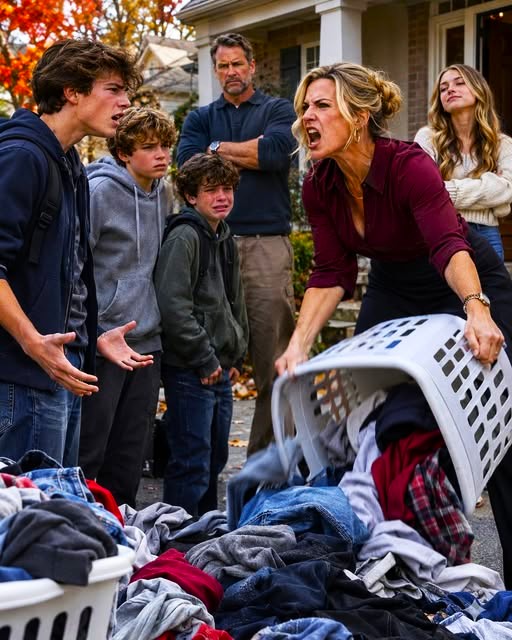
She’d left our clothes scattered across the driveway.
A few neighbors had slowed their cars as they passed.
Mrs. Patterson, who lived across the street, brought us three bottles of water.
She didn’t ask what we’d done.
She looked at Beck’s trembling hands and said, “Honey, do you need a blanket?”
He shook his head.
I thanked her anyway.
When Grandma’s silver Subaru turned onto our street, Jonah stood so quickly his backpack fell over.
Grandma pulled into the driveway, stopped just short of the clothes, and got out.
She wore her usual navy cardigan and white sneakers.
Her gray hair was clipped behind her head.
She looked at the overturned laundry baskets.
Then at the three of us.
Then at my father.
“Michael,” she said.
Dad straightened.
“Mom, this isn’t what it looks like.”
Grandma looked down at a pair of Beck’s pajamas lying in the dirt.
“Then I hope you have an extraordinary explanation.”
Dad rubbed his forehead.
“Vanessa’s necklace is missing. We’re trying to find out what happened.”
Grandma looked around.
“And you thought throwing your children’s clothes into the street would help?”
“It wasn’t my decision.”
She stared at him.
“Whose house is this?”
Dad blinked.
“What?”
“Whose children are these?”
He didn’t answer.
Grandma stepped closer.
“Then don’t stand there telling me it wasn’t your decision.”
I had never heard her speak to Dad like that.
Not once.
Vanessa appeared behind him.
“Oh, wonderful,” she said. “Now we’re involving the entire family.”
Grandma turned toward her.
“Vanessa, where is the necklace?”
Vanessa held up the jewelry-store appraisal.
“If I knew that, we wouldn’t be having this conversation.”
“Then where is your evidence that these boys took it?”
Vanessa’s expression hardened.
“Spencer suddenly spent almost six hundred dollars on computer equipment.”
Grandma looked at me.
“From your job?”
I nodded.
“Yes.”
She turned back.
“Then what’s the problem?”
Vanessa gave a sharp laugh.
“Children can lie, Carol.”
Grandma’s voice didn’t rise.
“So can adults.”
For a moment, nobody moved.
Then Vanessa said, “I don’t appreciate being accused in my own home.”
Grandma looked at the clothes scattered across the concrete.
“Neither do my grandsons.”
Dad tried to move everyone inside.
Grandma refused.
“First, we’re picking up their things.”
She opened the back of her Subaru and pulled out two reusable shopping bags.
Jonah immediately began gathering clothes.
I collected the winter coat Grandma had given me.
Beck crouched beside the recycling bins, trying to shake dirt off his dinosaur shirt.
Dad watched us.
Then he bent to help.
Grandma stopped him.
“Michael.”
He looked up.
“You can help after you answer one question.”
He sighed.
“Mom, please.”
She pointed toward Beck.
“Did you tell that little boy he was being kicked out?”
Dad looked at Beck.
“No.”
Grandma waited.
“Did Vanessa?”
Dad hesitated.
Vanessa crossed her arms.
“I said thieves couldn’t live in my house.”
Grandma closed her eyes briefly.
Then she looked at my father.
“And you let her say that?”
Dad said nothing.
Grandma nodded once.
“All right.”
She picked up another sweater.
“Spencer, get your brothers’ school things. You’re coming home with me tonight.”
Vanessa let out an offended laugh.
“You’re not taking children out of this house without Michael’s permission.”
Grandma looked at Dad.
“Michael?”
He stared at us.
I could see the struggle on his face.
He wanted the argument to stop.
He wanted Vanessa to calm down.
He wanted Grandma to stop asking questions.
He wanted everything to return to normal without having to decide what normal should mean.
Finally, he said, “Maybe one night would be best.”
Beck looked at him.
“Dad?”
Dad swallowed.
“It’s just until things calm down.”
My little brother’s face collapsed.
And that was when I knew I couldn’t wait any longer.
“Actually,” I said, “before we go, there’s something everybody should see.”
Vanessa looked at me.
“What now?”
I pulled out my phone.
“The doorbell camera.”
Dad frowned.
“What about it?”
“It records when somebody comes through the front door.”
Vanessa waved her hand.
“Obviously.”
I looked directly at her.
“Then we should probably check who came home before the necklace went missing.”
Her face changed.
Not much.
Just enough.
She stopped looking irritated.
And started looking careful.
Dad had installed the doorbell camera two years earlier after packages started disappearing from our porch.
He’d connected it to the family account.
Vanessa used the app whenever she wanted to see whether deliveries had arrived.
Dad checked it occasionally.
I had access because I’d helped configure the system and set up the notifications.
That afternoon, before Grandma arrived, I’d received a motion alert from the camera.
I hadn’t looked at the video.
I’d been too busy trying to keep Beck from crying.
Now I opened the app.
Vanessa stepped forward.
“Spencer, this is ridiculous. My necklace was inside my bedroom.”
“Then checking the camera won’t hurt anything.”
Dad held out his hand.
“Let me see.”
I moved beside him.
The recording list showed several clips from that morning.
A delivery driver.
The mail carrier.
A neighborhood cat.
Then a recording from 1:42 p.m.
The thumbnail showed someone standing near the front door.
Brielle.
Vanessa’s daughter.
She wore a white sweatshirt and carried a pink backpack.
I tapped the video.
Brielle approached the house, looked behind her, and unlocked the front door.
Nothing unusual about that.
Except she was supposed to be at school.
Jonah leaned closer.
“Why was Brielle home?”
Vanessa answered immediately.
“She wasn’t feeling well.”
I looked at her.
“You said she was at a friend’s house.”
“She went there afterward.”
I scrolled forward.
At 2:16 p.m., another recording showed Brielle leaving the house.
This time she wasn’t carrying her pink backpack.
She carried a small black handbag.
And beside her was a woman I didn’t recognize.
Probably in her twenties.
Brown hair.
A green jacket.
The woman stood on the porch holding a rectangular jewelry box.
Vanessa suddenly reached toward my phone.
“That’s enough.”
I pulled it back.
“What?”
“You’re invading Brielle’s privacy.”
Grandma stepped between us.
“Vanessa, don’t touch him.”
Dad stared at the screen.
“Who’s that woman?”
Vanessa’s mouth opened.
Then closed.
“I don’t know.”
But the camera had recorded audio too.
I turned up the volume.
Brielle’s voice came through the speaker.
“Mom said the appraisal was twenty-five hundred, but I told you we’d take fifteen hundred.”
The woman answered.
“That’s fine. I’ll transfer it once I verify it’s real.”
Nobody spoke.
The wind moved through the trees.
A car passed at the end of the street.
On my screen, Brielle laughed.
Then she said:
“Just don’t message my mom about it. She’ll freak out.”
The recording ended.
I looked up.
Dad’s face had gone completely white.
Grandma stared at Vanessa.
Jonah whispered:
“Oh, my God.”
And Beck, who was still holding his dirty pajamas, asked the simplest question of all.
“So we didn’t steal it?”
I crouched in front of him.
“No, buddy.”
My voice broke.
“We didn’t steal anything.”
Vanessa was the first to recover.
“That doesn’t prove anything.”
Grandma turned slowly.
“Excuse me?”
“That could be another necklace.”
Dad looked at her.
“Vanessa.”
She pointed at the phone.
“Brielle has costume jewelry. She sells clothes online. You can’t accuse my daughter just because she was talking about money.”
I looked at the recording again.
“She mentioned the exact appraisal amount.”
“Coincidence.”
“And a jewelry box.”
“That proves nothing.”
“And she said not to tell you.”
Vanessa’s voice sharpened.
“Spencer, stop interrogating me!”
Dad stepped forward.
“Enough.”
For a second, I thought he was speaking to me.
I actually braced myself.
Then he turned toward Vanessa.
“No. Enough.”
She stared at him.
“Michael?”
His voice was quiet.
But it sounded different.
“We’re calling Brielle.”
Vanessa shook her head.
“She’s at her friend’s house. We can discuss this later.”
Dad took out his phone.
“Now.”
He dialed.
We waited.
The call rang four times.
Then Brielle answered.
“Hey, Michael.”
Dad’s jaw tightened.
“Brielle, did you come home from school early today?”
A pause.
“Yeah. I wasn’t feeling good.”
“Did someone come to the house?”
Another pause.
“Why?”
Dad looked at the phone in my hand.
“Answer the question.”
Brielle sighed.
“My friend Tessa came over.”
“What did you give her?”
Silence.
Vanessa moved closer.
“Michael, don’t frighten her.”
Dad raised his hand.
It wasn’t threatening.
It was simply the first time I’d seen him tell Vanessa to stop.
“Brielle, what did you give Tessa?”
A long silence followed.
Then Brielle said:
“Mom already knows.”
Vanessa’s face drained.
Dad stared at her.
“What?”
Brielle continued.
“She said it was fine as long as we got it back before her dinner on Friday.”
Vanessa whispered:
“Brielle, stop talking.”
But Dad had already heard enough.
“What did your mother say was fine?”
Brielle sounded confused.
“The necklace. I was borrowing money against it. Mom said she’d help me get it back.”
The world seemed to go completely still.
I looked at Vanessa.
Her lips were pressed together.
Dad lowered the phone.
“Vanessa.”
She shook her head.
“It’s not what you think.”
He stared at her.
“You knew where the necklace was?”
She swallowed.
“I knew Brielle had borrowed it.”
“And you accused my sons of stealing it?”
Vanessa looked toward the street.
“Michael, I was upset.”
Dad didn’t move.
“Answer me.”
Her voice grew smaller.
“Yes.”
Jonah made a sound beside me.
Not quite a laugh.
Not quite a sob.
I looked down at Beck.
He was staring at Vanessa with an expression I hoped never to see on a child’s face again.
Not anger.
Not even fear.
Confusion.
He couldn’t understand why an adult would accuse him of something she knew he hadn’t done.
Neither could I.
Dad ended the call.
Then he stood there looking at his wife.
“Why?”
Vanessa’s eyes filled with tears.
I had seen her cry before.
Usually when she wanted Dad to stop asking questions.
But this time, nobody rushed to comfort her.
She wrapped her arms around herself.
“I panicked.”
Grandma said nothing.
Vanessa continued.
“Brielle needed money. She was behind on payments for something, and I told her she could use the necklace temporarily.”
Dad stared at her.
“What payments?”
“Some things she bought online.”
“What things?”
Vanessa looked away.
“Clothes. A phone. I don’t know everything.”
Dad shook his head.
“So you knew the necklace wasn’t stolen.”
“I knew Brielle had taken it. But then she stopped answering my calls, and I thought she might have lost it.”
I stared at her.
“Then why blame us?”
She looked directly at me.
And for the first time, I saw something honest in her expression.
Not remorse.
Resentment.
“Because you always have money, Spencer.”
I blinked.
“What?”
“You’re seventeen, and somehow you have hundreds of dollars for computer parts while we’re trying to manage a household.”
I couldn’t believe what I was hearing.
“I work twenty hours a week.”
“That’s not the point.”
“Then what is?”
Her voice rose.
“You keep everything separate! Your savings, your little job, your plans for college. You act like you’re better than the rest of us.”
I stared at her.
I’d spent two years trying to stay out of her way.
I’d cleaned the kitchen.
I’d helped Beck with homework.
I’d taken Jonah to basketball practice when Dad was working late.
I’d bought my own clothes whenever I could so nobody could accuse me of costing too much.
And apparently, even that had offended her.
Grandma stepped forward.
“Vanessa, that boy earns his money.”
Vanessa turned on her.
“And I’m expected to feed three boys who aren’t even mine!”
The sentence hit harder than anything else she’d said.
For a moment, nobody moved.
Then Dad spoke.
Very quietly.
“Get inside.”
Vanessa blinked.
“What?”
“Go inside.”
She stared at him.
“Michael, don’t talk to me like that.”
He looked at the clothes covering the driveway.
Then at Beck.
Then at Jonah.
Finally, at me.
His voice broke.
“I need to speak to my children.”
Vanessa opened her mouth.
He shook his head.
“Not now.”
She turned and walked into the house.
The front door slammed.
Dad stood in front of us.
For a long time, he didn’t speak.
Then he looked at me.
“Spencer.”
I waited.
He rubbed his face.
“I’m sorry.”
I wanted those words to make everything better.
They didn’t.
I looked at the clothes scattered around us.
“Which part?”
Dad frowned.
“What?”
“Which part are you sorry for?”
He looked wounded.
I didn’t care.
Not because I wanted to hurt him.
But because for two years, every argument had ended the same way.
Dad apologized.
Vanessa cried.
We were told to move on.
And nothing changed.
“Are you sorry you accused me of stealing?” I asked.
He nodded.
“Yes.”
“Are you sorry you let her throw our clothes outside?”
“Yes.”
“Are you sorry Beck thought he was being kicked out?”
His face tightened.
“Spencer, please.”
I shook my head.
“No, Dad. You need to answer.”
He looked at Beck.
My little brother was still standing beside the driveway.
His dinosaur T-shirt hung from one hand.
His red hoodie was tucked beneath his arm.
Dad swallowed.
“Yes.”
I stepped closer.
“Then why didn’t you say anything when he asked if we were leaving?”
Dad’s eyes filled.
“I didn’t know what to say.”
I stared at him.
“You’re our father.”
He nodded.
“I know.”
“You’re supposed to know what to say when your kids think they’re losing their home.”
He lowered his head.
And for the first time since Mom died, I saw my father cry.
Not loudly.
Not dramatically.
Just tears sliding down a face that suddenly looked exhausted.
“I failed you,” he whispered.
Grandma stood beside us.
She didn’t interrupt.
She didn’t tell me to forgive him.
And I was grateful.
Because I wasn’t ready.
We still went to Grandma’s that night.
Dad didn’t argue.
He helped load the laundry bags into her car.
He picked up the last few shirts himself.
When he found Beck’s red hoodie, he brushed the dirt off the sleeve.
Then he held it out.
Beck didn’t take it.
He looked at me.
I gently accepted it instead.
Dad noticed.
I know he did.
His face changed.
But he didn’t say anything.
Before we left, he asked whether he could hug us.
Jonah stepped forward first.
Dad held him tightly.
Then Beck allowed a quick hug.
When Dad turned toward me, I hesitated.
He stopped.
“That’s okay,” he said.
I nodded.
“Good night, Dad.”
He looked as though I’d struck him.
But I got into Grandma’s car anyway.
On the drive, Jonah sat beside Beck in the back seat.
For the first ten minutes, nobody spoke.
Then Beck asked:
“Are we bad kids?”
I turned around.
“No.”
“Then why doesn’t Vanessa want us?”
My throat tightened.
Grandma’s hands gripped the steering wheel.
I tried to answer.
But I couldn’t find words that wouldn’t make the situation worse.
Finally, Grandma spoke.
“Beck, sometimes grown-ups behave badly because they haven’t learned how to handle their own feelings.”
He stared at her in the rearview mirror.
“Does that mean it’s our fault?”
“No, sweetheart.”
Her voice was firm.
“It means they have work to do. And that work belongs to them.”
Beck looked down at his hoodie.
Then he whispered:
“I miss Mom.”
Nobody spoke for a moment.
Then Jonah reached across the seat and took his hand.
“Me too.”
I turned toward the window.
I didn’t want my brothers to see me crying.
But Grandma noticed.
She reached over and squeezed my knee.
And for once, I let myself cry.
Grandma’s house smelled like cinnamon and laundry detergent.
She made grilled cheese sandwiches even though it was nearly eight o’clock.
Beck ate two.
Jonah barely touched his.
After dinner, Grandma found clean pajamas for both of them.
Then she gave us the guest rooms.
Jonah and Beck shared the larger one.
I slept on the pullout couch in her study.
At 10:36 p.m., my phone buzzed.
Dad.
I’m sorry. I should have protected you.
I stared at the message.
Then another arrived.
Vanessa and I are talking. The necklace situation is being handled.
I typed a response.
Deleted it.
Typed another.
Finally, I wrote:
Dad, this isn’t about the necklace anymore.
He replied almost immediately.
I know.
I put the phone down.
For the first time that day, I believed he might actually understand.
But believing something and trusting it were different.
And I needed to see what he did next.
The following morning, Grandma drove us to school.
Beck insisted he was fine.
Jonah barely spoke.
I had a calculus test first period.
I sat at my desk staring at equations that might as well have been written in another language.
My teacher, Mr. Jennings, noticed.
After class, he asked me to stay.
“Spencer, everything okay?”
I almost said yes.
It was my automatic answer.
The one I’d learned to give whenever things at home became uncomfortable.
But then I thought about Beck standing in the driveway.
And I told the truth.
“Not really.”
Mr. Jennings pulled out a chair.
He listened.
He didn’t interrupt.
When I finished, he looked concerned.
“Do you have somewhere safe to stay?”
“Yes. My grandmother’s.”
“Good.”
He asked whether I wanted to speak with the school counselor.
Normally, I would have refused.
I didn’t like people knowing our business.
But I thought about Jonah and Beck.
“Could you help my brothers too?”
He nodded.
“Absolutely.”
By lunch, the school counselor had met with me.
She helped me explain what had happened without making me feel as though I were betraying my father.
That was important.
Because I still loved Dad.
Even after everything.
I just didn’t trust him to protect us yet.
That afternoon, Dad called.
I answered outside the school library.
“Hi, Dad.”
“Spencer, I need to tell you something.”
His voice sounded different.
Tired.
But steady.
“Okay.”
“Vanessa and I had a long conversation.”
I waited.
“She admitted she’d known Brielle had the necklace since Friday.”
I frowned.
“Friday?”
“Yes.”
“But yesterday was Monday.”
“I know.”
I leaned against the wall.
“So she knew for three days?”
“Yes.”
“And she still accused us?”
Dad exhaled.
“Yes.”
I closed my eyes.
There was something almost unbearable about that.
Three days.
Three days to think.
Three days to ask Brielle.
Three days to make a phone call.
And instead, Vanessa had chosen to throw our belongings into the driveway.
Dad continued.
“I asked her why.”
I waited.
“She said she was angry that I’d paid for Jonah’s basketball registration and Beck’s school trip while she was helping Brielle cover her expenses.”
My stomach dropped.
“She was angry about that?”
“Yes.”
I thought about Jonah’s basketball shoes.
The way he’d saved allowance money to buy his own socks.
Beck’s field trip to the science museum.
The permission slip he’d kept beside his bed because he was so excited.
“Those are normal things parents pay for,” I said.
“I know.”
Dad’s voice broke.
“I know that now.”
I stared at the floor.
Then he said:
“I told Vanessa she can’t stay in the house while we figure this out.”
I straightened.
“What?”
“She’s staying with her sister.”
I didn’t speak.
He continued.
“Brielle is going with her. I’ve told Vanessa we need counseling and that I won’t let the three of you be treated like that again.”
For a moment, all I could hear was the distant noise of students in the hallway.
Then I asked:
“Did she agree?”
Dad was quiet.
“Not really.”
“What did she say?”
He sighed.
“She said I was choosing my children over my marriage.”
I swallowed.
“And what did you say?”
Dad answered immediately.
“I told her my children aren’t a choice.”
I leaned my head against the wall.
And started crying.
We didn’t move home that night.
Or the next.
Grandma said there was no reason to rush.
Dad agreed.
He started meeting with a family counselor.
At first, he went alone.
Then Grandma joined him for one session.
Eventually, Jonah and I went too.
Beck met separately with a counselor who worked with younger children.
Nobody forced us to forgive anyone.
Nobody told us that families should stay together no matter what.
Instead, we talked about what safety meant.
Not just locked doors and working smoke detectors.
Emotional safety.
Knowing that if someone accused you unfairly, an adult would listen.
Knowing your home wouldn’t disappear because somebody was angry.
Knowing your belongings wouldn’t be thrown outside as punishment.
Knowing your father would speak when you needed him to.
Dad listened.
Sometimes he cried.
Sometimes he tried to explain himself.
And sometimes the counselor stopped him and asked:
“Michael, are you explaining what happened, or are you trying to make your children feel responsible for understanding it?”
That question changed something.
Because Dad had always wanted us to understand.
Understand Vanessa’s stress.
Understand Brielle’s adjustments.
Understand how hard remarriage could be.
But nobody had spent much time asking how hard it was for us.
Three boys who had already lost their mother.
Three boys trying to make room for a new family without losing the old one completely.
A week after the driveway incident, Brielle texted me.
Hey.
I stared at the message.
Then she wrote:
I’m sorry about everything.
I didn’t answer immediately.
Brielle and I had never been close.
But we’d never been enemies either.
She liked music I couldn’t stand.
I liked computers she called boring.
We mostly stayed out of each other’s way.
I typed:
Did you know your mom was accusing us?
Three dots appeared.
Disappeared.
Then appeared again.
Finally, she replied:
Not until Monday night.
I stared at the screen.
Why didn’t you tell her where the necklace was?
Her answer came slowly.
I thought she already knew. She helped me arrange it.
I sat back.
Then another message arrived.
She said she’d tell Michael herself.
I looked toward Grandma’s kitchen.
Something about that made my stomach hurt.
Brielle continued.
I didn’t know she put your clothes outside. I swear.
I believed that part.
Not because Brielle was innocent of everything.
She’d still used the necklace as collateral to get money.
She’d still tried to hide the details.
But the driveway had been Vanessa’s decision.
And Brielle hadn’t been home when it happened.
I typed:
Beck thought he was being kicked out.
There was a long silence.
Then Brielle replied:
Oh my God.
Another message.
I’m really sorry.
I stared at the words.
Then I answered:
You should tell him that yourself someday.
She replied:
I will.
The necklace was eventually returned.
Vanessa paid the money Brielle owed Tessa, and the jewelry came back into her possession.
There had been no theft by any of us.
No secret sale of Vanessa’s property by her stepsons.
No evidence against me.
Just a decision Vanessa had made, followed by a lie she had allowed to grow.
Dad told me the necklace was back during one of our counseling sessions.
He placed a small envelope on the table.
Inside were copies of my pay stubs and the receipt for my computer parts.
I frowned.
“What’s this?”
He looked embarrassed.
“I found the papers in your desk drawer.”
I stared at him.
“You went through my desk?”
He nodded.
“Yes.”
“Without asking?”
“Yes.”
I felt anger rise.
Dad held up his hand.
“You’re right to be upset.”
I waited.
He continued.
“I was looking for proof that you hadn’t done anything wrong.”
I shook my head.
“Dad, I already told you I hadn’t.”
His eyes filled.
“I know.”
I looked at the papers.
Then back at him.
“That’s the problem.”
He nodded slowly.
“You shouldn’t have needed to prove you were innocent to me.”
I swallowed.
“No.”
Dad looked down.
“I believed an accusation without evidence. And when you offered an explanation, I treated it like you were making excuses.”
I didn’t answer.
He pushed the papers toward me.
“I’m sorry, Spencer.”
I took them.
Then I said something I’d been carrying around for days.
“Dad, I don’t need you to believe I’m perfect.”
He looked up.
“I just need you to believe I’m worth defending.”
His face crumpled.
And for the first time, I reached across the table and took his hand.
By the middle of November, things had started changing at home.
Dad replaced the lock on my bedroom door.
Not because I was hiding anything.
Because he finally understood I deserved privacy.
He also moved Jonah and Beck back into their original separate rooms.
Before Vanessa moved in, Jonah had the room beside mine.
Beck had the smaller bedroom overlooking the backyard.
When Brielle came, Vanessa insisted the boys share so her daughter could have the bigger room.
Dad had agreed.
He’d called it a compromise.
Now he admitted it hadn’t been one.
A compromise meant everyone gave something up.
We’d been the only ones giving.
Dad repainted Beck’s room light blue.
He put glow-in-the-dark stars on the ceiling.
He helped Jonah rearrange his furniture.
And he built a shelf for my computer equipment.
I didn’t move back immediately.
I wanted to.
But I was afraid.
Not of Dad exactly.
Of everything returning to the way it had been.
So I asked him one question.
“Is Vanessa coming back?”
Dad looked at me for a long moment.
Then he said:
“Not while things are unresolved.”
I waited.
He continued.
“I’ve told her that the way she treated you was unacceptable. If there’s ever a discussion about living together again, it won’t happen without serious changes and professional help.”
I looked down.
“Do we get a say?”
Dad nodded.
“Yes.”
That was the first time anyone had said it.
We get a say.
Not because we paid the mortgage.
Not because we were adults.
But because it was our home too.
We moved back the Saturday before Thanksgiving.
Grandma drove us.
Dad stood on the porch waiting.
There were no laundry baskets in the driveway.
No clothes in the gutter.
No angry accusations.
He had made a sign for Beck.
A ridiculous one.
Blue poster board.
Huge letters.
WELCOME HOME, BOYS.
Jonah laughed when he saw it.
“That’s embarrassing.”
Dad smiled nervously.
“I know.”
Beck ran toward him.
Dad dropped to one knee.
And my little brother threw his arms around his neck.
I stood beside Grandma, watching.
She leaned toward me.
“How are you feeling?”
I thought about it.
“Scared.”
She nodded.
“That’s understandable.”
“But I want to try.”
She squeezed my shoulder.
“Then try. Just remember, you don’t have to pretend everything is fixed.”
I looked at her.
“Thanks, Grandma.”
She smiled.
“You’re welcome, sweetheart.”
Then she added:
“And if anything ever makes you feel unsafe again, you know where I live.”
I laughed.
“Fifteen minutes away.”
She shook her head.
“Fourteen if I ignore the speed limit.”
Thanksgiving was quieter than usual.
No Vanessa.
No Brielle.
No pretending everything was wonderful.
Just Dad, Grandma, my brothers, and me.
Dad made turkey.
He burned the rolls.
Jonah complained that the mashed potatoes needed more butter.
Beck spilled cranberry sauce on the tablecloth.
And for the first time in two years, nobody acted as though ordinary family noise was a personal insult.
After dinner, Dad asked us to stay at the table.
He looked nervous.
“I want to say something.”
Jonah leaned back.
“Are we in trouble?”
Dad smiled sadly.
“No.”
He looked at each of us.
“Your mother and I used to talk about what kind of family we wanted.”
The room went quiet.
Dad rarely talked about Mom.
Not because we didn’t want him to.
Because it hurt him.
He looked down at his hands.
“She used to say that home should be the place where you don’t have to earn your right to belong.”
My throat tightened.
Dad continued.
“After she died, I was so afraid of being alone that I started making decisions based on keeping another adult happy.”
He took a breath.
“And somewhere along the way, I forgot that you three were the people I was supposed to protect first.”
Beck reached for his water.
Dad looked at him.
“I’m sorry I let you think you might lose your home.”
Beck nodded.
Dad turned to Jonah.
“I’m sorry I let you feel like you had to defend your brothers because I wasn’t doing it.”
Jonah looked away.
Then Dad looked at me.
“And Spencer…”
His voice broke.
“I’m sorry I made you grow up faster than you should have.”
I stared at my plate.
He continued.
“You’ve been helping with bills, watching your brothers, fixing things around the house, and trying not to cause trouble.”
I swallowed.
“That’s okay, Dad.”
He shook his head.
“No.”
He looked directly at me.
“Helping your family is okay. Feeling responsible for holding it together isn’t.”
I couldn’t speak.
Dad reached across the table.
“I should have been the one making sure you felt safe.”
I took his hand.
And for the first time in a long time, I believed he understood.
Winter came slowly that year.
The trees lost their leaves.
The mornings turned cold.
Basketball season started.
Jonah made the junior varsity team.
Beck joined a school robotics club.
I finished my college applications.
Dad attended every basketball game he could.
He helped Beck build a small robot that kept driving into walls.
And he began asking me about my computer projects.
Not suspiciously.
Not because he wanted to know where my money came from.
Because he was interested.
One evening, I was installing the new graphics card when he knocked on my bedroom door.
“Can I come in?”
I looked up.
That question alone almost made me smile.
“Sure.”
He stepped inside.
“What are you working on?”
I showed him the computer.
Explained the power supply.
The cooling system.
The graphics card.
He listened.
Then he asked:
“Can you teach me?”
I stared at him.
“What?”
He smiled.
“Can you teach me how this stuff works?”
I laughed.
“Dad, you’ve been calling every computer problem a virus since 2009.”
He laughed too.
“Then I’ve got a lot to learn.”
We spent two hours working together.
He asked terrible questions.
I gave overly complicated answers.
At one point, he accidentally disconnected a cable.
I told him he’d destroyed everything.
He looked horrified.
Then I started laughing.
He threw a rolled-up paper towel at me.
And suddenly, for a moment, he felt like the Dad I remembered from before everything changed.
Vanessa and Dad eventually separated permanently.
The decision wasn’t quick.
There were counseling sessions.
Arguments.
Discussions about finances.
And difficult conversations about how their marriage had affected all five people involved.
But Dad ultimately decided that the trust between them had been damaged too deeply.
Vanessa moved into an apartment with Brielle.
I saw Brielle occasionally.
We weren’t close.
But we were polite.
One afternoon, she came to watch Beck’s robotics competition.
She brought him a small bag of candy.
He looked surprised.
“What’s this for?”
She shrugged.
“For being good at robots.”
He laughed.
“They’re not real robots.”
She smiled.
“Whatever.”
Then she looked at me.
“Can we talk?”
We stepped into the hallway.
She looked nervous.
“I wanted to apologize properly.”
I waited.
She continued.
“I should have been honest with everybody about the necklace. Even if Mom said she was handling it.”
I nodded.
“Yeah.”
She swallowed.
“And I’m sorry about what happened to your brothers.”
I looked at her.
“Thanks.”
She hesitated.
“Do you hate me?”
I thought about it.
“No.”
She looked relieved.
“But I don’t really trust you either.”
Her smile faded.
I continued.
“Maybe that’ll change.”
She nodded.
“That’s fair.”
We went back inside.
And when Beck’s little robot finally crossed the finish line, Brielle cheered with the rest of us.
It wasn’t a perfect family reunion.
It wasn’t meant to be.
It was just a small moment when people who’d hurt each other were learning how to behave better.
Sometimes that was enough.
In January, I received an acceptance letter from Wake Tech.
I’d applied to study information technology.
The letter arrived on a Wednesday.
Dad was making dinner.
Jonah was doing homework at the kitchen table.
Beck was lying on the floor with his robot parts.
I opened the envelope.
Read it.
Then read it again.
“Dad?”
He turned.
“What?”
“I got in.”
He froze.
Then a huge smile spread across his face.
“You got in?”
I nodded.
“Yeah.”
He crossed the kitchen in three steps and hugged me.
“I’m so proud of you.”
I laughed.
“Dad, it’s community college.”
He pulled back.
“And?”
I shrugged.
“It’s not exactly Harvard.”
His expression changed.
“Spencer.”
I looked at him.
“You worked for this.”
I nodded.
“You held a job. You saved money. You kept your grades up while dealing with more than most kids should have to.”
My eyes filled.
He put his hands on my shoulders.
“Don’t make your achievement smaller just because it doesn’t come with a fancy name.”
I laughed through my tears.
“Okay.”
He hugged me again.
Then Beck shouted from the floor:
“Does this mean Spencer’s moving out?”
I looked at him.
“Not yet, buddy.”
He grinned.
“Good. My robot needs repairs.”
Jonah rolled his eyes.
“Everything in this house needs repairs.”
Dad looked around.
Then he smiled.
“Yeah.”
He pulled me closer.
“But we’re getting better at fixing things.”
The doorbell camera is still mounted beside our front door.
Dad offered to replace it after everything happened.
I told him not to.
He asked why.
I thought about that afternoon.
The clothes.
The accusations.
Beck’s face.
The way Vanessa tried to stop me from playing the recording.
And the way one ordinary camera clip changed everything.
Then I said:
“Because it reminds us to check the facts before we blame someone.”
Dad nodded.
“Fair enough.”
But that wasn’t the whole truth.
The camera reminded me of something else.
It reminded me how easy it is for adults to mistake authority for being right.
Vanessa had been certain we would accept her accusations.
Dad had been so afraid of conflict that he’d let her certainty replace evidence.
And the three of us had been expected to defend ourselves against a story that wasn’t even true.
I don’t think about that day every time I walk through the door.
Not anymore.
But sometimes, when I hear the little notification sound from the camera, I remember.
And I remember what happened afterward.
Dad learning to apologize without making excuses.
Jonah learning he didn’t have to fight every battle alone.
Beck learning that his home was still his home.
And me learning that protecting my brothers didn’t mean carrying the whole world on my shoulders.
A few months later, I found Dad standing in the driveway.
He was holding a blue sweater.
The same sweater that had landed in the gutter that October afternoon.
I’d forgotten it was still in a storage bin in the garage.
Dad looked at it.
Then at me.
“Do you remember this?”
I nodded.
“Yeah.”
He rubbed the fabric between his fingers.
“I found it while cleaning.”
I waited.
He took a breath.
“I don’t think I’ve ever told you how ashamed I am of that day.”
I looked at him.
“You’ve apologized, Dad.”
“I know.”
He glanced toward the house.
“But sometimes I think about how easily I let it happen.”
I stood beside him.
For a moment, neither of us spoke.
Then I said:
“You can’t change what happened.”
He nodded.
“No.”
“But you can keep making sure it doesn’t happen again.”
He looked at me.
“I’m trying.”
I smiled faintly.
“I know.”
He folded the sweater.
Then he asked:
“Do you think we’ll ever feel normal again?”
I thought about Jonah arguing over basketball.
Beck laughing at his robot.
Grandma bringing over casseroles.
Dad asking permission before entering my room.
The quiet evenings when nobody was afraid of saying the wrong thing.
I looked toward our front door.
“Maybe this is our new normal.”
Dad considered that.
Then he smiled.
“I think I can live with that.”
I was seventeen when my stepmother dumped our clothes into the driveway.
She accused three boys of stealing a necklace she already knew her daughter had taken.
She humiliated us in front of our neighbors.
She made my youngest brother believe he might be homeless.
And for a few terrible minutes, my father stood beside her.
He didn’t defend us.
He didn’t stop her.
He didn’t even answer when Beck asked whether we were being kicked out.
I’ll never forget that.
But I’ll also never forget what happened next.
Grandma arrived.
The doorbell camera showed the truth.
And my father was forced to face something he’d been avoiding for years.
He hadn’t just failed to stop one terrible afternoon.
He’d allowed our home to become a place where three grieving children were expected to make themselves smaller so another adult could feel comfortable.
The missing necklace was worth $2,500.
My computer parts cost $589.
But neither number mattered nearly as much as what happened in that driveway.
Because the real question was never whether I could prove where my money came from.
The real question was why my father needed proof before he was willing to protect his own children.
We didn’t fix everything overnight.
We still have arguments.
Dad still makes mistakes.
So do I.
Jonah still thinks he’s right about everything.
Beck still leaves robot parts all over the kitchen.
And Grandma still calls every Sunday to make sure we’re eating vegetables.
But our home feels different now.
Nobody has to earn the right to belong.
Nobody’s clothes are used as punishment.
And when something goes wrong, we talk about it before deciding who’s guilty.
Sometimes Dad tells me he’s proud of how I handled that day.
I appreciate hearing it.
But I always tell him the same thing.
“I shouldn’t have had to handle it.”
And he always answers:
“You’re right.”
Those two words mean more to me than he probably realizes.
Because I spent a long time believing that being the oldest brother meant I had to be strong enough for everyone.
Now I know strength can also mean asking for help.
Calling Grandma.
Telling a counselor the truth.
Letting my father see how badly he’d hurt us.
And giving him the chance to change without pretending the past never happened.
Last week, Beck asked me something while we were working on his robot.
“Spence?”
“Yeah?”
“Do you think Mom would be proud of us?”
I stopped tightening a screw.
I looked at my little brother.
His hair was falling into his eyes.
There was a smudge of grease on his cheek.
He looked so much like Mom at that moment that my chest hurt.
I smiled.
“Yeah, buddy.”
He looked down.
“Even after everything?”
I put the screwdriver aside.
“Especially after everything.”
He thought about that.
Then he nodded.
“Good.”
A moment later, he picked up his robot.
“Can you fix this?”
I laughed.
“What did you do to it?”
He grinned.
“Nothing.”
I raised an eyebrow.
“Beck.”
He sighed.
“Okay. Maybe something.”
We both started laughing.
And from the kitchen, Dad called:
“Everything okay in there?”
I looked at Beck.
Then at the open bedroom door.
“Yeah, Dad,” I called back.
“Everything’s okay.”
And this time, I meant it.
Because the camera didn’t just expose a missing necklace.
It exposed the truth about our family—and gave us the chance to build a home where three brothers would never have to wonder whether they belonged again.
THE END