Alden stood in the doorway with that laundry bag hanging off one shoulder.
“What’s that supposed to mean?”
I dried my hands on the dish towel.
“It means I already ate.”
He looked at the stove. No pot. No steam on the windows. No dumplings waiting under the lid of my mother’s Dutch oven.
Then he looked at the table.
I had set out one sheet of paper beside his usual chair.
“What’s that?”
“Something you ought to read.”
He dropped his bag. It landed hard enough to make the spoons jump in the drawer.
I flinched.
Forty-five years will teach your body things your mind has already decided to stop doing.
He saw it, too.
For half a second, he looked satisfied.
Then something outside struck the porch rail with a hollow clunk.
Alden turned toward the window.
“What in the devil was that?”
“Might be Ruth.”
“Who’s Ruth?”
“One of Miriam’s goats.”
He stared at me.
I folded the dish towel and put it beside the sink.
“There are twenty-six of them out front. They’re staying.”
He went out so fast he caught his shoulder on the screen door.
I followed at my own pace.
The porch light reached just far enough to show a white goat standing beside his zero-turn mower, which I had parked safely inside the equipment shed.
The goat was on the other side of the new fence.
Alden stopped at the top step.
Along my daddy’s old cedar posts ran four feet of fresh woven wire. A new gate stood where the old opening had been.
Beyond it, the pasture shifted and rustled.
Twenty-six goats were eating what Alden had spent three years mowing into submission.
Across the road, Miriam lifted her tea glass.
“Evening, Alden.”
“What have you done to my pasture?”
“Joanne’s pasture,” she said.
He turned toward me so sharply I took one step back.
Then I planted that foot again.
“What did you sign?”
“The paper’s inside.”
“You get them animals out of here.”
“No.”
The word surprised me with how little room it needed.
Alden looked at Miriam.
Her laughter had stopped.
Her husband, Amos, came out and stood beside her. He didn’t say anything. He just rested one hand on the porch post.
Alden looked back at me.
I went inside.
After a moment, he followed.
He picked up the paper by one corner, like something dirty had fallen on his dinner plate.
Across the top it said PASTURE LEASE SUMMARY.
Under that were the names of the people who had signed the actual lease, which was several pages long and sitting in a folder in my bedroom.
Joanne Kittle.
Amos and Miriam Yoder.
I had made the summary myself because Alden always said too much reading gave him a headache.
He read the first line aloud.
“Eight acres?”
“The front eight.”
“For a year?”
“Yes.”
“Four hundred dollars a month?”
“Yes.”
His eyes moved down the page.
The Yoders would maintain the fencing. They would provide water for their animals from their own side of the road. The lease covered grazing, not buildings, not equipment, not the rest of the farm.
At the bottom, I had put one more sentence.
All rental payments shall be made directly to Joanne Kittle.
He slapped the paper against the table.
“You don’t know the first thing about doing business.”
“I knew enough to have a lawyer read it.”
That stopped him.
“You hired a lawyer?”
“Yes.”
“With what money?”
I looked at him until he understood the question he had asked.
“My pension, Alden.”
He pulled out his chair and sat down.
Not because he was calm. Because his knees seemed to have lost an argument with the rest of him.
“What lawyer?”
“A woman in Harrison.”
“What did you tell her?”
“The truth.”
He rubbed both hands over his face.
Outside, one of the goats bleated.
For the first time all evening, I nearly laughed.
Alden heard it in my breathing.
“You think this is funny?”
“No.”
I sat across from him.
“I thought it was funny for about ten minutes at Miriam’s kitchen table. Then I got home and started adding up what you’d done.”
“I didn’t do anything.”
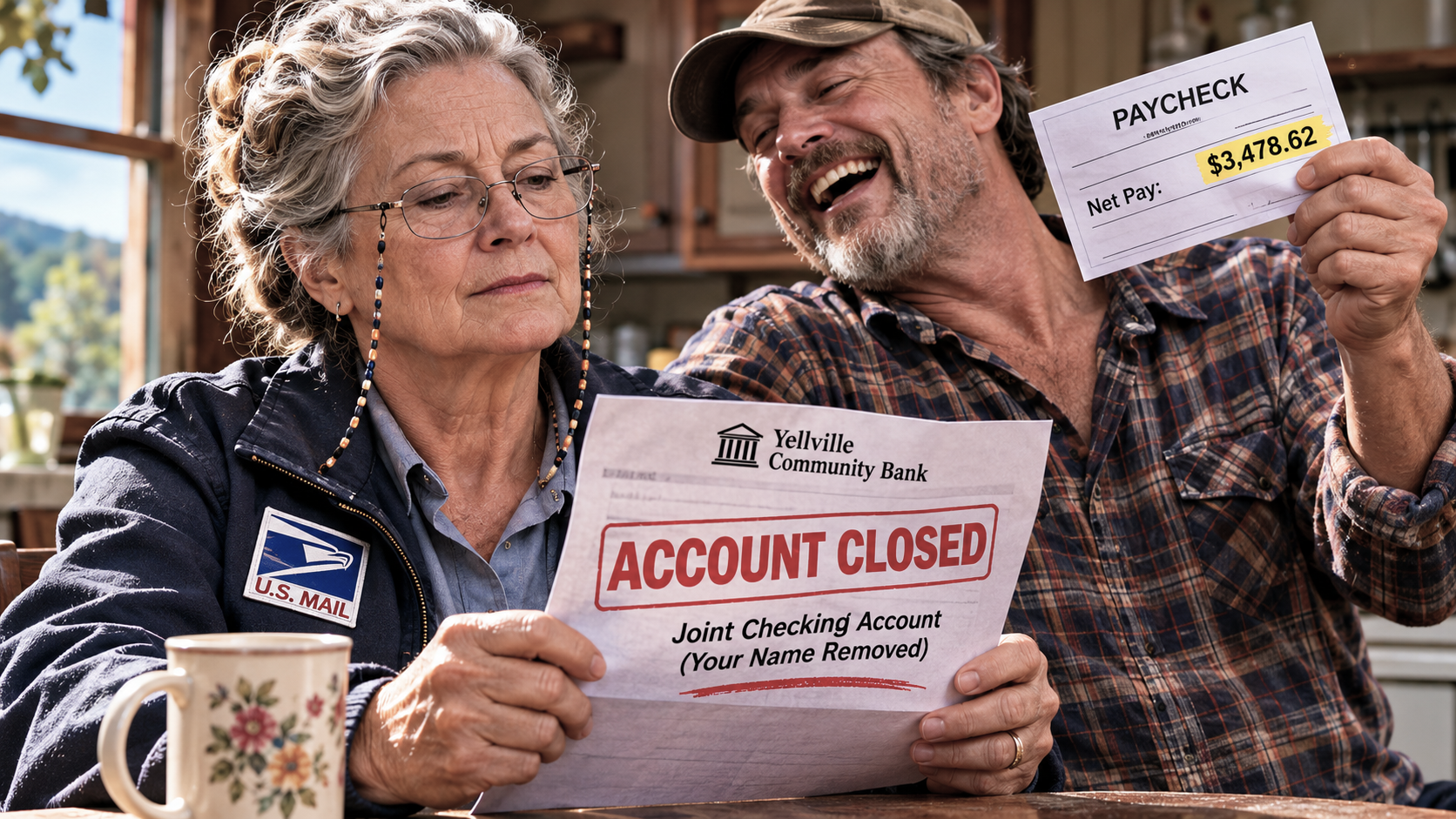
“You closed our checking account.”
“That account was costing fees.”
“You redirected my pension.”
“I moved our money.”
“You moved my deposit to an account I couldn’t access.”
He waved one hand.
“Same difference.”
“No,” I said. “That’s the difference we’re discussing.”
He glanced toward the hall, toward the bedroom where he expected to sleep, toward the refrigerator he expected to find stocked.
Everything was still where he had left it.
That seemed to bother him more than the goats.
I got my folder.
Inside were copies of the bank statements I had been able to obtain, my pension correspondence, the certified deed, the pasture lease, and the photograph he had asked me to take.
I laid the photograph on top.
There he was at my kitchen table, grinning, his paycheck held beside his cheek.
He looked down at it.
“You sent that to somebody?”
“To myself. So I wouldn’t lose it.”
“You know I was joking.”
“I know you wanted your sisters to see.”
“That’s just how we talk.”
“I know.”
Those two words were harder than any of the others.
Because I did know.
I knew the jokes about how women spent money. I knew the stories about men whose wives had gotten above themselves.
I knew how quickly an ugly remark became a joke when somebody objected.
I had spent years laughing a second late so nobody would notice I hadn’t found the humor.
Alden pushed the photograph away.
“You’ve been listening to Miriam.”
“I’ve been listening to you.”
He asked about supper again.
Not because he had forgotten. Because he wanted the evening back on familiar ground.
“There’s bread,” I told him. “Ham in the refrigerator. Mustard’s where it always is.”
“You expect me to fix my own?”
“Yes.”
He waited.
I waited, too.
The refrigerator motor clicked on.
Finally he stood, opened the refrigerator, and stared into it as though somebody had changed the alphabet.
I went to my room.
For two weeks, I had slept in the smaller bedroom overlooking the side yard. I had moved my clothes into the old oak dresser that had belonged to my father.
Alden appeared in the doorway while I was taking off my glasses.
“What’s all this?”
“My room.”
“You mad enough to sleep in here over a checking account?”
I set my glasses on the dresser.
“I’m tired enough.”
He stood there a long time.
Then he said, “You’ll feel foolish in the morning.”
I shut the door.
My hands shook so badly I had to use both of them to turn the little lock.
But I turned it.
I didn’t sleep much.
Around midnight, I heard the television.
At one, I heard him open a kitchen drawer.
At two, I heard the back door and smelled a cigarette through the screen. He had quit smoking nine years earlier, except for every time he didn’t.
I lay under my mother’s quilt and watched headlights move across the ceiling when a car passed.
I thought about unlocking the door.
I thought about making coffee before he woke.
I thought about how easily I could soften the whole thing.
Tell him we would discuss the goats.
Tell him I hadn’t meant to embarrass him.
Tell him I was sorry he had come home hungry.
There were so many ways to return to the life I knew.
At a quarter past three, I got up, took a pencil from the dresser, and wrote on the back of an envelope.
He took your pension.
I put it beside the clock.
Whenever my mind started wandering toward excuses, I read it.
By dawn, I had worn a dark line beneath those four words.
He was at the table when I came into the kitchen.
The lease summary lay in front of him.
He had made coffee.
One cup.
For reasons I still can’t properly explain, that hurt worse than the shouting.
I got another mug.
“We need to straighten this out,” he said.
“Yes.”
“You cancel that lease. I’ll put you back on the account.”
I poured my coffee.
“No.”
“You wanted your name on it. I’m offering.”
“I want the money you moved.”
“It’s all tied together.”
“Then untie it.”
His jaw worked.
He looked older in the morning light. So did I, reflected in the dark kitchen window.
For a moment, I could see the young man who had helped me bury my father.
Then he said, “You’ve got no idea what it costs to keep this place running.”
I pulled out my chair.
“Then show me.”
That was the beginning of the part nobody laughs about on a porch.
Not goats. Not paychecks.
Paperwork.
We spent three hours at that table.
Alden brought out a metal box from the bedroom closet. I had dusted around that box for years.
There were insurance papers, repair receipts, tax returns, and bank envelopes held together with rubber bands.
Some bills were exactly what he had always said.
Some were higher.
Some were lower.
There was money I hadn’t known we had, and debt I hadn’t known we owed.
The mower payment was there.
So were three credit cards.
One had my name printed on a second card I had never carried.
I held it between my fingers.
“When did you get this?”
“It came with the account.”
“Did I sign anything?”
“I don’t remember.”
I put it in a separate pile.
He didn’t like that pile.
Every time I added something, he reached toward it.
Every time, I moved it closer to me.
My pension deposit had landed in his new account.
That much he finally admitted.
He said he had meant to give me cash for groceries.
I asked how much.
“Whatever you needed.”
“How much, Alden?”
“I don’t know. Two hundred.”
“For a month?”
“You’re one woman when I’m gone.”
I looked toward the stove where I had heated bathwater all winter.
He followed my eyes.
“I was going to replace that heater.”
“You bought the mower.”
“The mower was a good deal.”
“So was hot water.”
He sat back.
I didn’t raise my voice.
I think he had counted on me raising it.
Then he could have called me worked up, unreasonable, impossible to talk to.
Instead, I wrote down the pension amount to the cent.
I turned the paper so he could see.
“I want this transferred back.”
“You don’t trust me?”
“No.”
He looked at that word a long while, even though I hadn’t written it.
His sister Darlene called before lunch.
I knew because he answered with, “Well, she’s sitting right here.”
He listened for a minute, watching me.
Then he held out the phone.
“Darlene wants you.”
I took it.
“What have you done to my brother?”
“Good morning to you, too.”
“He’s worked himself half to death for that farm.”
“So have I.”
“Men need to feel respected, Joanne.”
I looked at Alden.
He watched the tabletop.
“Did he tell you he moved my pension?”
A pause.
“He said you got confused over some banking.”
“No. He changed the deposit information and closed the account I used.”
“Well, I’m sure there was a reason.”
“There was. He wanted me asking him for money.”
“You ought to work these things out privately.”
“I was trying. Then you called.”
She inhaled sharply.
I could hear a television in the background.
Finally she said, “You’ve changed.”
“I’m trying.”
I handed him the phone.
My coffee had gone cold.
I drank it anyway.
He stayed home all three days between runs.
Usually those days belonged entirely to him.
The laundry. The meals. The errands he left on a list under the sugar bowl.
This time, his jeans stayed in the duffel bag until he carried them to the washer.
He used too much detergent.
Foam came up against the glass.
He called my name like the machine had injured him.
I stood in the doorway and told him which button to press.
Then I left him to it.
On Sunday, Miriam came across with the first rent check.
She knocked.
She had always knocked, even when we had been friends for years.
Alden sat in his recliner.
Miriam handed the envelope to me.
“Girls are settling in fine.”
“I can see that.”
“One of them’s taken a liking to that crooked post by the lane.”
“Daddy put that in with a broken hand.”
“Well,” she said, “apparently he put it in to last.”
Alden stared at the television.
Miriam didn’t look at him.
Neither did I.
Before he left Monday, he put a folded bank receipt on the kitchen counter.
The pension money had been transferred.
Every cent.
I checked my account myself.
Then I checked it again.
Old habit.
He stood beside the door holding his keys.
“There. Can we quit this now?”
I laid the receipt flat.
“That part’s settled.”
He looked toward the front pasture.
“You really signed a year?”
“Yes.”
“I could’ve made more off hay.”
“You didn’t.”
He opened his mouth, closed it, and lifted his bag.
I walked as far as the porch.
For thirty years, I had stood there while his truck pulled away. Sometimes I waved until the trailer disappeared.
That morning, he stopped on the bottom step.
“You going to tell me to drive safe?”
I swallowed.
“Drive safe, Alden.”
He nodded, as though we had agreed on something larger.
We hadn’t.
But I did want him to drive safe.
Being angry hadn’t emptied me of everything else.
The water heater arrived on Wednesday.
I had called the plumber the week before.
He brought an apprentice and a narrow handcart. They tracked a little mud into the utility room and apologized more times than necessary.
I told them floors could be washed.
By four, the old tank was on their truck.
By six, I stood in my bathroom with steam curling around the mirror.
I put my hand under the faucet and left it there.
No kettle.
No saucepan.
No carrying boiling water down the hall with a towel wrapped around the handle.
I ran a bath deep enough to cover my knees.
Then I sat on the closed toilet lid and cried.
I was embarrassed, even alone.
It was a water heater.
People needed roofs. Medicines. Operations.
But I had spent six weeks making myself smaller than a machine that cut grass.
I got into that bath.
I stayed until the water cooled because I wanted to, and when it cooled, I added more hot water.
The lawyer’s name was Helen Shaw.
I had found her through a woman at church who had needed help after her husband died.
Helen didn’t act shocked when I told her what had happened.
She listened and wrote things down.
That first day, I had wanted her to tell me the deed meant everything was simple.
She hadn’t.
“Bring the records,” she said. “We’ll look at what actually happened.”
That was why I trusted her.
On my second visit, I brought two grocery sacks of papers.
She helped me sort questions from fears.
The inherited property needed one kind of review. Our debts needed another. The pension changes needed records of their own.
She never promised that forty-five years could be divided neatly.
Neither did she tell me to be grateful it wasn’t worse.
When I left, I had a list.
For the first time in years, it was a list that served me.
I changed passwords.
I changed the email address attached to my pension.
I turned on account alerts and wrote recovery information in a notebook I kept somewhere Alden wouldn’t think to look.
Then I moved it.
Hiding things had begun to feel too much like the marriage I was trying to leave behind.
I bought a small locking file box instead.
My name went on it in black marker.
At the bank, the teller who used to get birthday cards from me helped me understand the difference between being named on an account and merely being allowed to use something.
I asked questions until I understood.
Once, I apologized for taking so long.
She shook her head.
“Miss Joanne, this is your appointment.”
I thought about that all the way home.
My appointment.
My time.
Mine didn’t have to mean somebody else went without.
It could just mean I was allowed to finish asking.
Alden called from Oklahoma.
“Darlene says you’re talking about us all over town.”
“I talked to a lawyer and my bank.”
“And Miriam.”
“Yes.”
“She’s got a big mouth.”
“She’s got goats, Alden. You can hear them from the road.”
He didn’t laugh.
Neither did I.
He asked what the plumber had charged.
I told him.
“That much?”
“That much.”
“You should’ve called around.”
“I got three estimates.”
Silence.
Then he asked, “Which one did you use?”
“The middle one. He could come Wednesday.”
He began telling me what he would have done.
I let him finish.
Then I said, “It’s installed.”
That was another sentence I had needed for years.
A thing could be completed without his approval.
A decision could remain a decision after he disliked it.
We talked about rain after that.
It was the strangest peaceful minute we had shared in months.
I wish I could say that was where he changed.
It wasn’t.
On his next trip home, he brought roses from a truck stop.
Red ones in a plastic sleeve, with a price sticker still attached.
I put them in water.
He watched me.
“Well?”
“Thank you.”
“That all?”
“What else would you like me to say?”
He dragged a hand down his face.
“I’m trying here.”
“I see the flowers.”
“Lord, Joanne.”
I set the vase in the middle of the table.
“I need you to understand why I’m upset.”
“I said I’d put you back on the account.”
“And I said I don’t want that.”
He looked at the flowers, offended on their behalf.
That night, he grilled pork chops.
He left the dishes.
In the morning, he seemed honestly surprised they were still beside the sink.
For years, he had mistaken my work for the natural condition of a house.
We tried counseling.
That was my suggestion.
Helen had asked what I wanted, and I had discovered I couldn’t answer without thinking about what everybody else wanted first.
So I gave myself time.
Alden agreed because he thought the counselor would explain me to myself.
He wore his ironed blue shirt.
He had ironed it.
I noticed the crooked crease down one sleeve and felt a tenderness so sudden it nearly undid me.
Then the counselor asked him about the pension.
He said, “She’s always been nervous about money.”
I looked down at my hands.
The counselor asked again.
He explained fees, household management, and how difficult it was to handle things from the road.
Finally she said, “Did Joanne agree to the change?”
“No, but—”
She waited.
He looked at me.
For once, there was nobody laughing with him.
“No,” he said.
It was the first straight answer he had given in that room.
We went three times.
At the second visit, I told him about heating bathwater.
He said he hadn’t realized it bothered me so much.
“I told you every week.”
“I thought you were complaining.”
I sat very still.
The counselor asked what he thought complaining meant.
He didn’t answer.
At the third visit, he said he couldn’t spend every day apologizing for being the man I had married.
I looked at his hands.
They were broad hands. Scarred at the knuckles. Hands that had changed tires in freezing rain and once carried me across a flooded ditch when we were young.
I had loved those hands.
“I’m not asking for every day,” I said. “I’m asking for what happens next.”
He said I had a good home.
I said I wanted a good life inside it.
On the drive back, we passed the feed store.
He turned in without asking.
I waited in the truck for forty minutes.
That evening, I made chicken and dumplings.
I had wanted them all week.
Alden came into the kitchen when he smelled the broth.
His face softened.
“There she is.”
I stood with the spoon in my hand.
He meant his wife.
His old wife.
The one who came back around if he waited long enough.
I put two bowls on the table because I hadn’t yet decided we were strangers.
We ate quietly.
Afterward, he reached across and patted my wrist.
“Let’s quit making ourselves miserable.”
I watched his thumb rest against my skin.
“What happens the next time I tell you no?”
He withdrew his hand.
“Here we go.”
I nodded.
Not at him.
At the answer.
The next morning, I called Helen.
Leaving a marriage while remaining in your own house is a peculiar business.
His boots still stood by the back door.
His favorite coffee cup still had a crack near the handle.
I found myself buying the cereal he liked and putting it back on the shelf.
We talked through lawyers about living arrangements.
I didn’t put his belongings in the yard.
I didn’t change the locks while he was out on a run.
We set dates. We wrote things down. We let people who understood the process keep us from turning hurt into something messier.
He rented a small place nearer the trucking yard.
For three weekends, he moved boxes.
On the last afternoon, he carried out the lodge photograph from the hall.
There was a pale rectangle on the wallpaper where it had hung.
He paused beside me.
“You really want to eat alone?”
I couldn’t answer right away.
Then I said, “I’ve done that most nights for thirty years.”
He looked toward the truck.
“I mean when I’m home.”
“I know.”
Darlene came the following Saturday.
Her other sister, Patty, waited in the car.
Darlene stood on my porch holding a casserole dish.
For one foolish moment, I thought she had brought me supper.
Then she said it was Alden’s mother’s dish and he wanted it.
I went and found the right lid.
She followed me into the kitchen without being invited.
“You know he’s staying late at the yard because he doesn’t want to go back to that little apartment.”
I dried the lid.
“He could call somebody.”
“He has a wife.”
I looked at her.
She looked away first.
When I handed her the dish, she took it with both hands.
“Forty-five years, Joanne.”
“Yes.”
“You just throw that away?”
I thought about all the things I had kept because throwing them away seemed wasteful.
Broken lamps.
Bent screens.
Promises.
“I lived those years,” I told her. “They already happened.”
She had nothing ready for that.
The hard days came in small, ordinary ways.
A storm warning.
A flat tire.
A strange noise under the refrigerator.
I would reach for my phone and stop.
Sometimes I called a professional.
Sometimes I asked Amos.
Sometimes I figured it out.
Once, I sat on the kitchen floor beside a leaking pipe and cried because I didn’t know where the shutoff valve was.
Then I called Miriam.
She came across in rubber boots and turned it off.
“Amos showed me after the second flood,” she said.
I laughed through my tears.
She sat beside me on the floor.
“I keep thinking I should know everything now,” I admitted.
“Why?”
“Because I made such a fuss about handling things.”
She looked at the wet towels.
“Joanne, renting somebody a pasture doesn’t make you a plumber.”
We laughed so hard I had to blow my nose on a dry corner of a dishcloth.
The divorce took longer than the story folks in town wanted to tell.
People preferred the goats.
They liked imagining Alden pulling up, seeing his pasture full, and being served papers with his supper.
I let them enjoy what they liked.
The real thing involved statements, appointments, and days when I wished I had never opened that first bank envelope.
There were arguments over equipment and balances.
There were things Helen advised me to compromise on.
I listened.
I kept the farm, and we reached an agreement about the rest.
I didn’t get every dollar I thought I deserved.
Neither did Alden.
At the final meeting, I carried the same purse I had taken to the courthouse for my deed.
My glasses hung from the same beaded chain.
I read every page.
Twice.
When it was over, I sat in my truck with the windows down.
This time, I didn’t cry.
I just sat until I was ready to drive.
Alden called three days later.
I almost let it ring.
Then I answered.
“I found something of your daddy’s,” he said.
My hand tightened around the phone.
“What?”
“That little pocketknife. The one with the dark handle.”
I had looked for it for years.
He said it had been in a toolbox he moved from the shed.
“Want me to leave it with Vonda?”
“No. You can bring it.”
He came Sunday afternoon.
I met him on the porch.
He had lost some weight. There was a clean shirt folded on the passenger seat of his pickup, probably waiting for Monday.
He put the knife in my palm.
The handle was worn smooth where my father’s thumb had rested.
“Thank you.”
Alden nodded.
From the pasture came the soft clatter of goats along the fence.
He watched them for a while.
“They’ve cleaned that corner up.”
“They have.”
“Fence looks good.”
“Amos’s boys did good work.”
He nodded again.
Then he said, “I shouldn’t have moved your money.”
I didn’t help him.
I didn’t say it was all right.
He looked at the road.
“I knew you wouldn’t agree. That’s why I didn’t ask.”
The porch seemed very quiet.
“That’s true,” I said.
He swallowed.
“I didn’t think you’d leave.”
“I know.”
For once, he didn’t turn it into a joke.
He rubbed a thumb over his key ring.
“I thought you’d holler. Then we’d settle down.”
“I know that, too.”
He stood there with nowhere comfortable to put his hands.
I had waited years for him to understand certain things.
Now that he understood one of them, I didn’t feel triumphant.
I felt tired.
And a little sad.
But I didn’t ask him in.
After a while, he said he ought to go.
I told him to drive safe.
He did.
That fall, I painted the kitchen.
Not some wild color meant to prove a point.
Just a warm yellow I had liked on a paint card for twelve years.
Alden had said yellow showed grease.
It probably did.
Walls could be washed.
Miriam helped me move the table.
Her youngest boy fixed the screen door so it no longer caught at the bottom.
I paid him what he asked, and he argued that it was too much.
I told him I had spent thirty-one years knowing when people were trying to slip money into a mailbox without a stamp.
He grinned and took it.
I hung Daddy’s pocketknife on a small hook beside his photograph.
Then I took it down.
He hadn’t owned it to have it displayed.
I put it in my coat pocket, where it belonged.
That afternoon, I used it to cut twine around a bale of straw.
The blade was still sharp.
At Thanksgiving, I made a smaller pan of dressing.
That was harder than signing the lease.
My hands kept reaching for the big bowl.
For years, I had measured holidays by how much food left my kitchen.
This time, I took a pie across the road.
The Yoders had pushed two tables together.
There were children everywhere, boots by the door, and somebody arguing over whether a goat had eaten a school permission slip.
Miriam made room beside her.
Nobody asked me to explain my life before passing the potatoes.
After dinner, I walked home carrying half my pie.
My porch light was on a timer now.
The yellow kitchen glowed through the window.
For the first time, coming home alone didn’t feel like arriving somewhere after everybody else had left.
It felt like my house was waiting for me.
I put the pie in the refrigerator.
Then I took it back out and cut a piece.
The next spring, Miriam asked about renewing.
We sat at my kitchen table.
Not hers this time.
She brought the old lease. I brought my glasses.
We went over the terms, changed the start date, and discussed a section near the creek that needed to rest.
Amos would repair two leaning posts.
I would have the dead limb over the gate removed.
Ordinary business.
At the bottom of the new agreement, I wrote my name slowly.
Joanne Kittle.
I had kept it.
It had been mine for most of my life, and I didn’t intend to spend money changing every card in my wallet just because Alden and I had stopped being married.
Miriam signed beneath me.
Then she took a check from her purse.
“Another year.”
“Another year.”
Outside, the goats were already waiting at the gate.
They had no interest in paperwork.
I respected that, even if I couldn’t relate.
I still read every piece of mail twice.
Some habits earn their place.
But I don’t stand at the counter with my stomach tight anymore, wondering what I might discover after somebody else has decided what I’m allowed to know.
My pension arrives in my account.
The pasture rent comes in an envelope Miriam hands directly to me.
The water gets hot when I turn the faucet.
Alden sends a Christmas card. Last year, he wrote that his truck needed a new transmission and asked after the farm.
I wrote back that the farm was fine.
It was.
Some evenings, I sit on the porch until the shadows reach the fence.
Across the road, Miriam raises her glass.
I raise mine.
Then I go inside and decide what I want for supper.
Sometimes it’s a sandwich.
Sometimes it’s chicken and dumplings.
And sometimes, when I’ve spent the whole afternoon outside and don’t feel like cooking, I eat a slice of pie over the sink.
I don’t ask anybody first.