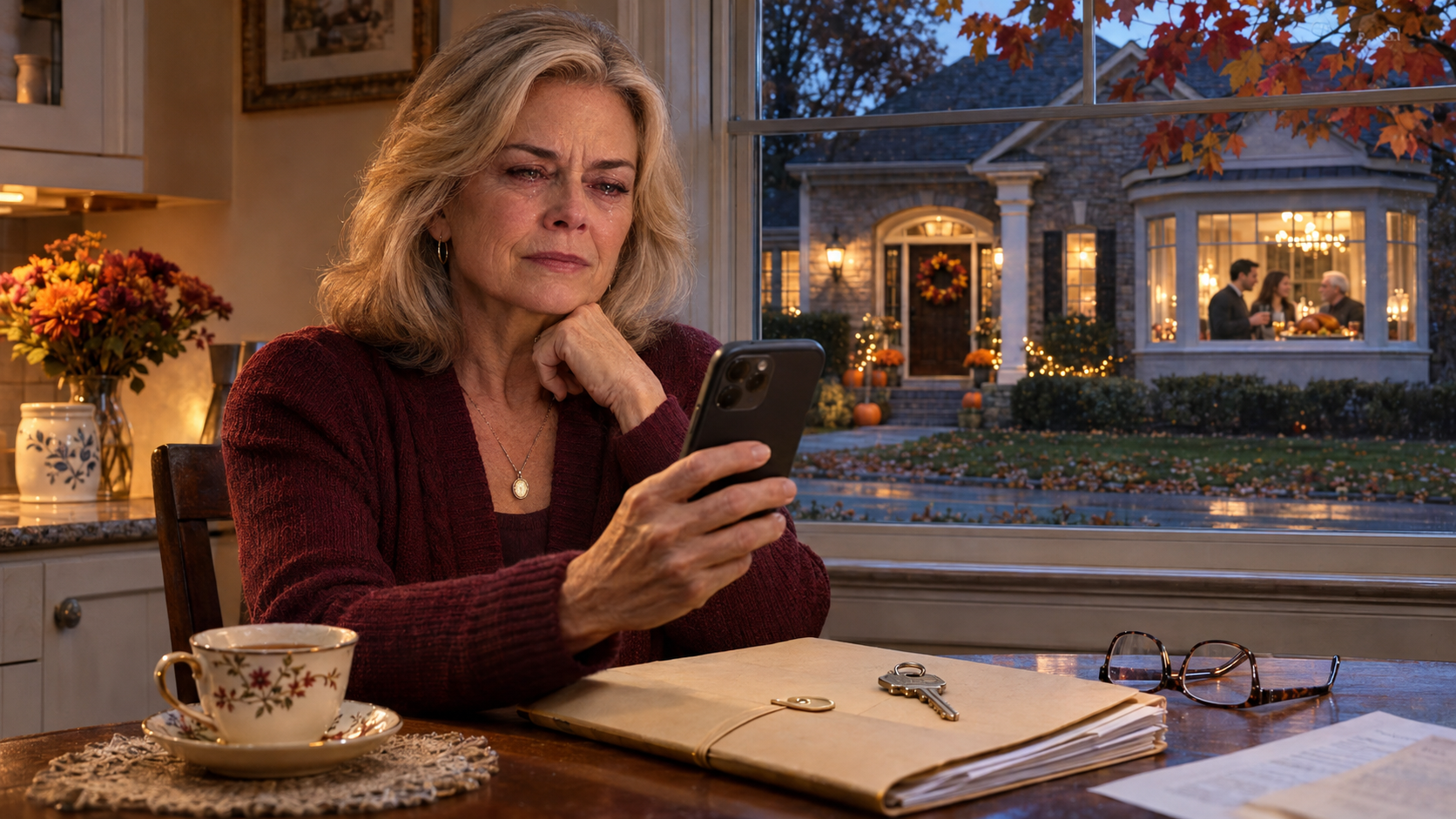
The first call came while I was washing my teacup.
My son’s name filled the screen.
Daniel.
For years, that name had made my hand move before I thought. Whatever I was doing could wait. Whatever he needed came first.
This time, I dried the cup.
Then I answered.
“Mom, what is this?”
“Hello, Daniel.”
“I’m at work. Somebody brought an envelope up to my desk.”
“I sent you a copy of the notice.”
“A notice saying you’re taking our house?”
“Saying I’ve asked my attorney to review the transfer.”
“You can’t be serious.”
Behind him, I heard a door shut.
Then his voice dropped.
“Is this because of Thanksgiving?”
I rested my hand on the counter.
“No. Thanksgiving is when I finally heard you.”
“That doesn’t even make sense.”
“It does to me.”
He exhaled hard.
“Lauren’s father is difficult. You know that.”
“I barely know him.”
“Exactly. You don’t know how he gets.”
I looked at the chair across from mine. Daniel had sat there three weeks earlier, eating the last slice of banana bread while telling me the house would change everything.
Apparently, it had.
“Whose house were you planning to have dinner in?” I asked.
“Ours.”
“And who decided I couldn’t come?”
A pause.
“Richard.”
“And who sent me the message?”
He didn’t answer.
Lauren called eleven minutes later.
She skipped hello entirely.
“Daniel is having a panic attack.”
“Then he should sit down.”
“How can you be so cold?”
I looked at the grocery bags still sitting by my back door. I had returned to the supermarket that morning for milk, bread, and things I actually liked.
“I’m not discussing this through you.”
“You’re trying to make us homeless over a dinner invitation.”
“I’m asking for a legal review of a very large transaction.”
“You said the house was a gift.”
“Yes.”
“You stood in the kitchen and said you wanted us to feel secure.”
“I did.”
“And now you’re threatening us?”
Her voice rose on the last word.
I could picture her pacing across the pale oak floors, one hand pressed to her forehead, the other holding the phone.
“I’m not threatening you, Lauren. I’ve stopped pretending everything is fine.”
She went quiet.
Then she said, very carefully, “My father thinks you should calm down before you embarrass yourself.”
For a moment, I couldn’t speak.
There he was again.
Richard.
A man who had contributed opinions to every expensive decision and money to none of them.
“Your father is welcome to speak with my attorney.”
I ended the call before she answered.
That evening, I turned off my phone.
I expected peace.
Instead, I heard every doubt I had managed to outrun during the day.
What kind of mother sent legal notices to her own child?
What if I had misunderstood?
What if Richard had simply wanted a smaller gathering?
What if Daniel had been planning to visit me afterward?
I made soup and forgot to eat it.
At nine, I opened our message thread.
There was no second invitation.
No explanation.
No “I told him absolutely not.”
Just the original message, sitting above my single-word reply.
I scrolled backward.
Requests.
Amounts.
Promises.
A photograph of a broken dishwasher.
A screenshot of a utility warning.
A link to a sofa Lauren loved.
Somewhere among all of that, I found a message from Daniel asking whether I had gotten home safely after a thunderstorm.
It was eight months old.
I cried over that one.
Not the money.
That small, ordinary question.
I missed being someone he wondered about.
Rachel called the following morning.
Her voice sounded different from the day before.
Less certain.
“Carol, I’ve gone through the complete closing file.”
I pulled out a chair.
“All right.”
“I need to correct something I told you.”
My stomach tightened.
She didn’t rush past it.
“I spoke too broadly about our ability to recover a completed gift. Being treated badly does not, by itself, turn a gift into a debt.”
I stared at the window above my sink.
“And the house?”
“The language you found matters, but we need to establish exactly which documents were signed and which conditions were incorporated into the transfer.”
“You said we could take it back.”
“I said that too confidently. I’m sorry.”
There was no excuse attached.
No effort to make me feel foolish for believing her.
“The notices preserve our position,” she continued. “They don’t decide the outcome. I want a real estate litigator to review this with me before we make another demand.”
I closed my eyes.
For two days, anger had felt like solid ground.
Now I could feel it moving.
“Tell me what is actually possible,” I said.
“That’s what we’re going to do.”
I went back to her office that afternoon.
This time, I brought a notebook.
On the first page, I wrote three questions.
What belongs to me?
What can I prove?
What do I want?
The second attorney was a gray-haired woman named Judith Price.
She had the closing documents arranged in separate stacks.
One stack concerned the deed.
Another concerned the agreement Daniel and Lauren had signed when I provided the purchase money.
A third contained the older transactions.
Judith tapped that third stack first.
“Some of these are clearly gifts.”
I nodded, though it hurt.
“The wedding?”
“Likely.”
“The furniture?”
“Probably, based on the messages we have.”
“And the car?”
She turned a page toward me.
Daniel had written: I’ll repay you two hundred a month once we get settled.
I remembered that promise.
I also remembered deciding not to remind him after the first payment failed to arrive.
“This one is different,” Judith said.
For the first time, we began separating what had happened from what I wished had happened.
The $185,000 looked different once somebody examined it carefully.
There were gifts I had given freely.
There were loans I had quietly forgiven without ever saying so.
There were emergencies I had paid for and forgotten.
There were transfers labeled “loan” in the memo line, with messages acknowledging repayment.
There was also nearly twenty thousand dollars I had counted twice because I had printed both the account withdrawal and the cashier’s check.
I felt my face burn when Judith showed me.
“I should have noticed.”
“You brought us raw records,” she said. “Sorting them is the work.”
I had arrived wanting a number large enough to express my hurt.
But hurt didn’t become more legitimate because the total was higher.
We corrected the spreadsheet.
We crossed out anything we couldn’t support.
By the end of the meeting, the stack of possible repayment claims was much smaller.
It was also real.
I could look at it without needing to exaggerate.
The house was more complicated.
Months earlier, when I first offered to buy it, Rachel had urged me to leave myself a way to reconsider.
I had laughed.
“He’s my son.”
She had insisted on a separate written agreement.
Daniel and Lauren had signed it at her office before closing. I remembered Lauren asking how long it would take because they had a flooring appointment.
The agreement allowed a limited review period and described what would happen if the parties couldn’t agree during it.
It wasn’t a magic sentence that made the deed disappear.
It created a dispute we could raise.
Judith was clear about that.
“They may challenge the meaning. They may challenge whether you exercised the provision properly. Litigation would cost money, and I won’t promise you a result.”
I looked down at my notebook.
“What do you recommend?”
“A negotiated resolution, if they’ll participate.”
“And if they won’t?”
“Then we discuss the cost of each next step before taking it.”
I wrote that down.
Nobody was getting another blank check from me.
Daniel came to my house that night.
I saw his car through the curtains and felt the old instinct to put on the kettle.
I did put it on.
Boundaries, I was discovering, didn’t require me to stop liking tea.
He stood on the porch with his coat unbuttoned.
“You won’t answer my messages.”
“I answered the one asking whether we could talk.”
“I sent fourteen others.”
“I know.”
He came in and looked around as though I might have redecorated out of spite.
On the coffee table sat a travel brochure.
He picked it up.
“Portugal?”
“I asked for information.”
He put it down.
“We might lose our house, and you’re planning a vacation?”
I carried the cups into the living room.
“I haven’t had a vacation in six years.”
“That isn’t what I meant.”
“Then say what you mean.”
He sat.
For a minute, he looked like the little boy who used to confess to broken things only after checking whether I already knew.
“Richard says you’re using money to control us.”
I handed him his tea.
“Does he?”
“He says a real gift doesn’t come with punishment.”
I sat opposite him.
“What did you say?”
“To what?”
“When he told you I couldn’t come.”
Daniel looked into his cup.
“I told him you’d already bought groceries.”
My throat tightened.
“And?”
“He said that wasn’t his problem.”
The room seemed to go very still.
“What did you say then?”
“Mom—”
“What did you say?”
He rubbed his forehead.
“Lauren was upset. Her mother was crying. Richard said he wouldn’t come if you came.”
“So you chose him.”
“I was trying to avoid a fight.”
“You sent the fight to my phone.”
He looked up.
I hadn’t planned that sentence.
It was simply what had happened.
He had taken the discomfort he didn’t want inside his house and placed it in mine.
“Why didn’t he want me there?”
Daniel’s eyes moved toward the window.
“Tell me.”
“He thought you’d bring up paying for the house.”
“Have I ever done that at a family dinner?”
“No.”
“Have I ever handed somebody a plate and reminded them what it cost?”
“No.”
“Then why?”
He took a long breath.
“Lauren told him you were getting too involved.”
I waited.
“The paint colors. The cabinet handles. You asked whether we were keeping the maple tree.”
“You asked me to go to the paint store.”
“I know.”
“And I asked about the tree because your father planted one like it outside your bedroom when you were born.”
“I know, Mom.”
The grief came so suddenly I had to set down my cup.
My husband had been dead eleven years.
I had spent so long trying to keep Daniel from feeling the empty space that I had filled it with everything I could buy.
Daniel stayed almost an hour.
We didn’t solve anything.
He said he loved me.
I said I loved him, too.
Then he asked whether I would withdraw the notices.
“Will you and Lauren attend mediation?”
“We shouldn’t need lawyers.”
“We needed them when I gave you the money.”
“That was different.”
“Yes,” I said. “Nobody objected to paperwork when it benefited you.”
He stood.
At the door, he turned back.
“If I’d just told Richard no, would we be here?”
I could have given him the easy answer.
Instead, I told him the truth.
“We would have reached this conversation eventually. I don’t know when.”
He nodded once.
Then he left.
I stood beside the closed door until the kettle clicked cold in the kitchen.
Thanksgiving arrived gray and wet.
For the first time in decades, I hadn’t bought a turkey.
My friend Ellen called at nine.
“You can still come here.”
“I know.”
“We have seventeen people. Eighteen won’t break us.”
“I’m coming at four.”
“And before four?”
“I’m doing something else.”
I had signed up to help serve lunch at a community center.
Not because I wanted a lesson about people having less than I did.
I already knew that.
I needed somewhere useful to put my hands.
A woman named Denise gave me an apron and assigned me mashed potatoes.
For three hours, nobody asked whether I was angry.
Nobody asked what my son had done.
They asked whether we had more gravy.
Whether a plate could be packed for someone’s brother.
Whether the coffee was fresh.
I answered questions I could answer.
It steadied me.
At Ellen’s house, somebody took my coat before I could offer to help.
Her husband poured me a small glass of wine.
I sat between a retired school principal and a college student who wanted to know whether accounting was really as boring as people said.
“It depends how much you enjoy finding out what people hoped you wouldn’t notice.”
He laughed.
I laughed, too.
Halfway through dinner, my phone vibrated in my purse.
Daniel.
A photograph.
The dining table at the house.
Place settings. Candles. A turkey glazed dark brown.
No message.
I looked at it for a long time.
Then another text arrived.
Wish things were different.
I typed: They can be.
I didn’t send a photograph of Ellen’s table.
I didn’t need him to know I had somewhere to be.
That evening belonged to me whether he saw it or not.
Richard called me the next Monday.
His voice had the smooth impatience of a man accustomed to being accommodated.
“Carol, we need to put an end to this.”
“Then encourage them to schedule mediation.”
“You’re upsetting my daughter.”
“I understand she’s upset.”
“She and Daniel are starting their life together. They need space.”
“They have it.”
“You know what I mean.”
“I don’t think I do.”
He sighed.
Then he offered the solution he apparently considered generous.
“I’ll have them invite you to Christmas.”
I sat back.
Have them.
As though holidays were permits he issued.
“I’m not negotiating invitations, Richard.”
“Then what is this about?”
“My finances and an agreement your daughter signed.”
“They’re a young couple.”
“They’re thirty-four.”
“They can’t produce three hundred fifty thousand dollars.”
“Then they should discuss the available options with their attorney.”
His voice hardened.
“You’ll destroy your relationship with your son.”
I looked at the photograph of Daniel on my mantel.
“I’m hoping we build a better one.”
Mediation was scheduled for the second week of December.
Before then, I made changes that didn’t require anyone else’s agreement.
I canceled the automatic transfer I had been sending Daniel on the first of every month.
I removed my card from their streaming accounts.
I told the insurance company I would no longer pay their premiums after the current billing period.
I sent one clear email with dates.
No accusations.
No account of every sacrifice.
Just the expenses, the final payment dates, and instructions to contact the providers.
Daniel called about the car insurance.
“Lauren’s policy is more expensive than we thought.”
“Then compare quotes.”
“We’re already stretched.”
“I understand.”
He waited.
I let him.
Finally, he said, “You’re really doing this.”
“Yes.”
After we hung up, I sat with my hands folded in my lap.
It hadn’t felt powerful.
It had felt like letting go of a railing.
But I hadn’t fallen.
I also made an appointment with a financial planner.
I had avoided one for years because I didn’t want to hear that I was giving away too much.
Her name was Anita.
She asked what I wanted retirement to look like.
I gave her my account balances.
She smiled gently.
“That tells me what you have. I asked what you want.”
I stared at her.
There were things I wanted.
A smaller place with less maintenance someday.
A trip while my knees still worked.
Enough put aside that a medical bill wouldn’t become a family emergency.
Maybe a class.
Maybe new tires before the old ones became an adventure.
I said all of it awkwardly, like a child reading a wish list aloud.
Anita wrote it down.
Then she showed me what I could afford.
Some things had to wait.
Some didn’t.
I drove home with a plan for the first time since retiring.
At mediation, Lauren arrived carrying a thick folder.
Daniel carried nothing.
Their attorney was a quiet man named Paul.
Richard came, too.
He wasn’t part of the agreement, and after a brief discussion, he waited outside.
Lauren didn’t like that.
I could see it in the way she arranged her papers.
The mediator met with us together briefly, then put us in separate rooms.
There were stale peppermints in a glass bowl.
A clock clicked too loudly.
Rachel sat beside me.
Before we began, she leaned over.
“We stay with what we can support.”
I nodded.
I appreciated that more than any speech about winning.
The first proposal from the other room was simple.
I would withdraw everything.
They would acknowledge that my feelings had been hurt.
I asked the mediator to repeat the second part.
He did.
I looked at Rachel.
Then I said, “No.”
By noon, the conversation had changed.
Their attorney had reviewed the house agreement.
They disputed our interpretation, but they didn’t dismiss it.
Neither side wanted months of litigation over a transaction that had happened less than a month earlier.
The mediator asked what outcome I could live with.
I looked at my notebook.
What do I want?
For weeks, I had thought the answer was the house.
But I didn’t want their house.
I wanted my savings restored.
I wanted to stop lying awake wondering whether I could afford the years ahead.
I wanted my son to know that my willingness to help had an end.
“They can buy me out,” I said. “Or we can agree to sell it.”
The mediator nodded.
“Let’s work through what those options would require.”
For the first time that day, I unclenched my hands.
Daniel asked to speak with me alone.
We met in a smaller room with a window overlooking a parking garage.
He looked exhausted.
“Richard isn’t going to help.”
I said nothing.
“He told Lauren he doesn’t believe in giving married children money.”
I looked at my son.
He gave a short, embarrassed laugh.
“Yeah. I heard it, too.”
I waited.
“We thought we could get a mortgage and pay you back.”
“Can you?”
“Not for the full amount.”
“Then you need to know what you can afford.”
He rubbed his palms against his trousers.
“We’ve never really done a budget.”
I thought of the house, the car, the wedding, the furniture.
All those numbers floating through my bank account while theirs remained a mystery.
“I know.”
He looked up sharply.
There was no accusation in my voice.
That seemed to make it harder for him.
“We let you make the difference,” he said.
“Yes.”
Then he cried.
Quietly.
He put one hand over his eyes and bent forward.
I had seen Daniel cry as a child, as a teenager, at his father’s funeral.
Every time, I had moved toward him.
This time, I stayed in my chair.
Not because he didn’t deserve comfort.
Because I needed to hear what came after.
“I knew that text was cruel,” he said.
The words came unevenly.
“I wrote it three times. I kept trying to make it sound less bad.”
I swallowed.
“Did you consider not sending it?”
“Yes.”
“What stopped you?”
“I didn’t want Lauren angry with me.”
There it was.
Small.
Plain.
Nothing about difficult fathers or holiday pressure.
My son had chosen the person whose anger frightened him most.
“I thought you’d forgive me,” he said.
“I probably will.”
He looked up.
“But forgiving you won’t mean paying for this house.”
He nodded.
This time, he seemed to understand.
We reached a settlement shortly before five.
Not the one I had imagined during that first furious night.
A practical one.
Daniel and Lauren would have a defined period to obtain financing and repay the agreed amount tied to the house.
If they couldn’t, they would cooperate in listing and selling it.
The agreement set out how expenses and proceeds would be handled.
The older documented loans were addressed separately.
The gifts stayed gifts.
I signed that provision without arguing.
I had given the wedding.
I had given the furniture.
I wasn’t going to rewrite every generous moment because the relationship had become painful.
But I also wasn’t giving anything more.
Both sides signed.
When Lauren finished, she put the pen down carefully.
Nobody smiled.
Outside, Richard stood when we entered the waiting area.
“Well?”
Lauren walked past him.
Daniel stopped beside me.
“I’ll call you tomorrow.”
“All right.”
It was the first promise from him in a long time that didn’t involve money.
He did call.
Not to ask me to reconsider.
He wanted the name of the financial planner.
“I can ask whether she’s taking new clients.”
“Thanks.”
Then he said, “How was Thanksgiving?”
I looked toward my kitchen.
The question was almost a month late.
I answered it anyway.
“I served potatoes at the community center. Then I ate at Ellen’s.”
“Was it nice?”
“Yes.”
“I’m glad.”
We talked for nine minutes.
I knew because I looked at the screen afterward.
Nine minutes.
No crisis.
No amount.
No link to something somebody needed me to buy.
After we hung up, I cried again.
I was beginning to understand that grief and relief could arrive together.
They didn’t cancel each other out.
The mortgage application failed.
Daniel called in January.
Their income wasn’t enough for the financing they needed, especially with the debts they had carried into the marriage.
Lauren had insisted at first that there must be another lender.
Their attorney and financial adviser told them to stop applying blindly and look at the numbers.
So they listed the house.
I drove past once.
Not to watch.
It was on the way to my dentist.
The sign stood beside the maple tree.
I felt a sharp, unexpected sadness.
I had imagined grandchildren playing beneath that tree someday.
I had imagined Christmas lights, Sunday lunches, Daniel growing older inside a home I had helped make possible.
Those dreams had been real.
So had the cost of keeping them alive by myself.
At the next intersection, I turned toward the dentist.
I didn’t circle back.
Lauren sent me an email two weeks later.
Four paragraphs.
The first explained that she had felt overwhelmed by gratitude and obligation.
The second said she had complained to her father instead of talking to me.
The third admitted she had allowed him to make the Thanksgiving decision because she didn’t want to challenge him.
The fourth was one sentence.
I’m sorry we made you pay for our inability to say no to him.
I read it twice.
Then I closed the laptop.
I didn’t reply immediately.
An apology didn’t become worthless because I needed time.
The following morning, I wrote back.
Thank you for saying that. I’m willing to have coffee when we can talk without discussing the house.
She replied an hour later.
I’d like that.
It was a beginning.
A small one.
I had learned to be careful with beginnings that asked for too much too soon.
We met at a café halfway between our homes.
Lauren arrived early.
So did I.
For a moment, we stood awkwardly beside the table, each uncertain whether a hug would be welcome.
We shook hands.
Then we laughed because it was ridiculous.
The laugh helped.
She told me her father had always used withdrawal as a punishment.
If she disagreed, he stopped calling.
If she made a choice he disliked, he threatened not to attend.
“I learned to keep him happy,” she said.
I stirred my tea.
“And I learned to make Daniel comfortable.”
She nodded.
Neither of us needed the other to explain the rest.
I didn’t blame her father for everything.
She hadn’t asked me to.
We talked for an hour.
When the bill came, she reached for it.
“I invited you.”
I let her pay.
The house sold in March.
The market hadn’t performed a miracle.
After the agreed expenses, I recovered less than I had originally spent.
The difference hurt.
I looked at it plainly.
There were legal fees, transaction costs, and months of worry no settlement could refund.
But most of the money came back.
Enough to restore the retirement plan Anita and I had built.
Enough that I stopped calculating the cost of getting old while brushing my teeth.
Rachel called after the funds cleared.
“It’s finished.”
I sat on the edge of my bed.
“Thank you.”
“I’m glad we found a resolution.”
“So am I.”
After we hung up, I checked the account.
Then I checked it again.
For months, I had imagined feeling victorious.
Instead, I felt tired enough to sleep for a week.
I took a nap.
It was the most sensible celebration available.
Daniel and Lauren moved into a two-bedroom rental.
There was no formal dining room.
No wide entryway.
The kitchen had laminate counters and a refrigerator that hummed loudly.
They invited me over after they had unpacked.
I brought a loaf of bread.
Not a gift card tucked underneath it.
Not an envelope for moving costs.
Bread.
Daniel opened the door wearing a dish towel over his shoulder.
“Come in, Mom.”
Lauren was making soup.
The table was secondhand.
I recognized it from a photograph she had once sent me as an example of something she didn’t want.
Now it had been sanded and painted.
“It looks lovely,” I said.
She smiled.
“We worked on it together.”
I ran my hand over the edge.
There was a small rough patch near one corner.
She noticed me notice it.
“We’re still learning.”
“So am I.”
At dinner, Daniel asked about Portugal.
I nearly laughed.
“I booked it.”
“When?”
“September.”
“For how long?”
“Twelve days.”
He smiled.
“That sounds wonderful.”
I waited for the rest.
For the calculation.
For a joke about spending his inheritance.
For some small reminder that my money had once belonged to an imagined future version of him.
It didn’t come.
He asked which cities.
I told him.
Lauren wanted to see the itinerary.
We ate soup and bread at a table they had refinished themselves.
Nobody discussed how much anything cost.
Afterward, Daniel cleared the dishes.
Lauren made coffee.
I sat in my chair.
At one point, I realized I hadn’t stood up to help.
Nobody seemed offended.
Repair didn’t happen in a straight line.
There were canceled lunches.
Awkward conversations.
An afternoon when Daniel complained about rent and I felt my whole body brace for a request he never made.
There was a week when I didn’t answer Lauren’s message because I couldn’t tell whether I wanted company or merely wanted to prove I wasn’t angry.
I started seeing a counselor.
At first, I talked mostly about them.
Eventually, I talked about myself.
About how useful I had needed to feel after my husband died.
About the terror of becoming unnecessary.
About how every transfer had bought a brief moment of closeness.
My counselor asked what I feared would happen if I stopped giving.
“They might stop calling.”
“And what happened?”
I thought about Daniel asking about Thanksgiving.
Lauren inviting me for coffee.
The soup.
“They started having to find something else to say.”
Richard and I never became friends.
He sent me a short message in the summer.
He said he regretted the “holiday misunderstanding.”
I didn’t argue over the wording.
I replied that I hoped future family gatherings would be handled with more consideration.
That was all.
Lauren began telling him no.
Sometimes he stayed away.
Sometimes he complained.
Sometimes, to everybody’s surprise, he adjusted.
I learned about those things only when they came up naturally.
I stopped asking Daniel to report on every difficult conversation.
Their marriage belonged to them.
So did the work of protecting it.
My job was no longer to absorb whatever discomfort escaped from their household.
I had my own life to keep in order.
There were appointments.
Friends.
A walking group.
A passport application that required a photograph in which I looked mildly accused.
There was plenty to do.
In September, I stood on a hill above Lisbon and sent Daniel a photograph.
Not of me.
Of the river shining beyond the rooftops.
He replied within minutes.
Dad would’ve loved that view.
I sat down on a low wall.
For years, I had avoided travel partly because I didn’t want to see beautiful things without my husband.
I hadn’t admitted that to anyone.
Now I looked at the water and let myself miss him.
Then I bought a pastry from a shop with a blue doorway and ate it while it was still warm.
Later, I sent Daniel a second photograph.
This one included me.
Windblown hair.
Sunglasses.
A smile I hadn’t arranged for somebody else.
His reply was simple.
You look happy, Mom.
I was.
The next Thanksgiving invitation came in October.
Daniel called.
No text.
“Would you like to come for dinner?”
“I’d like that.”
“We’re hosting at the rental.”
“What should I bring?”
“Yourself.”
“Daniel.”
He laughed.
“And the green beans, if you want.”
“I can do that.”
He hesitated.
“Lauren’s parents are invited.”
“All right.”
“I already told Richard that everyone who comes treats everyone else respectfully.”
I looked out at my backyard.
“And what did he say?”
“He said I didn’t need to lecture him.”
“What did you say?”
“I told him I wasn’t lecturing. I was explaining the invitation.”
I closed my eyes for a moment.
My son had finally learned that avoiding a fight and keeping peace weren’t always the same thing.
“Then I’ll see you Thursday,” I said.
I arrived with green beans and a pie.
The rental smelled of onions, butter, and something beginning to scorch.
Daniel opened the oven and swore softly.
Lauren laughed from the sink.
Her mother was setting out mismatched glasses.
Richard stood near the window.
When he saw me, he nodded.
“Carol.”
“Richard.”
That was enough.
There were no speeches before dinner.
No ceremonial apology.
No announcement that the family had learned a valuable lesson.
We passed dishes.
We talked about traffic, work, and a neighbor’s dog that kept stealing garden gloves.
Daniel’s turkey was dry.
I asked for gravy.
When he began apologizing for it, I told him about the first turkey I had cooked for his father.
It had still been frozen in the middle.
He laughed so hard he nearly spilled his water.
Lauren reached for his hand under the table.
I saw it.
I looked away and let them have it.
After dinner, I carried my plate toward the kitchen.
Daniel took it from me.
“Sit down, Mom.”
“I can carry a plate.”
“I know.”
He smiled.
“I’ve got it.”
So I sat.
From my chair, I could see the secondhand table, crowded with serving bowls.
The rough patch on the corner had been sanded smooth.
There was still no grand dining room.
No house worth three hundred fifty thousand dollars standing behind the evening like an admission fee.
There was just a small rented room full of people trying, with varying success, to behave better than they had before.
I could live with that.
Lauren brought me tea.
Earl Grey.
The good loose-leaf kind.
“I remembered,” she said.
I wrapped both hands around the cup.
“Thank you.”
When I got home, I put the leftover green beans in the refrigerator.
There was a message from Daniel.
Thank you for coming. Love you, Mom.
I read it once.
Then again.
For so long, I had thought being loved meant being needed urgently.
A broken car.
An overdue bill.
A house somebody else couldn’t afford.
Now there was nothing to solve.
No number waiting beneath the words.
I typed back.
Love you too. Thank you for dinner.
Then I set my phone on the counter and went to change into my comfortable clothes.
My passport was in the drawer beside my bed.
Anita and I had another appointment next month.
Ellen wanted to talk about a spring trip.
My life had become full of things that didn’t require my son to be in trouble.
Before turning out the kitchen light, I noticed the old manila closing folder on the bottom shelf of my desk.
For months, it had held everything I was afraid of losing.
I moved it to the filing cabinet.
Then I took my calendar down from the wall and opened it to the next year.
There were still plenty of empty squares.
For once, I was looking forward to deciding what belonged in them.