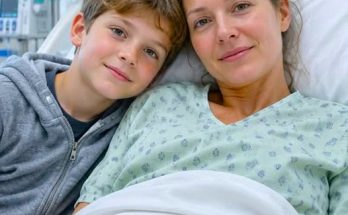
The drive to Mom’s house took twenty-three minutes.
I remembered every one of them.
Not because anything unusual happened on the road, but because ordinary life continued with almost offensive indifference.
A delivery van blocked one lane.
A man jogged beside the park wearing neon shoes.
Two children waited at a bus stop while one swung a backpack into the other’s shoulder.
At a red light, the driver beside me sang enthusiastically to a song I could not hear.
I wanted to roll down my window and tell everyone the world had changed.
Instead the light turned green.
I drove.
Sarah Donovan survived Maplewood.
The sentence repeated itself in my head.
Then another followed.
She spent years searching.
For me.
My hands tightened around the steering wheel.
I was angry with Mom.
More than angry.
Yet each time I tried to place all the blame neatly on her, another fact interfered.
She had tried to keep Sarah’s child from disappearing.
She had searched for Sarah.
She had protected records.
She had raised me.
And then she had lied.
Love and betrayal refused to separate cleanly.
By the time I reached the house, rain had begun.
I parked crookedly in the driveway and did not bother correcting it.
The spare-bedroom door stood open exactly as we had left it days earlier.
The wooden chest waited against the wall.
For years it had been nothing more than an object my mother did not want me touching.
Now it seemed almost alive.
I knelt.
There was no lock.
That surprised me.
Mom had not secured the secret with metal.
Only trust.
I lifted the lid.
A smell of old paper and cedar rose into the room.
Inside were folders.
Dozens.
Some had dates written in Mom’s handwriting.
Others bore Maplewood House letterhead in an old-fashioned serif font.
I stared at the name.
MAPLEWOOD HOUSE
RESIDENTIAL CARE AND TREATMENT CENTER
The blandness of it made my stomach twist.
On top rested a plain white envelope.
EMMA.
Mom’s handwriting.
I set it aside.
Beneath it lay a photograph.
I knew immediately who she was.
Not because she resembled me exactly.
She didn’t.
Sarah Donovan stood beside a brick wall wearing a pale cardigan and a plaid skirt. Her dark hair fell to her shoulders. She was very young.
Younger than I had imagined.
Sixteen had been an abstract fact in the hospital.
The photograph made it obscene.
She was a kid.
Someone had written SARAH — AUGUST on the back.
I turned it over again.
Her eyes were the part that unsettled me.
They were mine.
Same slight downward angle at the corners.
Same heavy upper lids.
I had spent my entire life seeing those eyes in mirrors and photographs without knowing they belonged to anyone before me.
I sat on the floor.
Rain tapped the window.
For several minutes I did nothing but hold the photograph.
Then I opened the first folder bearing Sarah’s name.
DONOVAN, SARAH M.
Age: 16.
Admission reason: behavioral disturbance, emotional instability, pregnancy management.
I read the line again.
Pregnancy management.
As though I were a condition.
The intake form listed Sarah’s father as the responsible party.
Her own signature appeared in several places, but the handwriting changed dramatically between documents.
I photographed pages with my phone.
Another form contained a psychiatric evaluation.
Patient exhibits paranoid fixation regarding alleged sexual relationship with adult male.
I felt heat rise through my chest.
The phrase adult male had been underlined.
Beside it, somebody had handwritten:
Family requests discretion. B. matter sensitive.
B.
Bell.
I kept reading.
Medication orders.
Restricted calls.
No unsupervised visitors.
Correspondence to be reviewed before release.
Then a note in Mom’s handwriting appeared on a copied nursing sheet.
Patient alert, oriented. Denies hallucinations. Repeatedly requests contact with attorney or police.
Below that, in different handwriting:
Request inappropriate at this stage.
I had to stop.
I stood and walked into the hallway.
Dad’s photograph hung on the wall.
He was fifty in it, smiling beside Mom at a family barbecue.
“You knew,” I said aloud.
The house gave no answer.
I returned to the chest.
A second folder contained paperwork surrounding my birth.
BABY DONOVAN.
Not Emma.
Not Carter.
Baby Donovan.
I touched the words.
Weight.
Length.
Apgar scores.
Normal newborn assessment.
Feeding schedule.
Everything clinical.
Then I found a handwritten line.
Mother requested infant remain in room. Request denied per administration.
My throat closed.
Another page recorded Sarah repeatedly asking whether I had been transferred.
Then came the document that changed my anger into something sharper.
Consent for permanent placement.
Sarah’s signature appeared at the bottom.
Beside the date, a medication administration record showed she had received a sedative less than forty minutes earlier.
I photographed both pages.
The placement sheet named Harold and Denise Mercer.
Someone had crossed out the names in red.
Below them appeared another couple.
Also crossed out.
Then the notation:
Hold pending legal review.
Underneath, in Mom’s handwriting:
DO NOT REMOVE ORIGINAL.
I almost laughed.
Even at twenty-three she had apparently believed capital letters could protect evidence.
Maybe they had.
I dug deeper.
The box contained correspondence.
Copies of letters Mom and Dad had sent to agencies and attorneys.
Requests for information about Sarah Donovan.
Returned envelopes.
Notes from a private investigator.
NO CONFIRMED LOCATION.
FAMILY REFUSES CONTACT.
TRANSFER RECORD UNAVAILABLE.
Then I found a letter dated eighteen months after my birth.
It was from an attorney representing Mom and Dad.
Finalization of the adoption could proceed after required notifications and searches produced no legally recognized objection.
I stared at the language.
No legally recognized objection.
Sarah had not consented knowingly.
She had vanished.
Yet the machinery of law had eventually moved forward anyway.
I felt suddenly exhausted.
At the bottom of the chest was a smaller packet held together with a brittle rubber band.
The first document bore Sarah’s name again.
But it was dated six years after my birth.
My pulse accelerated.
It was a photocopy of a missing-person inquiry filed in another state.
Subject seeks information concerning female child born at Maplewood House.
I stopped breathing.
Sarah.
She had been looking.
The next page was ten years later.
Another inquiry.
Then a letter addressed to a state records office.
Then another.
Then another.
Somebody had collected copies across decades.
I checked the notes.
Several had been obtained recently.
Mom had known.
My anger returned.
“She knew.”
I said it aloud.
Mom had told me she never found Sarah.
But there were records proving Sarah had searched for me.
Maybe Mom had obtained them only recently.
I needed dates.
I spread the documents across the floor.
One envelope caught my attention.
It was addressed to Helen Carter.
The postmark was twelve years old.
I stared at it.
Twelve years.
My hands began shaking.
Inside was a letter.
Mrs. Carter,
I believe you worked at Maplewood House in 1993. I am trying to locate the child born to Sarah Donovan during her confinement there.
My chest tightened.
The writer identified herself as an advocate working with former residents.
The letter asked Mom to contact them.
There was no copy of a response.
I searched again.
A second letter had arrived three months later.
Then a third.
I stood so abruptly I kicked one of the folders.
Mom had been contacted.
Twelve years ago.
She had known someone was looking.
I picked up my phone.
I almost called her.
Then I remembered she was in a hospital bed waiting for surgery, an investigator beside her.
No.
I needed the entire truth before another conversation.
I opened the white envelope marked EMMA.
The letter inside was several pages long.
I recognized the date at the top.
Five days earlier.
The day Mom brought down the chest.
My vision blurred before I had read a word.
Emma,
If you are reading this because I failed to come home from surgery, then I have done the cowardly thing one final time.
I stopped.
Mom never called herself a coward.
I continued.
There are facts about your life I should have told you myself. Your father believed that from the time you were old enough to understand, and I repeatedly convinced myself there would be a better moment.
There never was.
I told myself silence protected you. Sometimes it did. Eventually it protected me.
I sat back.
The words hurt because they were exactly what I had wanted her to admit.
The letter described Sarah.
Not clinically.
Personally.
She loved orange soda.
She hated scrambled eggs.
She read detective novels.
She had a habit of pulling the cuffs of her sweaters over her hands.
When nervous, she counted ceiling tiles.
I read each detail slowly.
Mom had remembered her.
The next paragraph made me cover my mouth.
Sarah named you before you were born.
My eyes filled.
The name she chose was Elizabeth.
I stared.
Elizabeth.
Not Emma.
I whispered it once.
It felt like trying on someone else’s coat.
The letter continued.
She called you Lizzie when she spoke about you.
I remembered no one had ever called me that.
A grief for something I had never possessed opened quietly inside me.
Mom explained that after my adoption she and Dad changed my name.
Emma had been Dad’s grandmother’s name.
They told themselves a new name would make it harder for anyone connected to Maplewood to trace me.
Again, protection and erasure were tangled together.
Then I reached the part about the letters.
Twelve years ago, an advocate named Miriam Cole contacted me asking about Sarah and the child born to her.
I knew immediately what that meant.
I should have answered.
I did not.
I lowered the page.
Rain struck the window harder.
I forced myself onward.
By then your father was ill with heart problems he had not yet told you about, and I panicked. We had built a life in which you were safe. I feared reopening the past would expose you to the Bell family, legal disputes, accusations concerning your adoption, or people who might attempt to use you as evidence.
None of those fears excused ignoring Sarah’s search.
Dad knew.
He and Mom argued.
The letter said he wanted to tell me.
Mom resisted.
Then Dad died before they resolved it.
I pressed the heel of my hand against my forehead.
The kitchen conversation when I was nineteen returned to me.
You can’t keep waiting forever, Helen.
The letter said the advocate contacted Mom again after Dad’s death.
Mom still did not respond.
Years passed.
Then, six months ago, another envelope arrived.
This one informed her that a group of former Maplewood residents was reopening efforts to locate separated children.
Mom had begun gathering the chest.
She planned to tell me.
Then she delayed again.
The knee surgery finally frightened her into writing the letter.
I reached the final page.
There was one sentence I read three times.
Sarah is alive as far as I have been able to determine.
My breath stopped.
Mom had known.
Not just suspected.
Known.
Below it:
Her last confirmed location was Portland, Oregon.
I grabbed my phone.
I searched the name Sarah Donovan.
Too many results.
Then I searched Sarah Donovan Maplewood.
Nothing obvious.
I searched Miriam Cole advocate.
There.
A nonprofit organization.
Survivor records advocacy.
I clicked.
The page loaded slowly.
A photograph appeared.
A group of women stood outside a courthouse.
One of them was older, with silver threaded through dark hair.
My eyes.
Those same eyes.
The caption named her.
Sarah Donovan.
I stared at my biological mother for the second time in my life, thirty-five years separating the two photographs.
Then I noticed the article date.
Eight months ago.
Sarah was alive.
At least eight months ago.
I called Investigator Moreno.
She answered immediately.
“Emma?”
“I have the box.”
“Good. Don’t disturb anything further if you can avoid it.”
“I already opened it.”
A pause.
“All right.”
“There are letters.”
“What kind?”
“Someone contacted Mom twelve years ago looking for me.”
Moreno was silent.
“And Sarah is alive.”
Another pause.
“Emma—”
“Is she alive now?”
“I need you to come back.”
“That isn’t an answer.”
“I don’t want to give you unverified information.”
“You told me she survived Maplewood.”
“Yes.”
“Do you know where she is?”
Moreno hesitated long enough to make my pulse race.
“We located a Sarah Donovan connected to the survivor network.”
“Located when?”
“This week.”
I stood completely still.
“This week?”
“Yes.”
“Have you spoken to her?”
“Not personally.”
“Has someone?”
“Yes.”
I closed my eyes.
“Does she know about me?”
Moreno’s answer came quietly.
“She knows we may have identified the nurse who prevented her daughter’s original placement.”
I could barely form the next question.
“Does she know I’m alive?”
“Emma, bring the records.”
“Tell me.”
Moreno exhaled.
“She was told this afternoon that Helen Carter’s daughter is the right age to possibly be the infant she lost.”
The house seemed to shrink around me.
“What did she say?”
Moreno paused.
Then she gave me the one answer I was not prepared for.
“She asked if your name was Elizabeth.”
Click Here to continue read next: PART8: Before I Could Decide Whether to Forgive Mom, the Woman Who Had Named Me Elizabeth Asked to Speak With Me
The Tiny Blue Flower on My Mother’s Wrist Was the Only Question She Would Never Let Me Ask Twice
Part 7 of 12