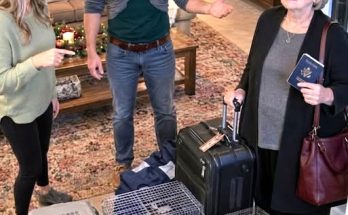
I moved into the studio on a Wednesday morning with help from Clara, Mrs. Higgins, and Mason. Stephanie came too. Clinton did not. She said he had an interview, though the brief pause before she explained his absence made me wonder whether that was entirely true. I decided not to ask. The days when I needed to know every detail of their household were over.
Mrs. Higgins had left a vase of rosemary sprigs on the windowsill. Clara brought sheets. Mason carried in boxes that were much too heavy for him while refusing every suggestion that he take something smaller.
“I’ve got it, Grandma.”
“You’re leaning backward.”
“That’s how strong people carry stuff.”
“That’s how people visit chiropractors.”
He laughed and nearly walked into the doorframe.
My furniture was mostly inexpensive and secondhand. Clara found a narrow dining table through a neighbor. Mrs. Higgins sold me a small bookcase for twenty dollars. I bought a comfortable armchair new because I decided there should be one thing in the room chosen solely for pleasure rather than necessity.
I stood in the furniture store for nearly forty minutes before paying.
Years of scarcity had made spending on myself feel suspicious.
The chair cost less than one dinner Stephanie once asked me to finance.
That thought made the purchase easier.
The first night in the studio, rain tapped softly against the broad window. I brewed chamomile tea—the same brand I had bought during the supermarket confrontation—and sat in my new chair wearing socks because the polished floor felt cool beneath my feet.
Nothing happened.
No one called from another room.
No dishwasher needed emptying.
No school form appeared on the counter.
No one asked whether I had seen Clinton’s blue shirt.
The silence was magnificent.
Then, unexpectedly, it frightened me.
For four years, usefulness had structured every hour. Without errands, chores, and obligations, the day opened in front of me like an unfamiliar road. I had fought to regain my time and suddenly did not know what to do with it.
The next morning I woke at six out of habit.
I lay still until seven.
At eight, I walked around the neighborhood.
At nine, I returned.
At nine-fifteen, I had already washed my breakfast plate.
There was nothing urgent afterward.
I laughed aloud.
Retirement.
I had technically been retired for years, yet this was the first morning that resembled what the word was supposed to mean.
I began keeping a notebook of expenses.
Rent.
Medication.
Food.
Telephone.
Transportation.
A modest amount for entertainment.
Savings for emergencies.
The arithmetic surprised me.
Once Stephanie’s utilities, subscriptions, groceries, repairs, and “temporary” household needs disappeared, my pension covered my essential expenses. Not lavishly, but adequately.
I could even save a little.
For years, I had believed twelve hundred dollars was barely enough to survive.
The truth was more painful.
It had been barely enough to support two households.
I showed Clara the figures.
She studied the notebook.
“Margaret, you were spending more on their house than on yourself.”
“I know.”
“You say that very calmly.”
“I’ve run out of shocked expressions.”
She laughed.
We began doing things together that had once seemed frivolous. A weekday museum visit. Coffee at a café where neither of us hurried home. A free concert in the park. We joined a library discussion group. Clara persuaded me to attend a community-center watercolor class.
I had no talent whatsoever.
My first painted pear looked like an injured potato.
I kept it.
The absurd little painting represented two uninterrupted hours during which nobody needed anything from me.
Stephanie’s calls became less frequent but more genuine.
Instead of beginning with a problem, she sometimes asked what I was doing.
That question revealed another change.
Previously, the assumption had always been that I was available.
Now she understood I might have plans.
She found part-time work first.
A medical office needed someone to handle patient accounts three afternoons a week. Her old experience helped. The pay was modest, but she sounded almost surprised by how much she enjoyed having colleagues again.
“I forgot what it’s like to talk to adults about something besides bills and school schedules,” she said.
“You used to be good at your job.”
“I used to complain about it constantly.”
“You were twenty-eight. You complained about traffic, coffee, your supervisor, weather, shoes, and the existence of Mondays.”
She laughed.
“I was awful.”
“You were young.”
“That is a very generous interpretation.”
Clinton had more difficulty.
His business finally closed.
Stephanie told me during a Sunday afternoon visit. Mason was inside my studio constructing something complicated with cardboard while we sat outside near Mrs. Higgins’s roses.
“He hates saying it out loud,” Stephanie said.
“How much debt is attached to the business?”
“A lot.”
I did not ask for the exact figure.
It was no longer my debt.
“He has two interviews next week.”
“That’s good.”
“He says the salaries are insulting.”
“What did the business pay him last year?”
Stephanie looked uncomfortable.
“After expenses?”
“Yes.”
“Almost nothing.”
I raised one eyebrow.
“I told him the same thing.”
Progress sometimes arrives disguised as unpleasant conversations.
The house remained on the market for nearly six weeks before receiving an acceptable offer.
The price sounded impressive.
The amount left after the mortgage, fees, and other obligations did not.
Stephanie and Clinton would walk away with enough to cover moving costs, deposits, and a very small reserve.
Four years earlier, I had given them two hundred fifty thousand dollars.
Now the house supposedly improved with that money would leave them with almost no equity.
I expected rage when I heard.
Instead, I felt tired.
Money can be earned again in smaller amounts.
Time cannot.
That realization made my legal decision clearer.
I met once more with the attorney.
He had reviewed copies of messages I found on an old tablet. Some were useful. Stephanie had written about “building Mom’s suite.” Clinton had mentioned renovation estimates. There was evidence supporting my understanding that the transfer was connected to my housing arrangement.
But there were complications.
I had never written “loan.”
I had never demanded repayment.
Some messages could be interpreted either way.
The attorney explained potential claims and possible outcomes without promising success.
“How long could this take?” I asked.
“A year or more, depending on how aggressively everyone fights.”
“And if they have no money?”
“A judgment and collecting a judgment are different matters.”
I knew then.
“I don’t want to spend the next year doing this.”
“You don’t have to decide today.”
“I already have.”
I did not release Stephanie and Clinton from moral responsibility.
I simply refused to make recovering lost money the organizing purpose of whatever retirement remained to me.
When I told Clara, she worried I was surrendering.
“I’m not,” I said.
“Two hundred fifty thousand dollars is a lot to walk away from.”
“It already walked away from me.”
“That doesn’t mean they should escape consequences.”
“They haven’t.”
I explained what I had finally understood.
Their consequence was not necessarily a court order.
Their consequence was living within the reality they had postponed.
They were losing the house.
Clinton’s business was gone.
Stephanie had returned to work.
Their credit was poor.
There was no mother in the basement paying whatever they could not manage.
I was not required to spend my remaining years chasing them to make the lesson legitimate.
Clara studied me.
“You’ve thought about this.”
“Constantly.”
“And you won’t regret it?”
“Probably sometimes.”
That made her smile.
“Now that sounds like you.”
The house sale closed two weeks later.
Stephanie, Clinton, and Mason moved into a two-bedroom apartment on the other side of town.
The complex was ordinary.
No landscaped entertainment area.
No marble counters.
No guest rooms.
No space devoted to appearances.
When I visited for the first time, Clinton answered the door.
He looked older.
Not physically older in the ordinary way, but reduced somehow. The polished certainty was gone.
“Margaret.”
“Clinton.”
He stepped aside.
Stephanie was at work. Mason had asked me to help him assemble a model airplane.
I expected Clinton to disappear into the bedroom.
Instead, he remained near the kitchen.
Finally, he said, “I owe you an apology.”
I looked at him.
“I know that.”
He almost smiled.
“I guess I deserved that.”
“You did.”
He leaned against the counter.
“I blamed you for everything after you left.”
“I know.”
“You shutting off those bills felt like sabotage.”
“I stopped paying bills that were yours.”
“I know that now.”
The sentence sounded remarkably similar to Stephanie’s.
I wondered how much understanding arrives only after rescue stops.
Clinton rubbed one hand over his jaw.
“I got a job.”
“Stephanie told me you were interviewing.”
“Operations supervisor. Manufacturing company.”
“That sounds steady.”
“It’s less money than I thought I should be making.”
“But more than your business was making.”
He stared at me.
“She told you?”
“She didn’t need to.”
A reluctant smile crossed his face.
Then he grew serious.
“We used you.”
There was no elegant language around it.
The bluntness stopped me.
“I told myself we were all one household,” he continued. “That your expenses and ours were mixed together. But when you left, I started adding up what you’d been paying.”
I said nothing.
He looked toward Mason’s room.
“We should have built the suite.”
“Yes.”
“We should never have touched most of that money.”
“Yes.”
“I don’t know how to fix it.”
For years, that sentence would have invited me to offer a solution.
This time, I let it remain his problem.
“You probably can’t fix everything,” I said.
He nodded.
“But you can stop doing it again.”
Mason called from his room.
“Grandma! The instructions make no sense!”
I walked toward him.
Behind me, Clinton said quietly, “Margaret?”
I turned.
“Thank you for still coming to see him.”
I looked at the small apartment.
At the secondhand sofa.
At the pile of unopened mail.
At the man who finally had to support his own household.
“I never stopped being his grandmother,” I said.
Then I closed Mason’s bedroom door behind me, leaving Clinton alone with the bills on his kitchen counter.
Click Here to continue read next: PART7: Just When My New Life Felt Secure, a Letter About Donald’s Old Account Gave Me One Last Choice Between Fear and Freedom
Three Carts of Luxury Groceries Forced Me to See What Four Years of Family Loyalty Had Really Cost Me
Part 6 of 8