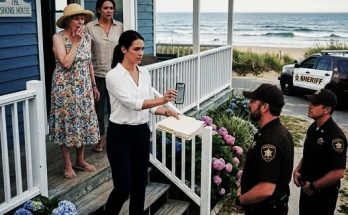
The deputy asked everyone to stay where they were while he finished speaking with me.
My mother looked as though she had swallowed something bitter.
She kept glancing toward the house, then toward the people gathered behind her.
The reunion had stopped being a celebration.
It had become a problem she couldn't solve by telling everyone what to do.
"Can we talk about this privately?" she asked me.
I looked at the deputy before answering.
"I've already explained what happened."
"Skyla, please."
She said it softly, in the tone she used when she wanted me to remember that she was my mother.
For a moment, the old reflex returned.
I wanted to make things easier.
I wanted to step aside, listen to her explanation, and find a way to let everyone leave without feeling humiliated.
Then I remembered the message she had allowed Bridget to send.
I wasn't invited.
Nobody was supposed to tell me where they were going.
They had chosen my house anyway.
"No," I said. "We can talk when you've answered his questions."
My mother stared at me.
She wasn't accustomed to hearing that from me without a long explanation afterward.
Bridget moved closer.
"This is ridiculous," she said. "We're not criminals. We came here for a family weekend."
The deputy turned toward her.
"Did the property owner give you permission to enter?"
Bridget looked at me.
I didn't answer for her.
"No," she finally said. "But we thought—"
"What made you think you had permission?"
She pressed her lips together.
I watched her eyes move toward my mother.
The two of them had spent years communicating through looks whenever a conversation became uncomfortable.
My mother would make a small gesture.
Bridget would change the subject.
Or Bridget would become offended, and my mother would step in to defend her.
This time, neither of them seemed sure which person should speak first.
"We believed there was an arrangement," my mother said.
"Was that arrangement in writing?"
"No."
"Did you speak directly with the owner?"
My mother hesitated.
Then she looked at me again.
"We didn't know Skyla owned this particular house."
The deputy glanced at the documents I had provided.
"She has identified herself as the owner and has stated that she did not authorize your entry."
My mother lifted her chin.
"She's my daughter."
The deputy's expression remained unchanged.
"I understand that."
"We're here for a family reunion."
"I understand that, too."
"Then surely we can work this out."
He didn't respond to the suggestion.
He asked Bridget how she had obtained the address.
She looked down at her phone.
"I had it."
"From whom?"
"I don't remember exactly."
That answer surprised me.
Bridget remembered everything that might make her look good.
She remembered who had liked her photographs, who had complimented her clothes, and who had failed to invite her to an event she thought she deserved to attend.
She could recall a slight from five years earlier with remarkable precision.
But now she couldn't remember where she'd obtained the address to a house she had brought our entire family to occupy.
I suspected the memory problem had more to do with the question than the answer.
The deputy made another note.
My father shifted his weight behind my mother.
He looked tired.
I knew that expression, too.
He had worn it whenever my mother and I disagreed, as though our conflict were an unfortunate weather system that would eventually pass if he waited long enough.
"Maybe we should just pack up," he said.
My mother turned sharply.
"We haven't even started the weekend."
"Linda," he replied, "perhaps we should listen to what they're asking."
She stared at him as if he had betrayed her.
I almost felt sorry for him.
Almost.
He had spent years allowing her to speak for him, then complained privately when her decisions caused trouble.
Now he wanted to leave without acknowledging what had brought us here.
The deputy asked whether anyone had damaged the property.
I told him I hadn't seen any damage, but that I wanted to inspect the house once everyone had left.
He nodded.
My mother seized on the statement.
"There you are. Nothing has been damaged. We haven't done anything."
She sounded relieved, as though the absence of broken furniture made the rest of the situation disappear.
The deputy explained that the issue wasn't limited to property damage.
He needed to establish whether the occupants had permission to be there.
He also needed to determine how they had entered.
My mother looked toward the keypad beside the door.
For the first time, I saw her study it properly.
She had entered the code without asking a question.
She had seen the green light and heard the chime, then assumed the system had confirmed her right to enter.
She hadn't considered that a door could open for reasons unrelated to permission.
Or perhaps she had considered it and decided not to care.
I couldn't know which possibility was true.
I did know that she had used a number she recognized.
My birthday.
She had entered it, and the lock had opened.
That was all she needed.
Bridget folded her arms.
"Skyla, why would you set the code to something Mom would know if you didn't want us here?"
I looked at her.
The question was so backward that I needed a moment to process it.
"I didn't give you permission to use it."
"But you chose that number."
"Yes."
"So you knew Mom would recognize it."
"I knew she would remember my birthday."
Bridget shook her head.
"Then you can't act surprised that we thought we could get in."
I looked at the deputy.
He was watching us quietly.
I turned back to my sister.
"I didn't act surprised. I called because you entered my house without asking."
She opened her mouth.
Nothing came out.
The deputy asked me whether I had changed the code specifically because I knew my family was coming.
I considered the question.
"I changed it after I saw the location pin and realized where they planned to hold the reunion," I said. "I didn't send them the code or tell them to use it."
He nodded and wrote something down.
My mother looked from him to me.
"Why would you change the code and then leave it working?"
I didn't answer immediately.
There was no point explaining every thought I had entertained while sitting across the road.
I had wanted to see whether they would ask permission.
They hadn't.
I had wanted an independent witness to establish what happened.
That was why the deputy was standing in the driveway.
But my mother wouldn't have accepted those reasons.
She would have heard only that I had watched her enter and chosen not to stop her.
She would have called it a trap.
Perhaps part of me had wanted them to reveal themselves without the usual excuses.
I wasn't going to pretend I had no complicated feelings about that.
Still, the choice to enter had been theirs.
"I didn't invite anyone," I said.
The deputy returned to the practical questions.
He asked who had organized the gathering.
Bridget admitted she had sent the family message.
My mother looked at her sharply.
"I helped with the arrangements," she added.
"Did either of you contact the owner?"
"No," Bridget said.
My mother remained silent.
"Did you know the owner was Skyla?"
My mother took a breath.
"I didn't know this was her house."
"But you knew she wasn't invited to the reunion?"
The question landed harder than the others.
Bridget looked at the deputy.
My mother turned toward me.
For several seconds, neither spoke.
Then Bridget said, "That was a separate issue."
I felt my face grow warm.
Not from the sun this time.
She had managed to make my exclusion sound like an administrative detail, something that could be separated from the gathering whenever it became inconvenient.
The deputy didn't argue with her about the family dispute.
He simply returned to the question of permission.
That was what made the exchange so difficult for them.
He wasn't interested in deciding whether I was sensitive or whether Bridget had been unkind.
He wasn't there to judge our history.
He wanted to know who had authorized the occupants to enter.
Nobody had an answer.
The deputy asked everyone to prepare to leave while he completed his report.
My mother immediately protested.
"We have food in the refrigerator. We've brought everything for the weekend."
"You'll need to remove your belongings," he said.
"All of them?"
"Your personal belongings and anything you've brought onto the property."
She looked toward the house.
I could see her calculating how much work that would involve.
Three vehicles.
Coolers.
Beach umbrellas.
Folding chairs.
Tote bags.
Clothing.
Drinks.
All the things they had unloaded without considering whether they had a right to be there.
Bridget turned to me.
"You're really going to make everyone pack up?"
I looked at the cousins standing behind her.
Some seemed embarrassed.
Others looked irritated, as though I had inconvenienced them personally.
I didn't blame them for being confused.
I did blame the people who had arranged the gathering without telling them the truth.
"You can ask Bridget why she brought you here without permission," I said.
Bridget's eyes flashed.
"Don't put this on me."
"You sent the message."
"I was trying to keep the weekend peaceful."
"You banned me from it."
My mother stepped between us.
"Enough. Both of you."
The old command came naturally to her.
She had always believed that if she ordered us to stop arguing, the original issue would vanish.
But the deputy was still there.
The house was still mine.
And the message still existed.
I didn't say anything else.
My mother turned away first.
She went inside to begin gathering her things.
Bridget followed, moving so quickly that she nearly collided with Kyle at the doorway.
The deputy remained outside while the group began packing.
I stood beside the driveway and watched the first cooler come back down the steps.
It was the same cooler Kyle had carried inside earlier.
He set it near the lead SUV and looked at me.
For a moment, I thought he might apologize.
Instead, he said, "You could have called me."
I stared at him.
"You were here."
He looked away.
That was the entire conversation.
I watched him return to the house.
The afternoon was far from over, but something had already changed.
My family had spent years treating my boundaries as invitations to negotiate.
This time, a stranger had asked them a direct question.
And none of them had been able to answer it.
Source: radadrama.com
Click here to continue reading: PART 6: My Brother Asked Why I Couldn’t Have Handled Things Privately, While My Mother Carried Her Bags Out of the Home She Claimed Was Hers
My Family Decided I Was the Problem Again, Until I Recognized the Address They Thought I Was Never Supposed to See
Part 5 of 12