By the end of the week, the messages had become less frequent.
My mother still had not apologized. My father had stopped asking me to call her, at least for the moment. Kyle had not mentioned the house again.
The silence did not mean they had accepted my position.
It only meant they were no longer asking me to change it every day.
I let that be enough.
I spent the morning taking care of the things I had put off while the family dispute occupied my attention. I washed the windows, changed the towels, and straightened the shelves in the living room.
The house gradually returned to its ordinary rhythm.
A delivery arrived, and I brought the package inside. I answered a routine call, then went back to what I had been doing.
No one needed me to explain myself.
No one needed me to mediate a disagreement.
No one needed me to make an uncomfortable truth sound pleasant.
I could simply live.
In the afternoon, I sat at the dining table and looked at the notebook where I had written down the facts of the incident.
I turned to the page and read the lines once more.
The words were plain, almost dull.
There was no description of my mother's tone or the expression on Kyle's face. There was no account of the old arguments that had made the confrontation feel familiar.
There was only what had happened.
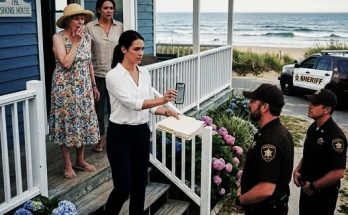
I had not given permission for my relatives to use my house. They had acted as though they could make that decision for me. I had refused. The deputy had asked questions, and my family had left.
I closed the notebook.
I did not need to add anything.
For a while, I had believed that if I explained the situation carefully enough, my family would understand. I thought that if I chose the right words, my mother would see that I was not rejecting her as a person.
Maybe she would understand someday.
Maybe she would not.
My decision could not depend on which outcome came first.
I went to the kitchen and filled a glass of water. The sunlight fell across the counter, and I watched the reflection move as a cloud passed overhead.
I thought about how easily the entire situation could have been avoided.
Someone could have called and asked whether the house was available.
Someone could have waited for an answer.
Someone could have accepted no without treating it as an insult.
None of those things would have required a dramatic conversation.
They would have required only respect.
That was what made the incident so difficult to forget. My relatives had not been confused about where the house was or who it belonged to. They had simply behaved as though my agreement was optional.
When I refused to go along with that assumption, they focused on the embarrassment of being challenged.
They wanted the confrontation to be the offense.
I was no longer willing to accept that version of events.
Later that evening, my father sent a brief message.
I hope things can get better between everyone.
I read it slowly.
For once, he had not asked me to call my mother. He had not said that I needed to apologize. He had not told me to consider how difficult the situation had been for her.
He had left the future open.
I replied, I hope so too. I need my home to be respected.
I did not know whether he would understand the significance of that sentence.
I did not try to make it more comfortable for him.
I put the phone down and went outside.
The sky was clearing, and the water had turned a deeper blue. The wind was gentle enough that I could sit on the porch without pulling my sweater tightly around myself.
I stayed there until the sun began to sink.
I thought about the version of myself who would have handled this differently.
She would have called her mother by now. She would have apologized for the deputy being involved. She would have said that she never wanted anyone to feel unwelcome.
Then she would have tried to forget the part where she had been made to feel unwelcome in her own home.
She would have called that compromise.
She would have called it keeping the peace.
I understood why she had done it. She wanted her family to be close. She wanted disagreements to end. She wanted to believe that being patient and helpful would eventually lead to the same patience and care being offered back to her.
Those were not bad things to want.
But I had learned that kindness without boundaries could become a promise I never intended to make.
I could care about my mother without giving her control over my property.
I could love my brother without agreeing with him.
I could wish my father understood me without waiting for his approval before I trusted my own judgment.
None of those choices required me to stop loving my family.
They required me to stop confusing love with permission.
The next morning, I unlocked the back door and stepped onto the porch with my coffee.
The house was quiet.
The chair I had straightened was still where I had left it. The windows were clean, and the kitchen behind me smelled faintly of coffee and fresh air.
I sat down and looked out at the water.
I did not know when my family would be ready to speak about what had happened without turning it into a complaint about my reaction. I did not know whether my mother would ever acknowledge that she should have asked before using the house.
I could not decide those things for them.
What I could decide was what happened next.
If anyone wanted to visit, they would have to ask.
If I agreed, they could come.
If I said no, that answer would stand.
There would be no assumption that family ties erased the need for permission. There would be no agreement created by someone else's confidence. There would be no obligation to apologize simply because another person disliked my answer.
The rules were not complicated.
They were the same rules I would have expected anyone else to respect.
I finished my coffee and carried the mug inside.
The day ahead was ordinary. I had things to do, a few errands to run, and a house to take care of. I would make dinner later and perhaps sit on the porch again if the weather held.
My family might agree with me eventually.
They might not.
For the first time, I understood that I did not need to know which it would be before I could move forward.
I had bought the house with my own work and money. I had made it a place where I could rest. I had every right to decide who could enter it and when.
I had not taken anything away from my family.
I had simply stopped giving away something that was mine to control.
I locked the door when I left for my errands.
When I returned, I unlocked it, stepped inside, and closed it behind me.
The house was quiet again.
This time, the quiet did not feel like a pause before another argument.
It felt like peace I did not have to ask anyone else to grant me.
Source: radadrama.com
The End
Read more original stories on Feel Every Story.
My Family Decided I Was the Problem Again, Until I Recognized the Address They Thought I Was Never Supposed to See
Part 12 of 12