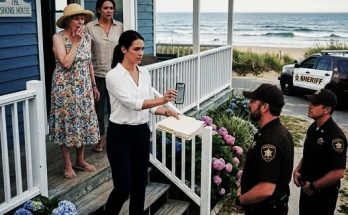
The sun had begun to lower when my phone finally rang.
I was sitting on the deck with a glass of water beside me.
The air had cooled slightly, though the boards beneath my feet still held the day's heat.
I looked at the screen.
It was my father.
For a moment, I considered letting the call go to voicemail.
Then I answered.
"Hello?"
He didn't speak immediately.
I could hear traffic in the background and the muffled sound of a car indicator.
"Are you still at the house?"
"Yes."
"Did you check everything?"
"I did."
"Was anything damaged?"
"Nothing serious that I could see."
He exhaled.
"That's good."
I waited.
My father had never been comfortable with conversations that required him to say something difficult.
He preferred practical questions because they gave him somewhere to begin.
I could hear him shifting in his seat.
"Your mother is very upset," he said.
I looked out toward the water.
"I imagine she is."
"She thinks you humiliated her."
I closed my eyes for a moment.
There it was.
Not an apology.
Not an acknowledgment.
A report about my mother's feelings.
"Did she tell you why I called the deputy?"
He was quiet.
"She said you could have handled it differently."
"Did she tell you she entered the house without asking me?"
Another pause.
"I don't think she understood that you owned it."
"She knew I owned property. She didn't know which one this was."
"That's what she said."
I rested my glass on the deck railing.
"Did anyone ask me if they could use the house?"
He didn't answer.
"Did Bridget contact me?"
"No."
"Then what should I have done?"
My father sighed.
"Maybe you could have called me first."
I looked at the water.
I could picture him sitting in the vehicle, one hand on the steering wheel, trying to find a version of the afternoon that would make everyone less uncomfortable.
He wanted me to have called him before the deputy.
He wanted me to bring him into the situation so he could mediate.
But he hadn't mediated the decision that brought them there.
He hadn't questioned Bridget's message.
He hadn't asked whether I wanted to attend the reunion.
He hadn't asked who had given them permission to use the house.
He had waited until the consequences arrived before deciding he should have been consulted.
"I didn't know you were going to help me," I said.
He went quiet.
I regretted the sharpness of the sentence almost as soon as I spoke.
Not because it was untrue.
Because I knew it would hurt him, and some part of me still wanted to protect him from the things he had earned.
He finally said, "That's unfair."
"Maybe."
I looked down at the deck boards.
"I've spent a long time hoping you'd speak up when something wasn't right."
"I don't want to get between you and your mother."
"I know."
"She's my wife."
"And I'm your daughter."
The words came out quietly.
He didn't respond.
I heard a vehicle pass on the road behind him.
Then he said, "I don't know what you want me to say."
I looked at the blue siding beside the deck door.
For years, I had wanted him to say that he understood.
I wanted him to tell me he had seen what was happening and wished he had done more.
I wanted him to admit that staying neutral had often meant leaving me alone with the consequences.
But I couldn't make him say those things.
"I want you to think about what happened," I said.
He sighed again.
"All right."
We ended the call a few minutes later.
I sat on the deck and watched the light change over the ocean.
The conversation hadn't solved anything.
Still, I was glad I hadn't spent the entire call defending myself.
I hadn't explained the house.
I hadn't recited the message.
I hadn't tried to persuade him that I deserved to be treated fairly.
I had asked him to think.
Whether he did was his decision.
My phone buzzed again.
This time, it was a message from Kyle.
He wrote that everyone was upset and that the day had turned into a mess.
He said nobody had expected the deputy to become involved.
Then he asked if I could please avoid making the situation worse.
I read the message twice.
He hadn't asked whether I was upset.
He hadn't asked how it felt to watch my family walk into my house after banning me from the reunion.
He hadn't asked whether the house was all right.
He had asked me to avoid making things worse.
I typed a response.
Then I deleted it.
I typed another.
I deleted that one, too.
Finally, I wrote that I had not invited anyone to the property and had asked them to leave when I discovered they were inside without permission.
I told him I wasn't going to argue about the facts.
Then I sent it.
He read the message.
No reply followed.
I put the phone facedown on the table.
The sky had begun turning orange near the horizon.
I could hear the soft scrape of a chair as I shifted my weight.
For years, I had believed that a family disagreement wasn't finished until everyone had agreed on what happened.
That belief had kept me trapped in arguments long after they stopped being useful.
My mother could deny something she had said.
Bridget could insist I had misunderstood.
Kyle could claim he hadn't been involved.
My father could say he didn't remember.
I would keep explaining until I was exhausted, hoping that if I found the right words, someone would finally admit what I already knew.
That evening, I decided I didn't need a shared version of the truth to move forward.
I knew what I had seen.
I knew what the message said.
I knew I had not given permission for the gathering.
The rest was not mine to control.
I went back inside and locked the deck doors.
Then I made a simple dinner and ate at the kitchen island.
The house felt different without the voices.
I could hear the refrigerator humming.
The clock above the doorway ticked steadily.
Outside, the ocean moved against the shore.
I washed my plate and put it away.
Then I checked the family chat again.
Bridget had not deleted her original message.
Nobody had replied to it.
The group had gone silent in the particular way families go silent when an event becomes too uncomfortable to discuss openly.
I scrolled back through the conversation.
There were messages about food, arrival times, and who would bring the beach umbrellas.
There were photographs of bags being packed.
There was a message from my mother reminding everyone to bring something suitable for dinner.
Then there was Bridget's announcement that I wasn't welcome.
I looked at the sequence.
The plans had been made around the assumption that I would remain outside.
No one had asked whether the reunion should be held somewhere else.
No one had suggested contacting me.
The only concern had been making sure I didn't find out where they were going.
I put the phone down.
For the first time, I didn't feel the urge to send a message demanding an explanation.
I knew the explanation would come eventually.
It would probably begin with my mother saying that she had been trying to keep the peace.
Bridget would claim she had misunderstood the property arrangements.
Kyle would say the whole thing had gotten out of hand.
My father would ask whether we could move on.
I could already hear the words.
But I didn't have to respond to them before they were spoken.
I turned off the kitchen light and walked into the living room.
The abstract painting hung above the sofa, its colors shifting in the fading light.
I had commissioned it because I wanted something that belonged in a home built around my own choices.
When I first saw it finished, I had stood in the gallery for several minutes, trying to decide whether it was too bold.
The artist had told me that I didn't have to like it immediately.
Sometimes a piece needed time.
I had bought it anyway.
Now I stood in front of it and thought about how often I had delayed making decisions because I worried about my family's reaction.
I had asked their opinions when I already knew what I wanted.
I had softened statements that didn't need softening.
I had apologized for being direct.
I had treated my own preferences as though they required approval.
That habit hadn't appeared overnight.
It had grown through years of small exchanges, each one teaching me that peace depended on my willingness to give something up.
I looked around the room.
The floors were clean.
The furniture was where I had left it.
The curtains moved slightly beside the glass.
Everything in the house reflected choices I had made without my family's permission.
I felt a quiet pride in that.
Not the kind Bridget tried to display through photographs.
Not the kind my mother measured by what other people might think.
Something simpler.
I had made a place for myself.
I had taken care of it.
And when someone crossed a boundary, I had acted.
I returned to the kitchen and checked the door lock one more time.
Then I placed my phone on the counter and went upstairs.
I didn't know whether my family would contact me the next morning.
I didn't know whether my mother would apologize or whether Bridget would try to explain the reunion as a misunderstanding.
I didn't know how long the silence would last.
For once, those questions didn't need immediate answers.
I turned off the bedroom light.
The house settled around me, quiet and familiar.
Outside, the tide continued moving along the shore.
I lay in bed and listened to it.
I had spent years thinking that being excluded from my family meant I had failed to belong.
That evening, I began to understand something else.
Sometimes the painful part wasn't being left out.
It was realizing how much of yourself you had been willing to surrender just to remain included.
I didn't know what would happen between us next.
But I knew I would not offer my home, my time, or my silence as the price of being allowed back into the room.
That decision belonged to me.
And for the first time in a long while, I was willing to let it stand.
Source: radadrama.com
Click here to continue reading: PART 9: The Calls I Stopped Answering
My Family Decided I Was the Problem Again, Until I Recognized the Address They Thought I Was Never Supposed to See
Part 8 of 12