I used to think being excluded by your own family was something that happened gradually.
A missed phone call here.
A holiday invitation that never arrived there.
Then one day, I opened our family group chat and realized they had stopped pretending I belonged.
My older sister, Bridget, had sent the message.
She had a way of making cruelty sound like a reasonable household decision, as though she were organizing a grocery list instead of hurting someone.
Nobody was to share the reunion address with me.
I wasn't invited.
Anyone who disobeyed her would be left out, too.
According to Bridget, the whole arrangement was meant to protect our mother from unnecessary stress.
I read that last sentence twice.
Then I laughed.
It wasn't a happy sound.
I was sitting at my kitchen counter with a mug of coffee that had gone cold, staring at my phone as if the words might rearrange themselves into something less ugly.
They didn't.
My mother, Linda, had spent years telling people that I was difficult.
Bridget had spent almost as long making sure everyone heard it.
My brother, Kyle, usually stayed quiet whenever the two of them decided I had done something wrong.
My father preferred not to interfere.
That was how our family worked.
Three people could agree that I was the problem, and the fourth would nod because disagreeing seemed like too much trouble.
I had spent most of my life trying to change that.
I tried being agreeable.
I tried being generous.
I tried keeping my opinions to myself, even when I was the person being insulted.
None of it made much difference.
There was always something about me that needed correcting.
If I worked late, I cared too much about money.
If I declined a family dinner, I thought I was better than everyone else.
If I bought something nice, I was showing off.
If I kept my purchases private, I was being secretive.
My mother had one particular accusation she returned to whenever she ran out of more specific complaints.
Skyla only thinks about herself.
She could use it to explain anything.
If I defended myself, I was selfish.
If I walked away, I was selfish.
If I stayed and listened, I was apparently selfish for making everyone endure my attitude.
For years, I thought there had to be some way to prove her wrong.
I was old enough by then to understand how exhausting that belief had made me.
Still, seeing Bridget announce my exclusion so openly hurt more than I wanted to admit.
It wasn't the reunion itself.
I had survived plenty of dinners without them.
It was the fact that they had made a rule about me and expected everyone else to follow it.
They weren't simply forgetting to include me.
They were organizing themselves around keeping me out.
Then I noticed the location pin beneath Bridget's message.
I tapped it without thinking.
The map opened.
I looked at the street name.
Then I looked again.
The coffee mug slipped slightly beneath my fingers, and I had to put it down before I spilled what remained.
They were going to my beach house.
For a few seconds, I couldn't even form a proper thought.
My family had banned me from their reunion and then chosen my property as the place to hold it.
They had managed to exclude the owner from a gathering at her own home.
I laughed again.
This time, I covered my mouth with my hand because the sound had become almost embarrassing.
My house was in Seabrook Cove, Georgia, along a stretch of private oceanfront property where the roads ran between dune grass and sea oats.
The house itself was easy to recognize.
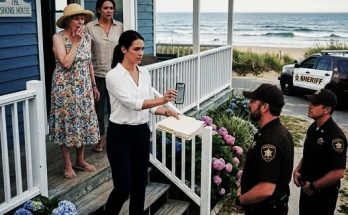
It was a three-story building painted a muted blue, with white trim and a deck that wrapped around the exterior.
The windows faced the ocean.
At sunset, the front rooms filled with warm light until the whole place seemed to glow.
I had bought it through my limited liability company two years earlier.
At the time, I was coming out of a failed marriage and a year that had taken more out of me than I liked discussing.
I had money by then.
Not the kind that made every decision effortless, but enough to buy a neglected property and rebuild it without asking anyone for help.
The house had been in terrible shape.
The deck had damaged boards and soft spots beneath the surface.
Salt had eaten into parts of the exterior.
The kitchen smelled damp, and the electrical system needed serious work.
The bathrooms were dated and badly maintained.
People told me I was making an expensive mistake.
I heard them.
I bought it anyway.
For six months, I worked through the repairs and choices one at a time.
I selected the blue paint myself.
I chose the white edging because I wanted the exterior to look bright without turning the house into something sterile.
I had oak flooring installed downstairs.
I spent an absurd amount of time choosing the marble for the kitchen island.
I wanted that room to feel welcoming, like a place where people could sit with coffee in the morning and talk without needing an occasion.
I commissioned a large oil painting from an artist in Savannah.
It hung in the living room, above the wall where the afternoon light moved across the floor.
I ordered linen curtains that shifted whenever the ocean breeze came through the open doors.
I even had the locks replaced and security cameras installed around the exterior.
The entry system connected to my phone.
I could check the doors from anywhere.
I had thought about all of it because the house mattered to me.
It was the first place I had ever owned that didn't come with someone else's expectations attached.
Nobody else had chosen the colors.
Nobody else had decided what I could afford.
Nobody else had a key simply because they believed family entitled them to one.
The property belonged to my company, and I had paid for its renovation.
My family knew I owned real estate.
They didn't know enough about my life to understand what that meant.
I had learned not to take their lack of interest personally.
Or at least, I had learned to tell myself that I did.
Bridget had always been interested in the appearance of success.
She wanted the right photographs, the right invitations, and the right people to notice when she entered a room.
Kyle liked things comfortable and convenient.
He wasn't eager to sacrifice his own peace to defend mine.
My father usually watched whichever way the argument was going and then moved in that direction.
My mother was more complicated.
Linda liked status she could display.
A better neighborhood.
A nicer restaurant.
A holiday somewhere expensive enough to mention afterward.
She wanted to be seen as the woman who had built a wonderful family, even when the people inside that family were barely speaking honestly to one another.
For years, I had mistaken her approval for something I could earn.
I thought that if I became more successful, she would respect me.
If I became more patient, she would treat me gently.
If I stopped reacting when she said hurtful things, perhaps she would eventually run out of reasons to say them.
Instead, she found new reasons.
My birthday had been one of her favorites.
I was born on July 5, 1985.
My mother had managed to turn that date into a complaint that followed me through childhood and well into adulthood.
She spoke about how my arrival had disrupted her plans, changed her body, exhausted her, and forced her to give things up.
She could make a birthday sound like an unpaid debt.
I used to laugh when she did it.
I thought laughing would make the words harmless.
Looking back, I wish I had understood how much energy I spent helping other people pretend they hadn't hurt me.
That afternoon, I sat at my counter and studied the address attached to Bridget's message.
They had not asked to use the property.
They had not contacted me about renting it.
They had not even bothered to check whether I would be there.
They simply assumed they could go.
I could have answered the group chat.
I could have asked Bridget whether she had lost her mind.
I could have sent a photograph of the deed or a screenshot of the property records.
But I knew what would happen.
She would claim the address had been shared accidentally.
My mother would say there had been a misunderstanding.
Kyle would insist everyone should calm down.
My father would ask why I had to turn a simple gathering into a family dispute.
They would make the argument about my reaction instead of their decision.
They had done it too many times for me to mistake the pattern.
So I left the message alone.
Instead, I opened the security application on my phone.
The front door code was still active.
I changed it remotely.
The new numbers appeared on my screen, and I looked at them for a moment before saving the change.
198507\.
My birthday.
I had chosen the date deliberately.
My mother remembered it whether she wanted to or not.
She had repeated it often enough over the years, usually while explaining how much she had sacrificed after I was born.
I knew she would recognize the numbers if she tried to enter them.
I also knew she would never guess why I had chosen them.
That was fine.
I wasn't trying to communicate with her.
I was making a decision about my own property.
Then I checked the cameras.
Everything was working.
The driveway was empty.
The deck was clear.
The front door was closed.
I could have called the sheriff immediately and explained what I knew.
I could have waited at the entrance and refused to let anyone through.
I could have sent Bridget a message telling her the gathering was over before it began.
Instead, I made another choice.
I wanted to see what they would do when they believed nobody was watching.
If I stopped them at the gate, they would have an excuse ready.
They would say they had misunderstood the arrangement.
They would claim somebody had told them they could use the house.
They would accuse me of making a scene over nothing.
But if I allowed them to enter, there would be no confusion about what they had chosen to do.
I wasn't proud of the satisfaction I felt at that thought.
It was still there.
I had spent years hoping my family would eventually recognize how unfairly they treated me.
For once, I wanted to stop arguing and let their actions speak for themselves.
I picked up my keys.
Then I left the house.
I didn't send a single message to the group chat.
By the time I reached the coast, I had made up my mind.
I would let them arrive.
I would let them settle in.
And when the time came to explain who owned the house, I wouldn't have to say very much at all.
Source: radadrama.com
Click here to continue reading: PART 2: I Watched Three SUVs Pull Into My Driveway While My Mother Prepared to Play Host in a House She Had Never Paid For
My Family Decided I Was the Problem Again, Until I Recognized the Address They Thought I Was Never Supposed to See
Part 1 of 12