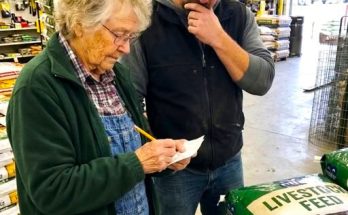
The manager kept one hand on the open binder.
He looked at the entry again, then at Mom.
I had never seen him so unsure of what to say.
A few minutes earlier, he had been comfortable enough to send us away without our purchase.
Now he seemed unable to make a decision about a single sentence written decades ago.
Mom waited for him to speak.
I wanted to reach across the counter and turn the binder toward myself.
Instead, I kept my hands at my sides.
Whatever had brought us to that page, it belonged to a time before I understood what it meant to run a farm.
The manager finally lifted his head.
He asked Mom whether she had known the entry was still there.
She said she had hoped it would be.
That answer surprised me.
She hadn't come in certain that the record had survived.
She had come because there was a chance it had.
I looked at the binder again.
Its pages had been handled many times in the past, but the section the manager had found looked as though it hadn't been opened in years.
He turned the book slightly toward Mom.
She read the entry once more.
Then she nodded.
I wanted to know what she was seeing that I couldn't.
The manager rubbed his thumb along the edge of the page.
He asked how long she had held on to the numbers.
Mom told him they had been given to her thirty-two years earlier.
He looked down again.
I could see him trying to connect the information in front of him with something he had been taught, or perhaps something he had been told by his father.
He asked whether Dad had explained what the numbers referred to.
Mom said he had explained enough for her to know when they might be needed.
She hadn't said they would be needed.
Only that they might.
The distinction mattered to her.
I could tell by the way she paused before answering.
The manager sat down on the stool behind the counter.
For a moment, he looked less like the man who ran the store and more like somebody who had discovered an old family matter he wasn't prepared to handle.
He asked whether she had come looking for this entry all along.
Mom glanced at the pallet.
Then she looked back at him.
She told him that she had come for the feed.
That was the truth.
We had driven into town because our cattle needed feeding, not because Mom had planned to spend the morning examining old business records.
But she had also known what she would do if the situation became necessary.
The manager looked at the receipt.
The six numbers were still written on the back.
He picked it up and compared them with the page.
I watched him do it.
He checked each number slowly.
Then he set the receipt beside the binder.
There was no mistaking it now.
He had found the record Mom had asked him to find.
I still couldn't tell what the entry meant.
I could only see that the manager had stopped treating it like an ordinary account.
He asked Mom what she expected him to do.
She didn't answer right away.
That was the first time I noticed how carefully she had chosen every step since he refused our purchase.
She hadn't demanded an apology.
She hadn't threatened to tell anyone what had happened.
She hadn't even asked him to sell us the feed again.
She had asked for a pencil, written the numbers, and waited for him to check the book.
Now she wanted to hear what he thought the entry meant.
The manager looked down at the page.
He began to explain what he understood from it, but he stopped before he got very far.
He said he needed to make sure he was reading it correctly.
Mom nodded.
She didn't correct him.
She didn't tell him he was wrong.
She let him take another look.
I wondered whether she had ever imagined this moment during the years she kept the numbers.
Perhaps she had hoped they would never be needed.
Perhaps she had simply done what Dad asked because she trusted him.
I knew she had never been interested in keeping a record just to have something to use against another person.
That wasn't her way.
She kept papers because they mattered.
She remembered promises because she believed people ought to honor them.
And she didn't bring up an old agreement unless there was a reason.
I looked at the manager.
He was still studying the page.
The silence had become uncomfortable, but nobody tried to fill it.
Finally, he closed the binder halfway, then opened it again.
He seemed to need the written entry in front of him while he thought.
He asked Mom whether she wanted a copy of the record.
She said she wanted to understand it first.
I felt a small wave of relief.
At least we were no longer standing there pretending that nothing had happened.
The manager had discovered something important enough to stop him in his tracks.
Mom had found the evidence she came to see.
And I was beginning to realize that the refusal over the feed had uncovered a matter much older than the morning itself.
I still didn't know what the final answer would be.
But I knew the answer would have to come from that book, not from the manager's opinion of us.
Click here to continue reading: PART 6: I Had Thought My Father Left Us Only Memories, but the Numbers on That Receipt Suggested He Had Left One Promise Unfinished
I Thought Being a Good Customer Meant Something Until a Man Behind a Counter Decided Our Family Wasn’t Worth the Money
Part 5 of 8