I could not read Alicia’s letter immediately.
The words were there.
My eyes moved across them.
But meaning refused to form.
I had imagined discovering biological family as something involving names on official documents, perhaps photographs, perhaps a DNA match. I had never imagined handwriting.
Handwriting was intimate.
A person had sat somewhere with a pen, paused between sentences, pressed harder on certain letters, left tiny imperfections no database could preserve.
Mom waited without speaking.
Moreno and Patricia stepped toward the other side of the room.
I appreciated that.
The first line used my name.
Emma.
Not Baby Grant.
Not a case number.
Not Elizabeth.
Emma.
I read slowly.
Alicia explained that she and Daniel were preparing for her upcoming surgery and trying to arrange temporary care for me. Maplewood had been recommended by someone connected to their insurance provider, but the tour had unsettled her.
She did not know anything about falsified records.
She did not know what Sarah Donovan had suffered.
She simply did not like the place.
Children seemed too quiet.
Doors locked too often.
Staff gave polished answers without answering ordinary questions.
Alicia had decided not to leave me there.
That was why she wrote the letter.
Not because she expected to die.
Because becoming a parent had made her aware that adults made plans and children inherited the consequences.
She wanted me to have something in her handwriting if life ever separated us unexpectedly.
The irony was almost unbearable.
I read on.
She described me at two.
I liked bananas but refused them if they were sliced.
I slept with one sock on and one sock off.
I called airplanes “sky cars.”
I demanded the same picture book every night and became furious if Daniel skipped a page.
A laugh escaped me.
Mom looked up.
“What?”
I shook my head, smiling through tears.
“Apparently I was difficult.”
Mom gave me a watery smile.
“That part of the record is definitely authentic.”
I almost laughed again.
Then I returned to the letter.
Alicia wrote about Daniel.
He sang badly while cooking.
He worried about money even when they had enough.
He wanted to teach me to ride a bicycle.
He had already bought a tiny baseball glove despite Alicia insisting I might hate baseball.
These were not grand revelations.
That was precisely why they hurt.
My biological parents had been ordinary people imagining ordinary years.
They had not abandoned me.
They had not chosen Maplewood as my permanent home.
They had expected to pick me up from wherever I stayed and continue living.
A wet road had interrupted them.
I reached the final section.
Alicia wrote that if another person ever had to raise me, she hoped I would not confuse a change in family with a shortage of love.
She hoped whoever held my hand through childhood would be allowed to become real family without needing to erase the people who came first.
I stopped.
Mom was crying silently.
She had not read the page.
She did not need to.
“What?” she whispered.
I could barely speak.
“She wrote about you.”
Mom stared.
“She couldn’t have.”
“Not you specifically.”
I wiped my face.
“She wrote about whoever raised me.”
Mom covered her mouth.
I continued reading.
Alicia hoped I would be loved without being made afraid of where I came from.
That line hurt differently.
I lowered the paper.
Mom saw it.
“What did she say?”
I looked at her.
“She hoped I wouldn’t be made afraid of my past.”
Mom closed her eyes.
“I failed her there.”
“Yes.”
The answer came out before I could soften it.
Mom nodded.
“Yes.”
I folded the letter halfway, then opened it again.
“But she also said something else.”
Mom waited.
“She said the people who raised me would be my family too.”
Her face crumpled.
I stood.
For a second neither of us moved.
Then I crossed the room.
Mom reached for me carefully, as if afraid permission might disappear.
I let her take my hand.
“I’m still angry.”
“I know.”
“I may be angry for a while.”
“I know.”
“You don’t get to decide when I’m finished.”
“I know.”
I sat beside her.
“But you are my mother.”
A sob escaped her.
I tightened my fingers around hers.
“That was never actually the part I needed explained.”
Mom bowed her head.
“I was so afraid it would be.”
“Dad knew better.”
“He usually did.”
I smiled despite myself.
“He would be unbearable about being right.”
“Completely.”
For a few moments we sat without talking.
Then Mom turned her wrist upward.
The blue flower lay between our hands.
I touched one petal with my thumb.
The gesture carried me back twenty-five years—to the porch, green beans, mosquito-filled summer air and a seven-year-old asking a simple question.
“What did it mean to you?” I asked.
Mom looked down.
“At first?”
“Yes.”
“That I belonged to Maplewood.”
“And later?”
“That I had survived working there without becoming completely blind to what was happening.”
“You copied records.”
“Yes.”
“You tried to report it.”
“Yes.”
“You also made mistakes.”
“Many.”
I traced the faded stem.
“Why hide the tattoo from me?”
“Because every explanation led to another question.”
“About me.”
“Yes.”
“And you were afraid if I learned I was adopted, I would leave.”
“Yes.”
I shook my head.
“That was never likely.”
“I know that now.”
“No. You knew it then too. You just didn’t trust it.”
Mom considered that.
“You may be right.”
“I am.”
“All right.”
I looked toward the chest.
“What happens to those records?”
Moreno returned to the table.
“With Helen’s consent, they’ll be transferred to the investigative team. We’ll digitize them, compare them with official archives and attempt to identify people whose histories were altered.”
“Sarah?”
“Priority case.”
“And Elizabeth?”
“Yes.”
“Can you actually find her?”
“We can try.”
The answer was appropriately cautious.
After the day I had experienced, caution felt merciful.
“What about my relatives?”
“We’ve already requested the original court file. If the names in it are accurate, we may be able to locate them.”
I looked at Mom.
“You’ll help?”
“Every step.”
“No deciding what I can handle.”
“No.”
“No intercepting letters.”
“Never again.”
“No protecting me from facts.”
She nodded.
“I promise.”
I believed she meant it.
That did not erase what she had done before.
But trust, I was beginning to understand, was not a single object that either existed or shattered forever. Sometimes it was a series of decisions made after damage.
Moreno’s phone vibrated.
She checked the message.
“The preliminary lab can expedite the kinship comparison because Sarah’s sample is already in the system.”
“How long?”
“Potentially tomorrow for an exclusion. Longer for full confirmation.”
I stared.
“Tomorrow.”
“Yes.”
Sarah was still nearby.
That thought had not left me.
“What should I tell her?”
“You don’t owe her an immediate conversation.”
“I already spoke to her.”
“You also learned information afterward that changed the situation.”
I looked at Alicia’s letter.
“Can I call her?”
“Of course.”
Mom released my hand.
I dialed using Moreno’s phone.
Sarah answered on the second ring.
“Emma?”
Not Lizzie.
I noticed.
“Yes.”
“I heard they found another file.”
“They did.”
A pause.
“Then you aren’t mine.”
“I don’t know yet.”
“But you think you aren’t.”
“Yes.”
Sarah breathed out.
“I’m sorry.”
“You have nothing to apologize for.”
“I called you Lizzie.”
“You wanted your daughter.”
“That doesn’t make you her.”
“No.”
Silence settled between us.
Then I asked, “Do you still want them to search?”
“For Elizabeth?”
“Yes.”
Sarah’s answer was immediate.
“Until I know what happened.”
I looked at Mom’s chest.
“We have records.”
“I heard.”
“Maybe they’ll help.”
“Maybe.”
There was no dramatic promise.
No certainty.
Just two women connected by a place neither had chosen.
“I hope you find her,” I said.
Sarah began crying.
“So do I.”
I almost ended the call.
Instead I asked one more question.
“Do you remember Alicia Grant?”
Silence.
“No.”
“She was my biological mother.”
“I’m glad you know her name.”
“She died when I was two.”
“I’m sorry.”
“Thank you.”
Another pause.
Then Sarah said, “Emma?”
“Yes?”
“Whatever the test says tomorrow, I’m glad Helen found you.”
I looked at Mom.
She was staring at the floor.
“Why?”
“Because when I knew her, she was one of the few adults in that place who looked at children as people instead of files.”
My throat tightened.
“She’s spent thirty years thinking she failed you.”
Sarah gave a tired laugh.
“She probably failed plenty of people. We all do.”
Mom looked up, unable to hear the words.
“But she tried,” Sarah continued. “That mattered too.”
I thanked her.
When the call ended, I told Mom what Sarah had said.
Mom cried again.
By then tears had become such a routine feature of the day that I almost offered her water for hydration.
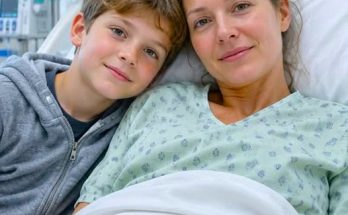
Patricia returned with a surgeon.
“Mrs. Carter?”
Mom straightened.
“Yes?”
“I understand your procedure has been delayed because of an administrative matter.”
I looked at the clock.
The entire day had vanished.
The surgeon continued.
“We can still operate this afternoon if you’re comfortable proceeding. Otherwise we can reschedule.”
Mom looked at me.
For once, I knew exactly what Dad would have said.
I pointed toward her knee.
“You are not leaving this hospital with the same broken joint you brought in.”
Mom blinked.
“Emma—”
“You prepared six frozen casseroles. You installed a handrail. I took time off work. We have survived security officers, investigators, two possible biological mothers and thirty years of corrupted paperwork.”
Patricia covered a smile.
“I am not doing this again next Tuesday.”
Mom stared at me.
Then she laughed.
Really laughed.
It was the familiar short burst that had followed Dad’s worst jokes and my childhood disasters.
I started laughing too.
The pressure in the room finally cracked.
Even Moreno smiled.
Mom wiped her cheeks.
“All right.”
Patricia lifted the IV kit she had been carrying around for what felt like an entire lifetime.
“May I finally do my job?”
Mom extended her left arm.
The blue flower faced upward.
She did not pull her sleeve over it.
She did not hide.
Patricia cleaned the skin above the tattoo.
I watched the five faded petals.
The mark had opened a door neither of us could close again.
Tomorrow might tell me Sarah was not my biological mother.
The investigation might find relatives I had never met.
It might find Elizabeth Donovan.
It might uncover uglier truths about Maplewood.
But for the first time, those possibilities did not feel like threats to the family I already had.
Mom squeezed my fingers as Patricia prepared the IV.
“Emma?”
“What?”
“When I wake up, don’t let me pretend we can put any of this back in the attic.”
I looked at her.
“No chance.”
She nodded.
Then she was wheeled toward surgery with the blue flower uncovered.
Click Here to continue read next: PART12: The Final DNA Result Changed One Last Detail of My Past, While the Blue Flower Finally Gave Other Families Their Names Back
The Tiny Blue Flower on My Mother’s Wrist Was the Only Question She Would Never Let Me Ask Twice
Part 11 of 12