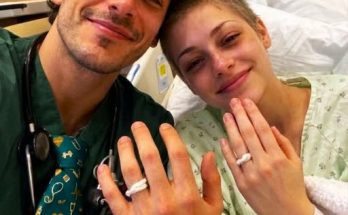
I thought I was doing something good.
That was the first thing I told myself when I looked back at the hospital room, the white scarf, and the two rings made from bandages.
I would repeat it many times afterward.
Eventually, I stopped believing it was enough.
My name was Lucas, and I was thirty years old when I met Alicia.
I had a medical degree, a hospital position, and a debt that followed me everywhere.
The debt was the part nobody saw.
People saw the white coat and assumed I had made it through the hardest years of my life. They saw a doctor and imagined a man who had finally reached solid ground.
I knew better.
Every month, another payment came due.
I had spent years studying during the week and working wherever I could on weekends. While other students went out, I counted the money in my account and decided which expenses could wait.
Sometimes I ate whatever was cheapest.
Sometimes I stayed awake studying because sleeping meant losing hours I could have used to work.
I had wanted to become a doctor for as long as I could remember.
My parents had supported that dream, but they couldn't pay for it. They had their own bills, and I refused to ask them to sacrifice more than they already had.
So I borrowed.
Then I borrowed again.
By the time I started working at the hospital, I thought the worst of it was behind me.
I was wrong about that, too.
Alicia was the first patient who made me forget to check the clock during a long shift.
She was eighteen, receiving treatment in the oncology ward, and determined not to let the people around her become too comfortable feeling sorry for her.
She could make a nurse laugh while the nurse was trying to change her bedding.
She could tease a technician about his serious expression while she was the one lying in the bed.
Even when she looked exhausted, she seemed to have a little joke saved for whoever entered her room.
One afternoon, I stopped beside her bed to review her latest results.
She studied my face for a moment.
"Do you ever smile, Doctor Lucas?"
"I smile when there's a reason."
"That's unfortunate. Smiling doesn't cost anything."
I tried to maintain my professional expression.
She waited.
I gave up and laughed.
"There. See? You can do it."
I shook my head and returned to her chart.
She looked pleased with herself.
At the time, I thought her humor was simply a way of coping with treatment. I understood that patients used different methods to get through difficult days, and Alicia's method was to make everybody else participate in the joke.
I didn't understand how much she was paying attention to us.
Or how carefully she remembered the things we said.
About six weeks after we first met, I was standing near the nurses' station, looking at a notification on my phone.
It was another reminder about my student loan payment.
I had already calculated the amount twice that month, but the numbers hadn't improved.
I rubbed my forehead.
When I looked up, Alicia was watching me from her doorway.
"Something bad happen?"
"Nothing I can't handle."
"That's what people say when something bad happens."
I slipped the phone into my pocket.
"It's a payment reminder."
"Your rent?"
"My student loans."
She frowned.
"You mean you still have to pay for becoming a doctor?"
"That's generally how it works."
She considered that.
"They should at least have given you a better penmanship grade. I've seen your handwriting."
"My handwriting is perfectly readable."
"To you, maybe."
I laughed again.
It was easy to talk to Alicia because she didn't treat every conversation as an opportunity to discuss her illness. Sometimes she wanted information about her medication. Sometimes she wanted to know what the nurses had been laughing about outside her room.
Sometimes she asked questions about my life.
I answered more than I probably should have, though at the time I saw nothing wrong with it.
She knew I had worked through medical school.
She knew I worried about money.
She knew I was proud of becoming a doctor, even if I hadn't yet reached the comfortable life people assumed came with the job.
I didn't know why she remembered those details.
I didn't ask.
I thought we were simply getting along.
Then her treatment stopped helping.
The change wasn't dramatic at first.
There were more conversations behind closed doors. The attending physician spent longer reviewing her results, and the nurses began entering her room with the kind of careful expression I had learned to recognize.
Nobody wanted to frighten Alicia.
Nobody wanted to offer her false hope, either.
I continued doing my work, but I noticed every pause.
On Tuesday, the attending physician spoke with Alicia's family.
Afterward, I heard the estimate.
Perhaps three days.
I had heard similar predictions before, but knowing the patient made the words harder to leave behind.
I stood outside Alicia's room with my hand near the door.
I couldn't think of anything useful to say.
I was supposed to be the doctor who could explain the next step, describe the available options, or at least tell a patient what we were going to try.
This time, there was no new treatment to offer.
I worried that Alicia would look at me and ask what we were going to do next.
I didn't have an answer that could help her.
I almost walked away.
Then I heard her voice.
"Lucas?"
She had seen me through the open doorway.
I went inside.
She was propped against her pillows, looking smaller than she had a week earlier. The usual energy in her expression was still there, but it took more effort for her to hold it.
"Come sit down."
I pulled a chair beside the bed.
"How are you feeling?"
She gave me a look.
"You know better than to ask me that."
I lowered my eyes.
"You're right."
For a moment, neither of us spoke.
I could hear the soft sounds of the ward outside the room. A cart rolled past, and somebody called for a nurse.
Alicia waited until the noise faded.
"I want to ask you for something."
"Anything I can do."
The words came out before I had considered what they meant.
She looked straight at me.
"I want you to marry me."
I stared at her.
I thought I had misunderstood.
"What?"
"Marry me. Not next month. Not after I get better. Now."
She didn't laugh.
That was what unsettled me most.
I looked toward the door, then back at her. I expected her to smile and tell me she had finally managed to shock me.
She didn't.
"Alicia, I'm your doctor."
"I know who you are."
"This isn't something you can decide in a few minutes."
"I've been thinking about it."
I searched her face for some sign that she was playing a joke on me.
There was none.
She shifted against the pillow and took a slow breath.
"I don't want to spend the time I have left waiting for everybody else to tell me what I can and can't do."
I didn't answer.
She continued.
"I've had people make decisions for me since I got sick. I know they're trying to help. But I want to choose something for myself."
I understood that part.
I had watched illness take control of her schedule, her body, and nearly every ordinary decision in her life.
Still, understanding her frustration didn't make her request simple.
"You know this wouldn't be a normal marriage."
"I wasn't expecting a normal wedding."
She glanced at my face.
"And don't worry. You're not exactly the man I would have picked if I were planning a big romantic future."
Despite myself, I smiled faintly.
"That's reassuring."
"I thought so."
She looked down at her hands.
Then her expression changed.
"But I have my reasons, Lucas."
I waited.
"Why me?"
She seemed surprised that I had asked.
"Because you listen to me."
"I'm supposed to listen to my patients."
"Some people listen because they're waiting for their turn to talk. You actually hear what I say."
I didn't know what to do with that.
She looked back at me.
"And because I want one thing in my life that I chose myself. I want to have that before everything is over."
Her voice was quiet.
I could have told her no.
I could have explained that being a doctor meant keeping boundaries even when a patient was frightened, lonely, or running out of time. I could have called my supervisor and asked for guidance before answering.
Instead, I imagined the disappointment on Alicia's face if I refused.
I imagined her spending the rest of her days surrounded by medical equipment, waiting for the next conversation about what her body could no longer do.
I wanted to give her something that wasn't another explanation of her prognosis.
That desire felt generous.
It also made me careless.
"I need to think about this," I said.
She nodded.
"That's fair."
There was no dramatic plea.
She didn't beg me to agree.
That should have made it easier to consider the request properly.
Instead, her calmness made me feel that I could say yes without doing any harm.
I transferred her medical care to another physician.
I told myself that had addressed the professional problem.
But I didn't speak to Dr. Patel, my supervisor, about the marriage. I didn't ask anyone with more experience to help me decide whether the idea I had begun entertaining was appropriate.
I made my decision privately.
I thought I was protecting Alicia from another disappointment.
I was also protecting myself from having to hear someone tell me no.
The following morning, I agreed to marry her.
Click here to continue reading: PART 2: The Wedding Took Less Than an Hour, and I Left the Room Believing I Had Given Her Something the Hospital Never Could
I Thought One Small Act of Kindness Could Change Her Final Days, Until I Realized I Had Never Asked What It Might Cost Me
Part 1 of 12