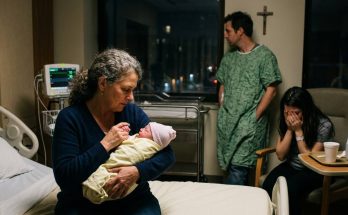
The first thing my son asked after seeing his daughter was not whether she was breathing, whether Sarah was all right, or whether the doctors knew what she would need. He stared through the nursery glass, rubbed both hands over his face, and said, “Maybe another family should raise her.” The nurse stopped moving. Sarah made a small, broken sound from the bed. I stood beside the bassinet with my coat still damp from the rain, trying to understand how a father could look at a newborn and see a problem before he saw a child.
David was thirty-two, old enough to have spent years telling people he was ready for fatherhood. He had assembled the crib himself. He had argued with Sarah about paint colors. He had sent me photographs of the ultrasound, enlarging the grainy images on his phone until he could point out what he believed was her nose. But now he stood by the window as though the glass between him and the outside world might protect him from what had happened inside the room.
The baby had been born without her left arm. The doctors had explained that she was otherwise stable. There would be appointments later, specialists to consult, decisions about adaptive equipment when she grew older. None of those facts were spoken with panic by the medical staff. They were simply facts. David was the one turning them into a sentence about what kind of life she could possibly have.
He rubbed his forehead again. “You don't understand what her life is going to be like.”
I looked at him. “No. But neither do you.”
“She’ll be stared at.”
“Then we teach her not to hide.”
His mouth tightened.
“She’ll struggle.”
“Then she’ll learn.”
“She’ll need more help than other kids.”
“Then we help her.”
He stared at me for several seconds before finally saying, “I can’t.”
That was the first honest thing he had said since the baby arrived.
Sarah began crying again. She had barely slept, and her face looked gray against the white hospital pillow. She kept looking toward the baby as though she wanted to reach for her but was afraid of what David might say next.
“I’m scared,” she whispered.
Her voice changed everything.
I walked closer to her bed. “You’re allowed to be scared.”
She swallowed. “I don't know how to be her mother.”
“No one knows how to be a mother on the first day.”
David turned sharply. “This isn't the same.”
“No,” I said. “It isn't. So you learn what is different.”
He looked toward the paperwork on the small table beside him. There were several forms there, still untouched. His eyes lingered on them long enough for me to understand that this conversation had already gone farther than I realized.
I picked up the baby.
She was astonishingly small. Her skin was warm and soft beneath the hospital blanket, and the little knit cap kept slipping over one eyebrow. Her remaining hand curled around my index finger with surprising strength.
“What have you named her?” I asked.
Neither parent answered.
The baby made a quiet snuffling noise against my sweater.
I looked down at her. “Someone ought to start calling you something.”
Sarah's lips trembled.
“My grandmother was named Harper,” she said.
I looked at her, then at the baby.
“Then Harper it is.”
David shook his head. “Mom, don't make this harder.”
I looked at the little face tucked beneath my chin.
“You keep saying that,” I told him. “But I'm not the one making this difficult. I'm the one who is staying.”
For several minutes nobody spoke.
Harper slept through all of it.
Her tiny fingers remained wrapped around mine, completely unaware that three adults were discussing the course of her life as though she were not already there.
No papers were signed while I was in that room. Eventually, the hospital staff asked us to settle down for the night. Sarah closed her eyes. David stood beside the window. I left sometime after midnight, carrying my coat over one arm because I could still smell the sterile hospital air on it.
At home, I sat at the kitchen island and stared at the container of soup I had packed for Sarah earlier that evening. I had brought a folded baby blanket too. It was still lying beside the front door.
I barely slept.
At 6:12 the next morning, I called the maternity ward.
The nurse told me Harper was stable.
She did not say Harper was going home.
That distinction stayed with me.
At 10:40, David called.
I answered immediately. “Where is she?”
There was silence on the other end.
“She's still at the hospital.”
My grip tightened around the phone. “What happened?”
David exhaled shakily.
“We signed temporary placement papers.”
For a moment, I could not speak.
Sarah was crying somewhere behind him.
David rushed to explain. “It's not permanent. They said family placement can still be considered. We just need time. We can't think straight. Everyone keeps telling us we have to decide before she leaves.”
“Everyone,” I repeated.
“Mom—”
“No. Don't hide behind everyone. Who signed?”
He went silent.
“You did,” I said.
“We were terrified.”
“I know.”
“We didn't know what else to do.”
I looked toward the folded blanket by the door.
“I'm coming.”
“Please don't make a scene.”
“I've already seen the scene,” I said. “I'm coming for the baby.”
The next several days were not dramatic in the way people imagine family emergencies should be. There was no single moment when someone dramatically handed me a child and announced that everything was settled.
There were offices.
There were forms.
There were questions asked by people who had learned how to keep their voices calm while families fell apart in front of them.
There was a social worker named Mrs. Gable, who had tired eyes and a habit of adjusting her glasses before asking difficult questions. She arranged a home assessment, reviewed the emergency kinship placement process, and explained that taking Harper would mean accepting responsibilities that would last long beyond the immediate crisis.
“You understand your age matters,” she told me.
“I understand babies don't care about age when they wake up at three in the morning.”
She almost smiled.
“They also become toddlers.”
“I've raised one of those.”
“Teenagers.”
“I survived one of those too.”
“And adults.”
I looked through the glass toward the nursery.
Harper was sleeping beneath a yellow blanket.
“I know what I'm agreeing to.”
Mrs. Gable studied me. “Why do you want to take her?”
There were many answers I could have given.
Because she was my granddaughter.
Because I loved my son.
Because Sarah was frightened.
Because no baby should begin life with paperwork deciding she was too difficult.
Instead, I told her the simplest truth.
“Because the first room she entered treated her like a problem,” I said. “I want the next room she enters to know she's a child.”
Mrs. Gable lowered her eyes and wrote something down.
When Harper finally came home with me, it was raining hard enough to blur the windshield. I carried her car seat beneath my trench coat from the driveway to the porch while trying not to slip.
The house smelled of laundry detergent and baked pasta my neighbor had left for me. The crib was borrowed. The dresser drawers were still stuffed with towels. A mountain of diapers leaned against one wall.
Nothing was ready.
Neither was I.
I placed the carrier on the kitchen table and looked down at Harper.
“Well,” I whispered, “I suppose we're both going to have to learn.”
One of her eyes opened.
She stared at me with an expression so serious that I laughed.
Then she closed it again.
I had no idea then that this tiny child would spend the next sixteen years teaching me how little fear has to do with what a person is actually capable of becoming.
Click here to continue reading: PART 2: The Baby Everyone Had Predicted Would Struggle Began Showing Me, One Ordinary Day at a Time, How Wrong Their Fear Had Been
The Room Went Quiet When My Son Looked at His Newborn Daughter and Decided Her Difference Was a Reason to Let Her Go
Part 1 of 20