A week later, Sarah came to my house.
She arrived alone.
No flowers.
No presents.
No carefully chosen gift meant to prove how sorry she was.
Her hands were completely empty.
I appreciated that.
Harper opened the front door herself.
Sarah stopped on the porch.
For a moment, neither of them spoke.
Then Sarah began crying.
Harper studied her.
“Are you my mother?”
Sarah nodded.
“Yes.”
“Did you name me?”
Sarah shook her head.
“No.”
“Did you want to?”
Sarah covered her mouth.
“Yes.”
“What would you have called me?”
Sarah lowered her hand.
“Clara.”
Harper considered the name.
“After my grandmother?”
“Yes.”
Harper nodded.
“I like Harper better.”
A tiny laugh escaped Sarah through her tears.
“So do I.”
Harper stepped aside.
“Come in.”
Sarah entered slowly.
I stayed nearby but did not interfere.
They sat together in the living room for nearly two hours.
I remained in the kitchen, close enough that Harper could see me if she needed an escape.
Their conversation came in pieces.
Sarah talked about the hospital.
She admitted she had been frightened.
She admitted she had listened to other people when she should have listened to herself.
She admitted that holding Harper had been the clearest moment she remembered from those first terrible hours.
Harper asked questions.
Some were gentle.
Some were not.
“When you held me, did you want me?”
Sarah began crying again.
“Yes.”
“Then why didn't you keep me?”
Sarah looked down at her hands.
“I was afraid.”
Harper nodded.
She did not say that fear was an excuse.
She did not say it wasn't.
She simply listened.
At one point, Harper asked, “When I was born, did I look at you?”
Sarah smiled through tears.
“Yes.”
“What did I look like?”
“Angry.”
Harper's mouth twitched.
“That sounds right.”
From the kitchen, I smiled into my tea.
Before Sarah left, she stood in the doorway.
“I am sorry.”
Harper did not say it was okay.
It wasn't.
Instead, she said, “I believe you.”
Sarah cried harder.
“I don't expect you to forgive me.”
“Good.”
Sarah nodded.
Harper looked down at the floor.
“But I can get to know you.”
Sarah looked up.
“Slowly.”
“Yes.”
That was all.
No dramatic reconciliation.
No sudden transformation of sixteen missing years.
Just a door opened a few inches.
By the time Harper reached her senior year, she had become almost impossible to surprise.
She had won regional science competitions.
She had designed adaptive tools for younger children.
She had earned a full scholarship to study mechanical engineering.
She had also been suspended briefly after telling a school board member that accessibility should not depend on whether parents could sell enough baked goods.
When she told me, I stared at her.
“You said that to the board?”
“They needed to hear it.”
“You could have chosen different words.”
“I did.”
I raised an eyebrow.
“These were the improved ones.”
I laughed.
She rolled her eyes.
“You're not helping.”
“I wasn't trying to.”
She was selected to give the graduation speech.
She complained for an entire week.
“I hate speeches.”
“You like correcting people.”
“That's different.”
“It isn't.”
“It absolutely is.”
On graduation night, the gymnasium was packed.
Families filled the bleachers.
Phones were held above heads.
Children cried.
Programs fluttered in the warm air.
David sat two rows behind me.
Sarah sat beside him, holding a tissue in both hands.
Harper walked toward the microphone wearing her graduation gown over a dark green dress and white sneakers.
She looked calm.
I was shaking enough for both of us.
She unfolded a sheet of paper.
“When I was born,” she began, “some people decided that the first thing they noticed about me was also the most important thing about me.”
The gym became quiet.
“They were wrong.”
She looked across the crowd.
“I grew up with one arm, one grandmother, and far too many strangers who thought they needed to tell me how brave I was while I was simply trying to buy groceries.”
Laughter moved through the room.
Harper smiled.
“My grandmother never treated me like I was breakable.”
My eyes filled.
“She helped when I asked. She waited when I wanted to try something myself. She let me fail. And when I made a mess, she handed me something to clean it up with.”
More laughter.
Harper continued.
“People sometimes expect children who look different to prove that they are complete.”
Her voice steadied.
“I think that's backward.”
The gym went silent.
“We are born complete. The world is the thing that has to learn how to look properly.”
I pressed my hands together.
Harper looked briefly toward David and Sarah.
“Some people in my life learned that later than they should have.”
David lowered his head.
Sarah pressed her tissue to her mouth.
“Learning late doesn't erase what happened,” Harper said. “But it can change what happens next.”
Then she turned toward me.
“Grandma, you chose me before I was old enough to choose anything for myself.”
I couldn't breathe.
“You gave me a home. You gave me a name. You gave me room to become stubborn without apologizing for it.”
Her voice softened.
“Thank you for seeing me first.”
The gymnasium rose.
Applause filled the room.
I stayed seated for several seconds because my knees had stopped cooperating.
After the ceremony, Harper found me near the side doors.
She wrapped her one arm around my neck.
“Was that too much?”
I was crying too hard to answer properly.
“It was terrible.”
She smiled.
“I knew it.”
“I may never recover.”
“Good.”
David and Sarah approached us.
They stopped several feet away.
They had learned, finally, not to walk into moments that did not belong to them.
Harper turned toward them.
“Thank you for coming.”
David's voice shook.
“Thank you for letting us.”
Sarah could not speak.
She simply nodded.
There was no perfect family waiting for us at the end of that night.
There never had been.
There was a grandmother who had stayed.
A granddaughter who had grown into someone none of us could have predicted.
A father who had finally learned to see the daughter he once feared.
A mother who had returned without demanding that she be placed at the center of Harper's life.
Years later, people still asked me whether David deserved a second chance.
I never answer quickly.
A second chance is not a prize someone receives because they feel guilty enough.
It belongs to the person who was hurt.
Harper decided how much of a door to open.
Some days she opened it wider.
Some days she barely cracked it.
Some days she closed it completely.
Everyone eventually learned to respect that.
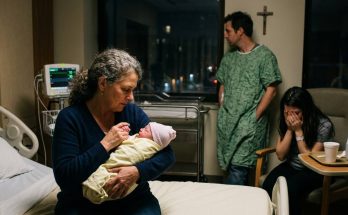
And sometimes, when I am alone in my kitchen, I still remember that hospital room.
The sterile walls.
The yellow receiving blanket.
The folder on the table.
David standing by the window.
Sarah crying into her hands.
The nurse waiting quietly because she did not know what else to do.
And that tiny baby gripping my finger.
People tell me I saved Harper.
I understand why they say it.
But I don't think that's exactly what happened.
Harper never needed saving from herself.
She needed one person in that room to recognize what should have been obvious from the beginning.
She was already whole.
The world saw one arm and tried to make that the entire story.
I saw one tiny hand holding mine.
And I stayed.
Click here to continue reading: PART 5: Harper Thought Graduation Would Finally Quiet the Questions About Her Past, Until One Unexpected Letter Forced Her to Reconsider What She Wanted From Both Parents
The Room Went Quiet When My Son Looked at His Newborn Daughter and Decided Her Difference Was a Reason to Let Her Go
Part 4 of 20